
M.C. Escher
Maurits Cornelis Escher made mathematics visible. Where others filled planes with triangles and hexagons, he locked lizards, birds, fish, and horsemen into seamless tessellations—and in PictorX you can explore that language with the M.C. Escher maker.
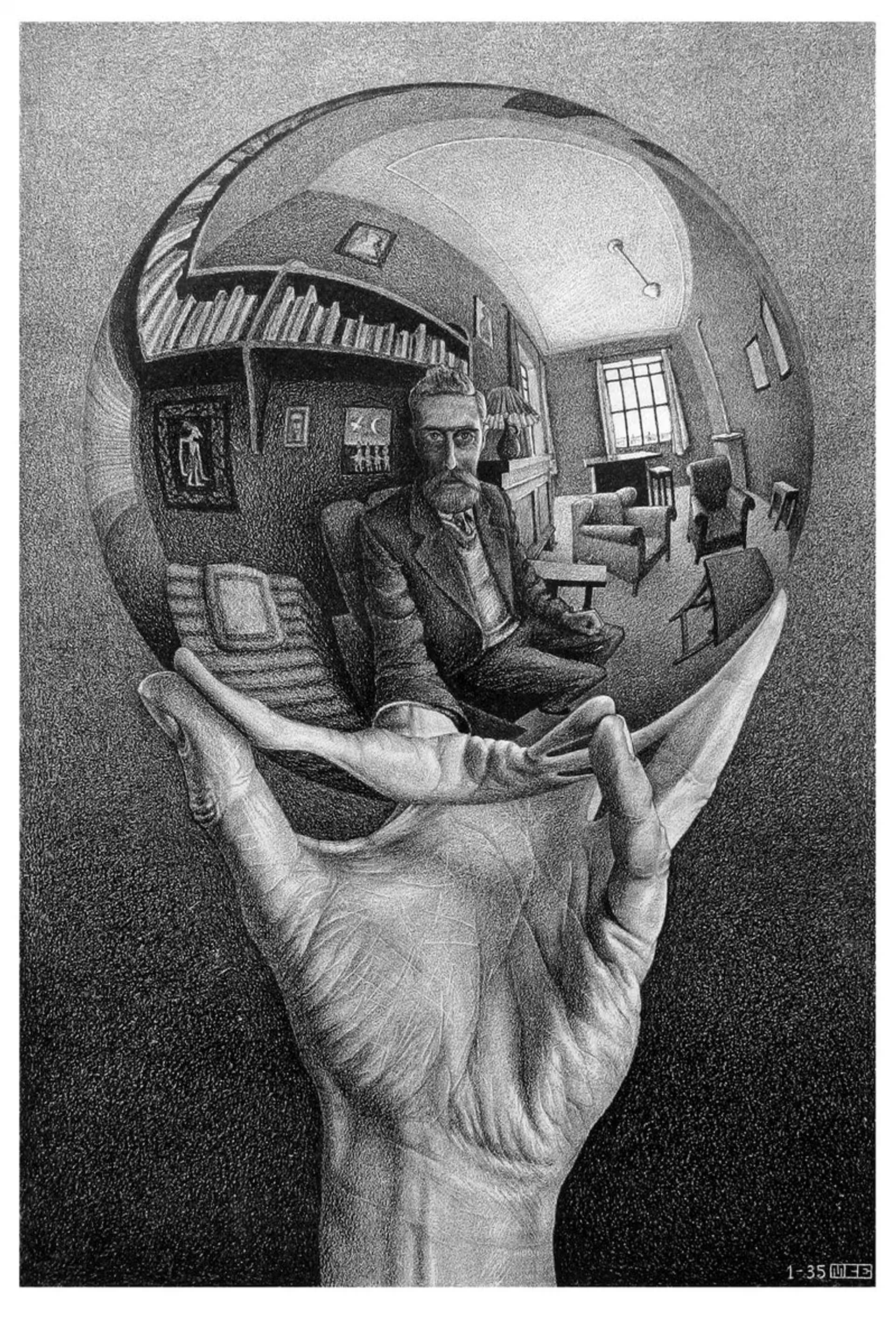
Regular division of the plane
Regular division of the plane—also called tessellation or mosaic tiling—is one of the most recognisable and mathematical sides of M.C. Escher’s work. It is the art of filling a flat surface completely with repeating figures that meet edge to edge, without gaps and without overlaps. Where mathematicians usually stayed with abstract shapes such as triangles, squares, or hexagons, Escher transformed those lattices into figurative motifs: fish, birds, lizards, and horsemen.
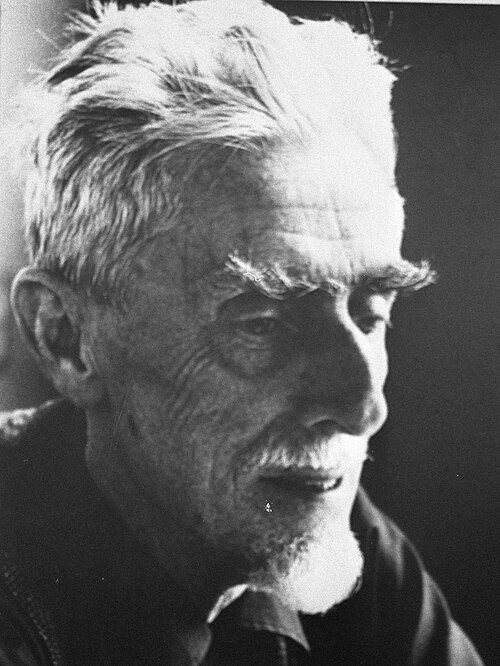
Alhambra origins
Escher experimented with patterns early on, but the real turning point came after his visits to the Alhambra in Granada, Spain, in 1922 and 1936. He was deeply struck by the Moorish mosaics. Because of Islamic tradition those craftsmen stayed with strictly abstract, geometric ornament. Escher called that abstraction a lack of soul and set himself a life’s goal: the same mathematical perfection, but with living creatures. He named it his greatest passion and returned to it for decades.
Translation, rotation, reflection
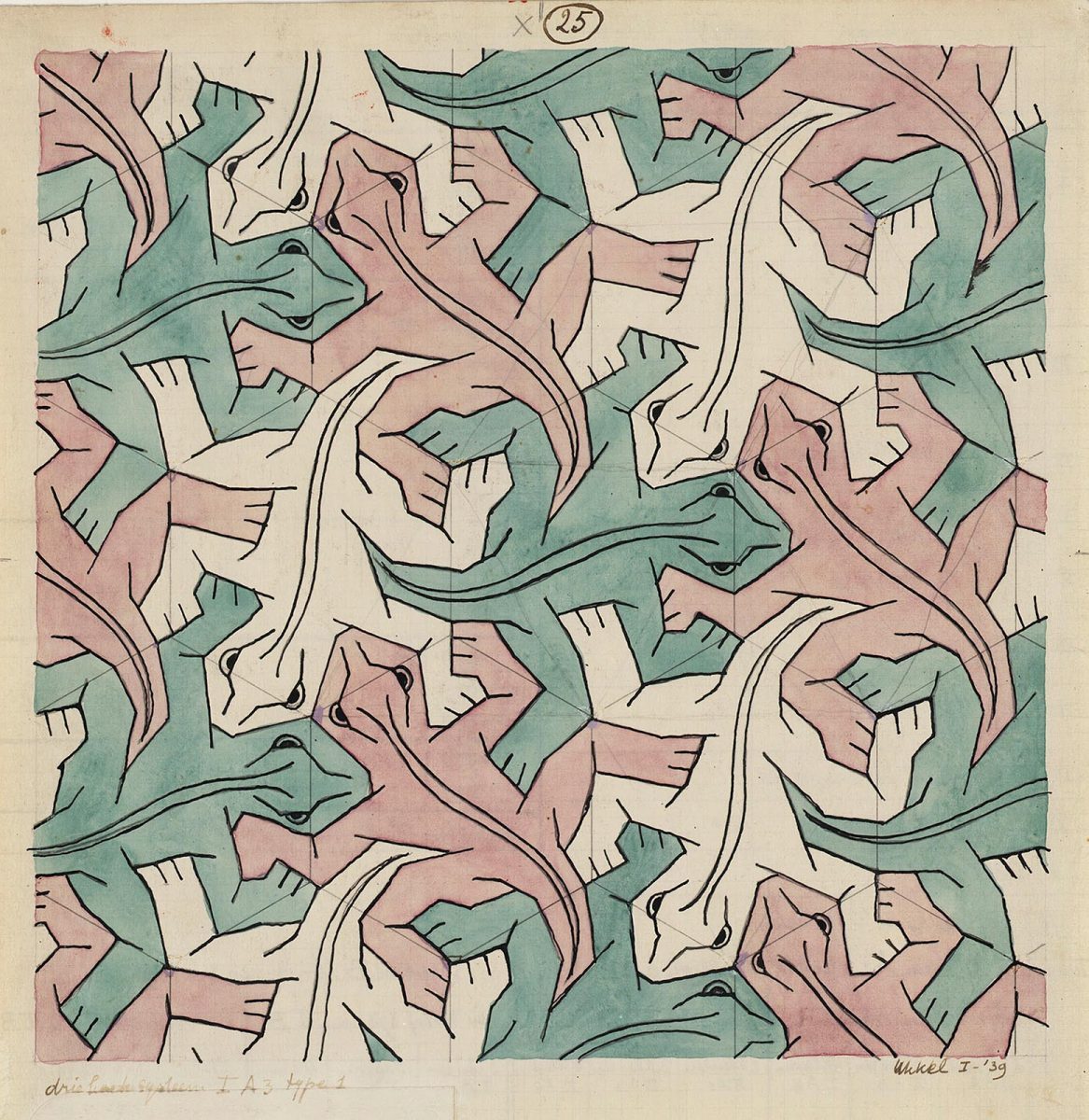
Escher was not a trained mathematician, yet he built an intuitive system for dividing the plane. Three primary geometric transformations guided him. Translation: a shape is shifted so that the indent on one side becomes the bulge on the next. Rotation: figures turn about a shared point—classic examples are three lizards whose heads or feet meet at a centre. Reflection: figures mirror across an axis, often combined with a glide so that birds fly left and right in alternation. He catalogued these systems carefully in notebooks; later mathematicians were astonished how well his symmetry groups matched formal classification.
Metamorphosis and infinity
Escher rarely left a pattern as a static wallpaper. He tied tessellation to two philosophical ideas. Metamorphosis: in masterpieces such as Metamorphosis II (1940), an abstract chessboard slowly becomes lizards, then hexagons, bees, butterflies, birds, and abstract forms again—a visual story of continuous change. The limit of infinity: on flat paper a pattern stops at the edge. Inspired by the mathematician H.S.M. Coxeter he built hyperbolic Circle Limit prints in which fish or angels and demons shrink toward the rim so that, in theory, infinitely many figures fit inside the circle.
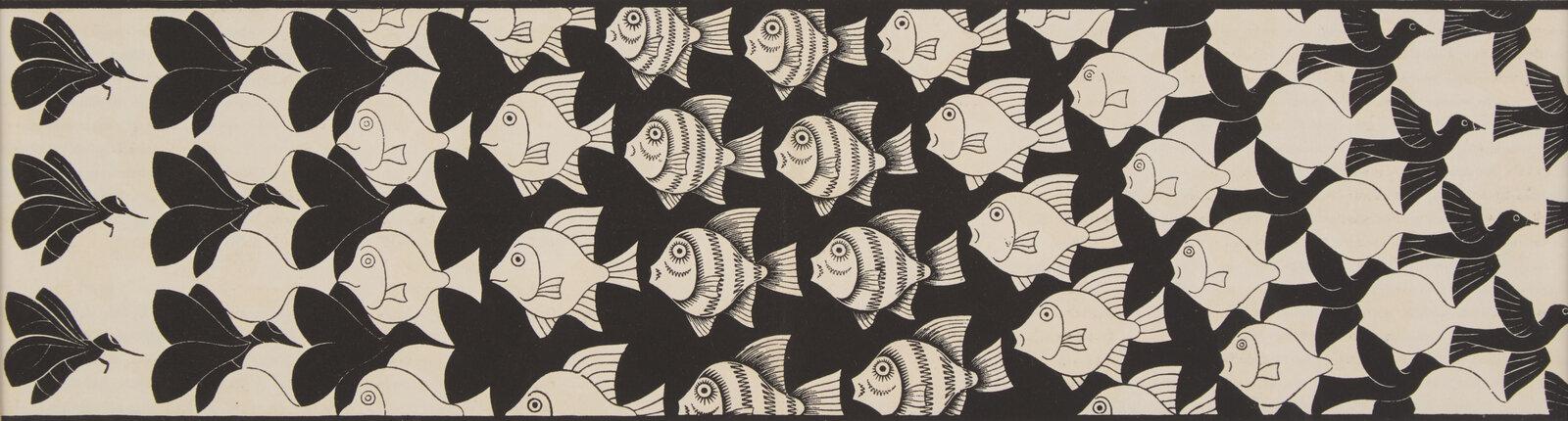
Figure and ground
What makes Escher’s divisions so compelling is duality. The brain usually cannot hold figure and ground at once. Focus on the white birds and the black ones become leftover space; blink and the black birds turn out to be equally perfect figures. Escher erased the border between subject and background.
Try M.C. Escher in PictorX
Open /mc-escher in PictorX to tile lizard, Pegasus, horsemen, swan, strong-men, flying-fish, and bird motifs in your browser. Tune scale, colours, outlines, smooth curves, round joins, and eyes; randomize a composition; then save a PNG or hand off to the editor. Nothing is uploaded to PictorX servers—your canvas stays on your device.
Frequently asked questions
What is a tessellation?
A tessellation (regular division of the plane) covers a surface with repeating shapes that fit together without gaps or overlaps. Escher specialised in figurative tessellations—animals and people instead of only polygons.
How did the Alhambra influence Escher?
Visits to the Alhambra’s Moorish mosaics showed Escher how rigorous geometric tiling could look. He kept the mathematical discipline but replaced abstract ornament with living motifs.
What transformations did Escher use?
Primarily translation (shift), rotation (turn about a point), and reflection (including glide reflection). He organised patterns by symmetry long before many artists talked in those terms.
Does PictorX upload my Escher canvas?
No. M.C. Escher runs in your browser; nothing you compose is uploaded to PictorX servers. Export a PNG when you want a file on your device.
How does this page relate to the M.C. Escher app?
This page is the background story—tessellation, Alhambra, metamorphosis, and infinity. M.C. Escher is the interactive PictorX tool where you can generate tiled motifs yourself.
Related tools
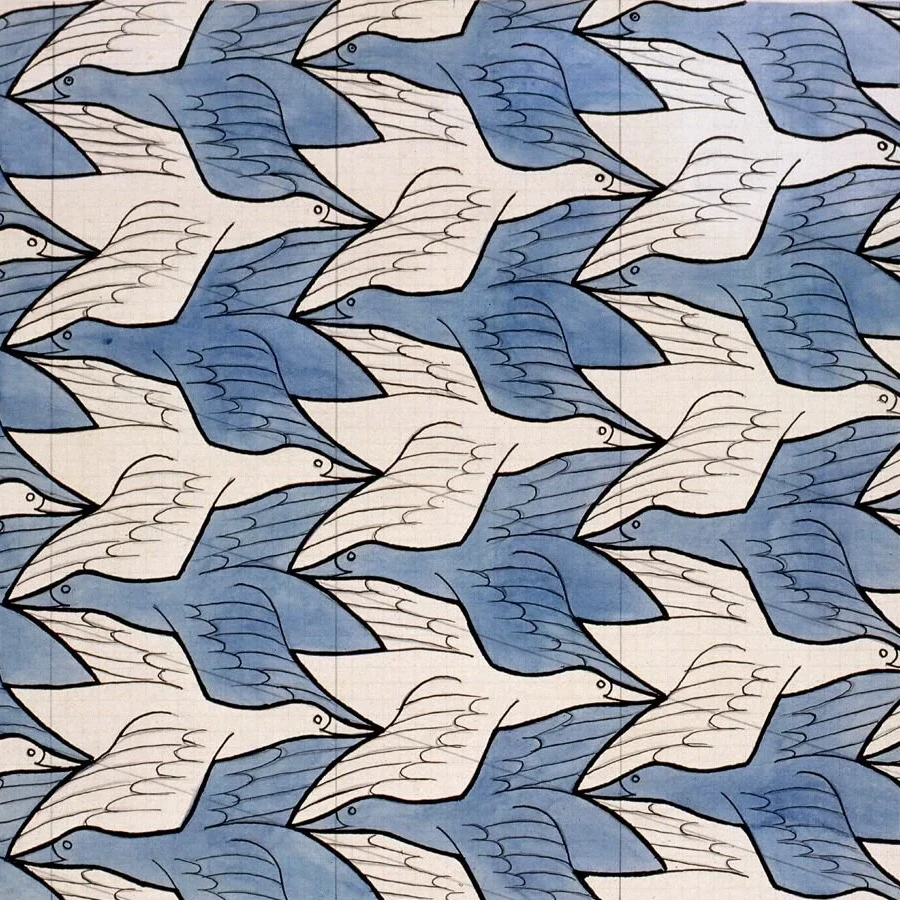
M.C. Escher
Create Escher-style tessellations in your browser. Lizards, birds, fish, horsemen and more—tune scale, colours, and eyes, then save a PNG. Nothing is uploaded.

Mondriaan
Compose classic Mondriaan-style De Stijl grids in your browser. Adjust complexity, line thickness, and color fill — click cells to recolor, then save a PNG. Nothing is uploaded.
Piet Mondriaan
Piet Mondriaan’s life and art: from The Red Tree to Victory Boogie Woogie, De Stijl and neoplasticism, and how PictorX Mondriaan lets you compose grids in the browser.
Pollock Painter
Paint Jackson-Pollock-style drips and splatters in your browser. Gesture brushes, Auto-Pollock, palettes, and PNG export — nothing is uploaded.
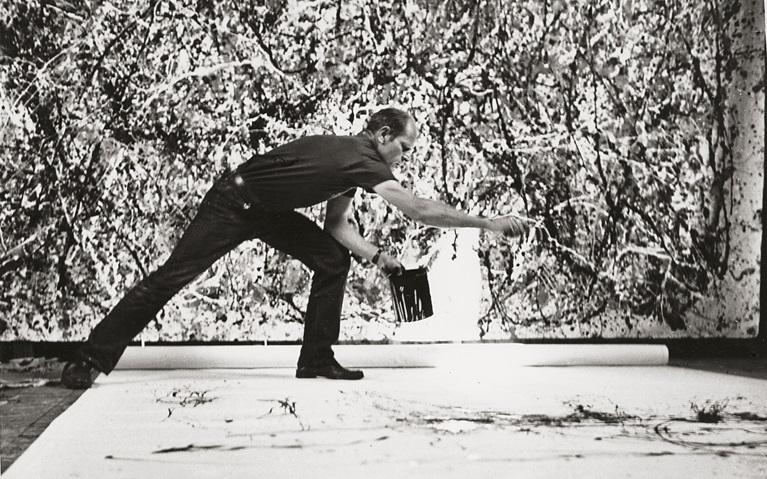
Jackson Pollock
Jackson Pollock's life and drip painting: Cody, the New York School, action painting, and how PictorX Pollock Painter lets you explore drip-and-splatter art in the browser.
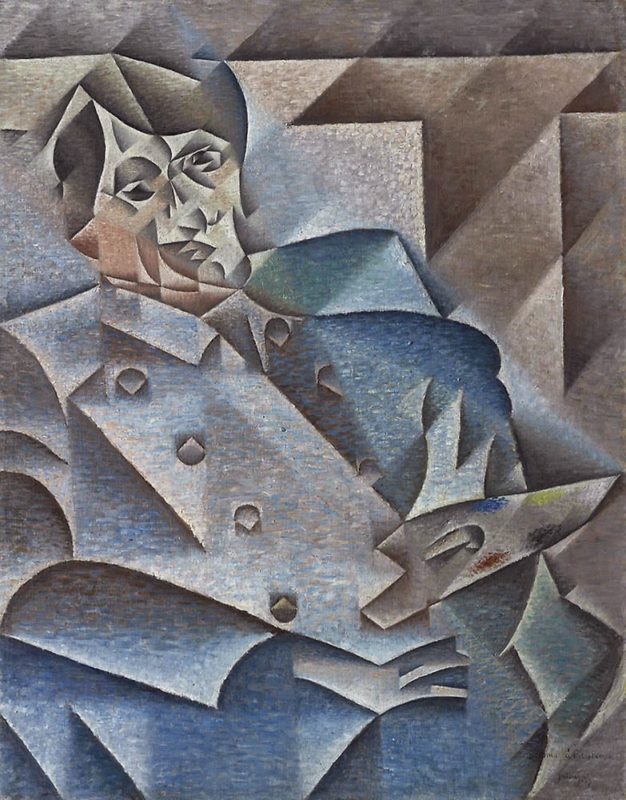
Cubism
A short guide to Cubism: Picasso and Braque, Analytic and Synthetic Cubism, fragmented planes, multiple viewpoints, and a digital homage you can try in PictorX.
Ready to try it?
Open PictorX in your browser — no install, no credit card required to start.
Try M.C. Escher