
The double pendulum
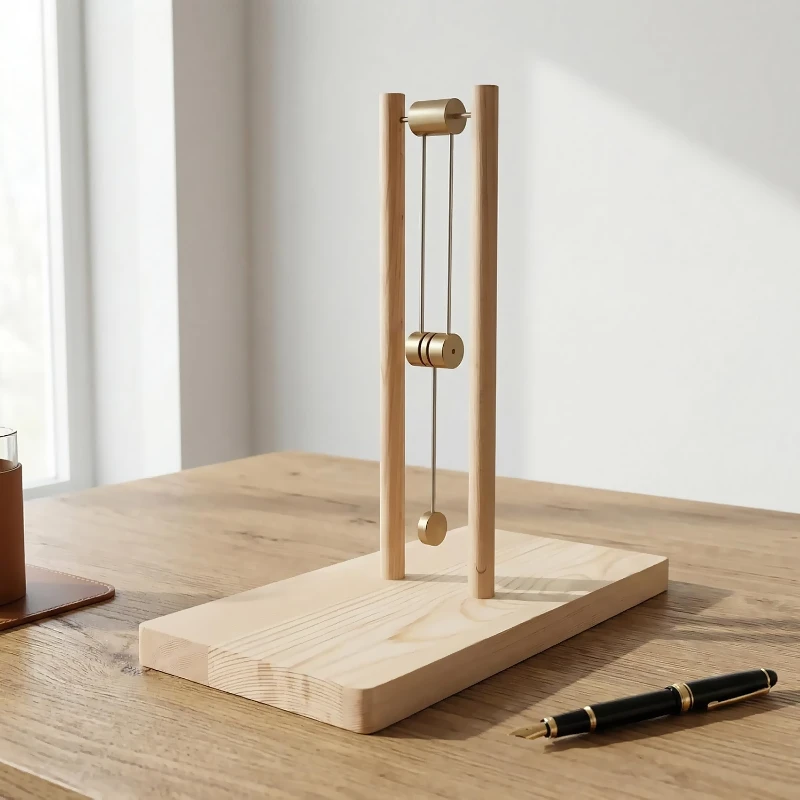
A double pendulum is two rods joined end to end, free to swing under gravity. The motion looks simple at first, then becomes wildly unpredictable—one of the cleanest classroom demos of deterministic chaos. In PictorX, that tip path becomes abstract light trails, long exposures, and distortion art.
What is a double pendulum?
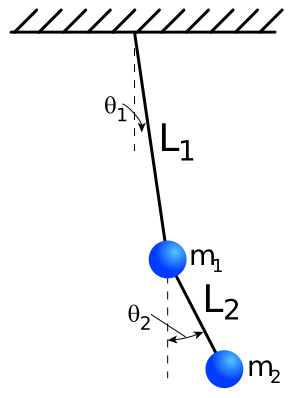
Hang one pendulum from a fixed pivot, then hang a second pendulum from the end of the first. You now have two angles—usually written θ₁ and θ₂—and four degrees of freedom once angular velocities are included. Gravity pulls both bobs; the joints couple their motion so energy sloshes between the upper and lower arms.
Why the motion becomes chaotic
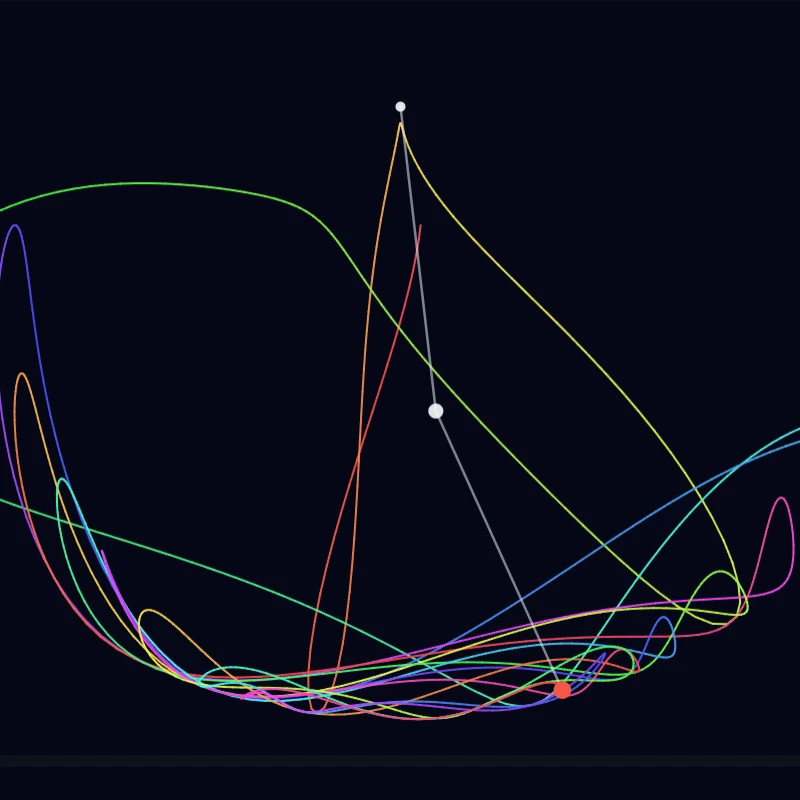
For small swings a double pendulum can look almost regular. Push the energy higher and tiny differences in the starting angles or speeds grow until two nearly identical starts paint completely different paths. That sensitive dependence on initial conditions is the hallmark of deterministic chaos: the rules are exact, yet long-term prediction is practically impossible.
Equations in brief
The standard model uses Lagrangian mechanics with lengths L₁, L₂ and masses m₁, m₂. The resulting ordinary differential equations for θ₁ and θ₂ are nonlinear and coupled—you integrate them numerically (for example with RK4) rather than solving them in closed form. Change a length or mass and the whole family of trails shifts.
Light trails and long exposures
Photographers hang LEDs on physical double pendulums and open the shutter to capture glowing ribbons. Digitally, you sample the tip position over thousands of steps and stroke those points onto a canvas. Fade the trail for neon streaks, keep every sample for a dense long-exposure lace, or warp a background along the path for distortion art.
Double pendulum vs painting pendulum
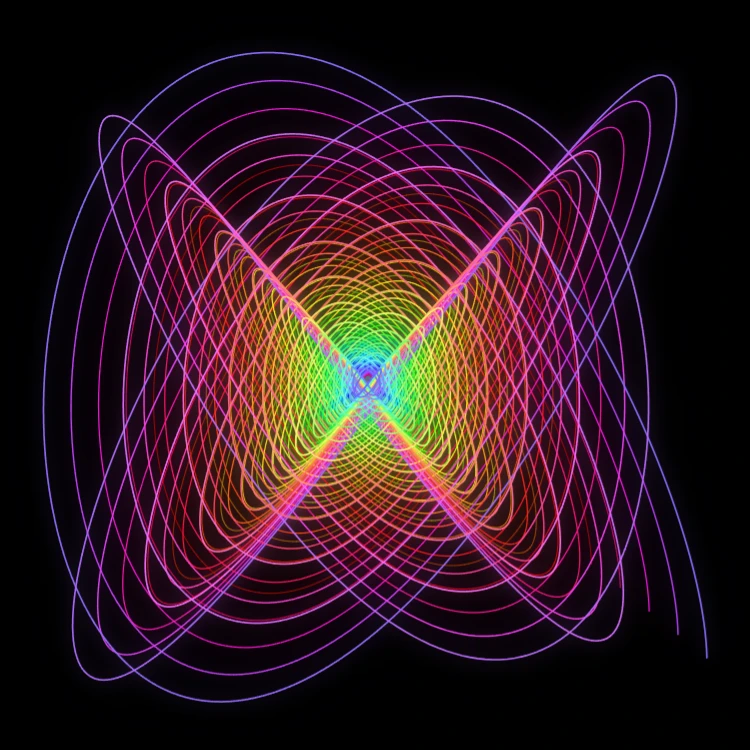
A painting (Blackburn) pendulum combines two harmonic oscillators and paints Lissajous figures—ordered loops when the frequency ratio is rational. A double pendulum is a single mechanical chain whose nonlinear coupling produces chaos. Both make beautiful trails; the mathematics and the look of the curves are different.
Try Double Pendulum in PictorX
Open /double-pendulum to simulate the tip in your browser. Tune lengths, masses, gravity, and damping; choose trails, long-exposure, or distort modes; set paint color and style; then save a PNG or open the result in the editor. Nothing is uploaded. Pair it with Painting Pendulum, Lorenz Attractor, or Spirograph for more generative play.
Frequently asked questions
Why is a double pendulum chaotic?
Its equations are nonlinear and coupled. At sufficient energy, tiny changes in the starting state grow rapidly, so long-term motion cannot be predicted in practice even though every step follows fixed physics.
What do L₁, L₂, m₁, and m₂ mean?
L₁ and L₂ are the lengths of the upper and lower rods; m₁ and m₂ are the masses at the joints (or bob masses in the usual idealized model). Together with gravity they set how fast and how wildly the tip moves.
How is this different from a painting pendulum?
A painting pendulum traces Lissajous curves from two independent harmonic oscillators. A double pendulum is one linked mechanism whose tip path becomes chaotic rather than a closed harmonic figure.
What are light-trail and long-exposure modes?
Light trails emphasize recent motion with glow and fade. Long exposure keeps a dense history of tip positions, like leaving a camera shutter open while an LED swings.
Does PictorX upload my image?
No. The double-pendulum simulation runs on a canvas in your browser. Save downloads a PNG you choose; optional distort modes can sample a local background without uploading it.
Related tools
Double Pendulum
Simulate a classical double pendulum in your browser. Paint chaotic tip trails, long-exposure paths, or distort a soft field—then save a PNG. Nothing is uploaded.
Painting Pendulum
Paint damped Lissajous curves in your browser—the classic Blackburn painting pendulum. Tune frequency ratios, phases, and damping, animate the trail, and save a PNG. Nothing is uploaded.
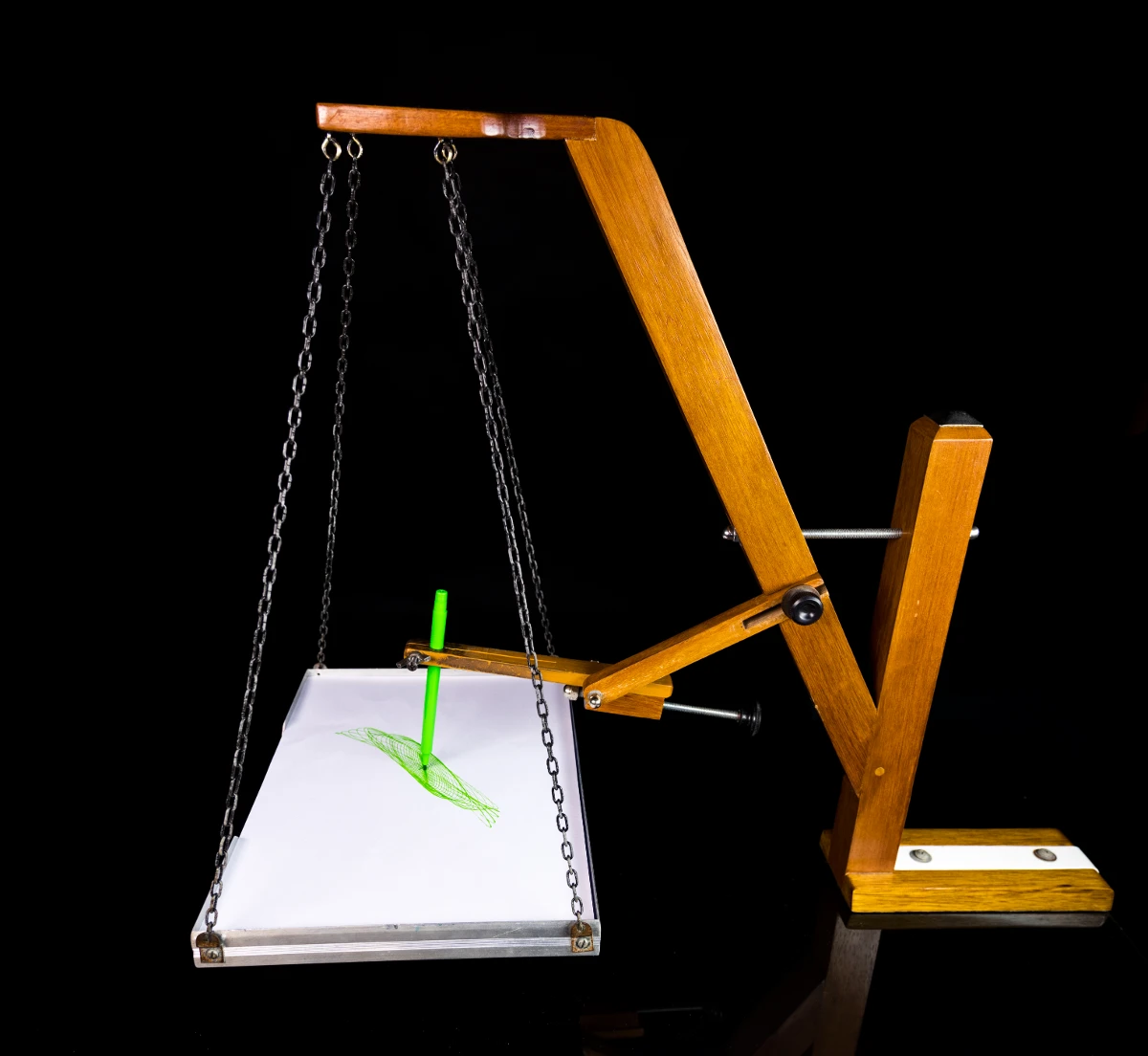
Painting pendulums
Learn how a Blackburn painting pendulum paints Lissajous figures—two perpendicular oscillators, frequency ratios, damping spirals—and try Painting Pendulum in PictorX.
Lorenz Attractor
Interactive Lorenz attractor: tune a, b, f, rotate in 3D, try neon/ink/smoke looks, and save a PNG.
The Lorenz Attractor
How Edward Lorenz's weather equations revealed chaos theory: the butterfly attractor, sensitive dependence on initial conditions, and why long-term forecasts fail.
Spirograph
Draw hypotrochoids and epitrochoids in your browser. Tune R, r, and pen offset, animate the curve, randomize styles, and save a PNG. Nothing is uploaded.
Ready to try it?
Open PictorX in your browser — no install, no credit card required to start.
Try Double Pendulum