
Snell's Law & Light Refraction
A lifeguard sees a swimmer in trouble. Running in a straight line is not fastest: the lifeguard runs faster on sand than they swim, so it pays to run further and swim less. The fastest path bends at the shoreline, and light does exactly the same when it passes from air into water. Snell's law says where the bend goes. Pick a scene. Lifeguard: drag the lifeguard, the swimmer, or the ring on the shore, then press Race. Light beam: drag the laser and choose the two materials. Brachistochrone: add layers and watch the light path turn into the cycloid.
How it works
- In Lifeguard, drag the lifeguard and the swimmer and press Race: the bent path beats the straight line.
- In Light beam, drag the laser and pick the two materials. Past the critical angle, no light gets out.
- In Brachistochrone, add layers and watch the light bend into the cycloid, the fastest slide, then save a PNG.
The lifeguard's problem
The lifeguard runs at 7 m/s on the sand and swims at 1.5 m/s in the sea. The fastest route crosses the shore where sin θ₁ / v₁ = sin θ₂ / v₂, with each angle measured from the line at right angles to the shore. Drag the white ring along the shore to try other crossing points: every one is slower than the gold path. With equal speeds, the fastest path is the straight line.
Light takes the fastest path
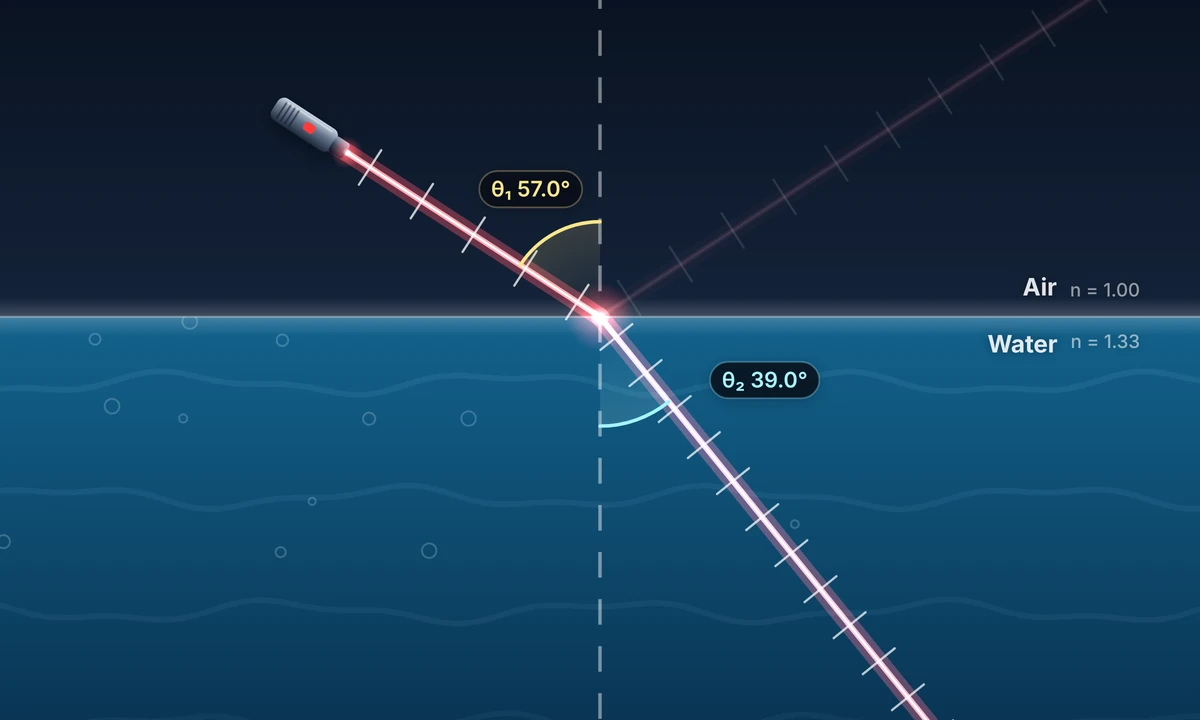
Light moves at about 300,000 km per second in air but only about 225,000 km per second in water, and slower still in glass and diamond. The refractive index n says how much slower: in a material with index n, light moves at its speed in a vacuum divided by n. Like the lifeguard, light crosses the boundary where n₁ sin θ₁ = n₂ sin θ₂. In the app, the wave crests on the beam bunch up where the light slows down, and the share that bounces back grows as the beam gets flatter.
Total internal reflection
Going from a dense material into a thinner one, light bends away from the normal. At the critical angle the refracted beam skims along the surface, and beyond it no light gets out at all: everything is reflected. For water into air that angle is 48.8°, for glass 41.8°, and for diamond only 24.4°, which is why a cut diamond traps light and sparkles. Optical fibers carry light the same way.
From layers to the brachistochrone
A ball sliding down a curve speeds up as it falls: after dropping a height y it moves at √(2gy). Johann Bernoulli saw that the fastest slide is the path of light through a medium whose speed grows in the same way. Cut that medium into thin layers and apply Snell's law at every boundary, so that sin θ / v stays the same. With one layer the path is a straight line; with more layers it bends and gets faster, until it matches the cycloid.
Frequently asked questions
What is Snell's law?
When light passes from one material into another, n₁ sin θ₁ = n₂ sin θ₂, where n is each material's refractive index and θ the angle from the normal. Written with speeds, sin θ₁ / v₁ = sin θ₂ / v₂.
Why does light bend at all?
Because it moves at different speeds in different materials. Fermat's principle says light takes the path of least time, and as with the lifeguard, the fastest path bends where the speed changes. The wave picture says the same: the part of a wave front that enters the slower material first falls behind, and the front turns.
What is the critical angle?
The angle beyond which light going into a less dense material cannot get out and is reflected completely: sin θc = n₂ / n₁. It is 48.8° for water into air, 41.8° for glass, and 24.4° for diamond.
How is this connected to the brachistochrone?
Johann Bernoulli solved the brachistochrone, the curve of fastest descent, by treating the falling ball as light in layers whose speed grows as √(2gy). Snell's law in every layer bends the path into a cycloid.
Does this upload anything?
No. Everything is drawn on a canvas in your browser. Save downloads a PNG. Edit opens that image in the PictorX editor.
Related tools
Snell's law of refraction
The history and physics of Snell's law: Ibn Sahl, Snellius, and Descartes, Fermat's principle of least time, the lifeguard problem, total internal reflection, and how Bernoulli used light to find the brachistochrone.
Brachistochrone race
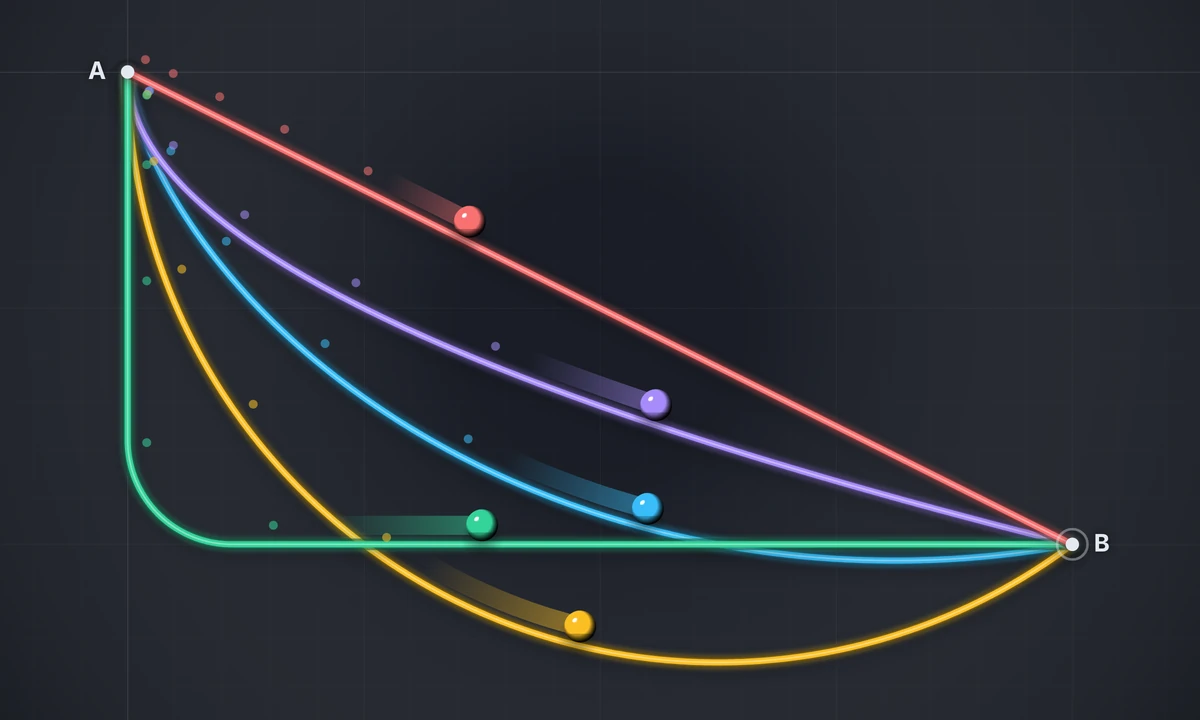
Race balls from A to B on a straight ramp, a circle, a parabola, and a cycloid. The cycloid always wins, even when it dips below the finish. Draw your own track.
Brachistochrone
What the brachistochrone is: why the cycloid beats the straight line, how Bernoulli's 1696 challenge was solved, and why a cycloid bowl is also the tautochrone.
Pendulum wave
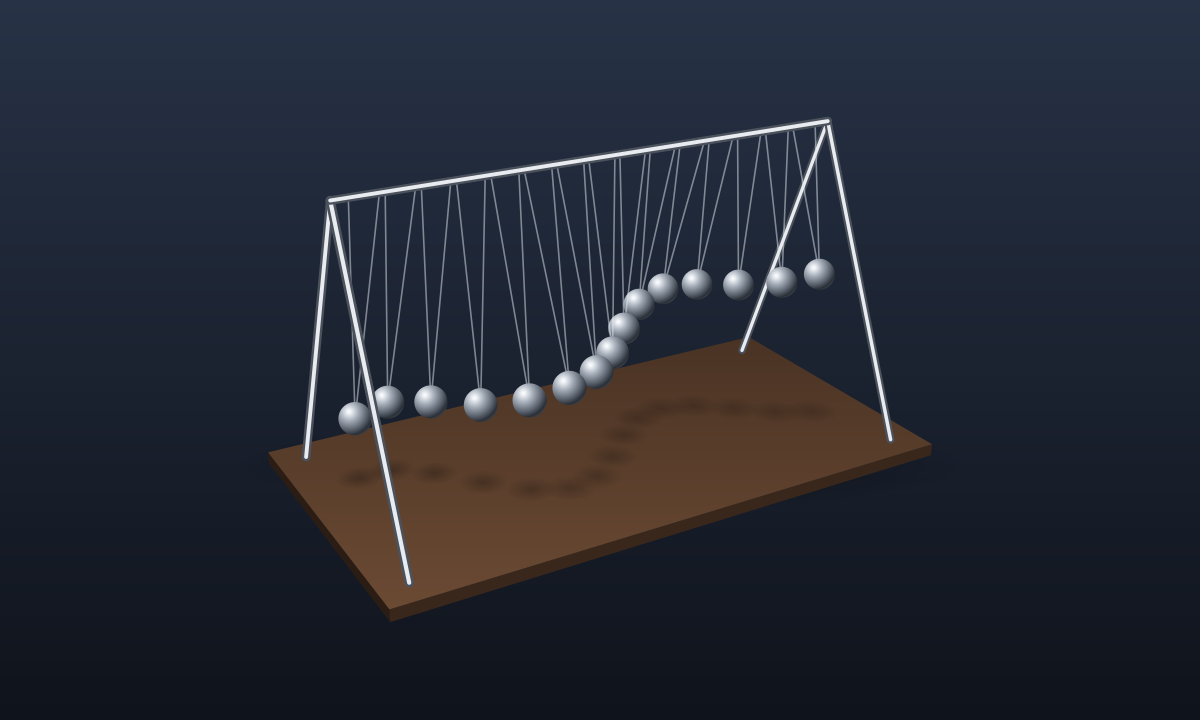
Fifteen pendulums, each a little shorter than the last. Let them go together and watch them drift into waves, split into rows, and swing in step again.
Galton board
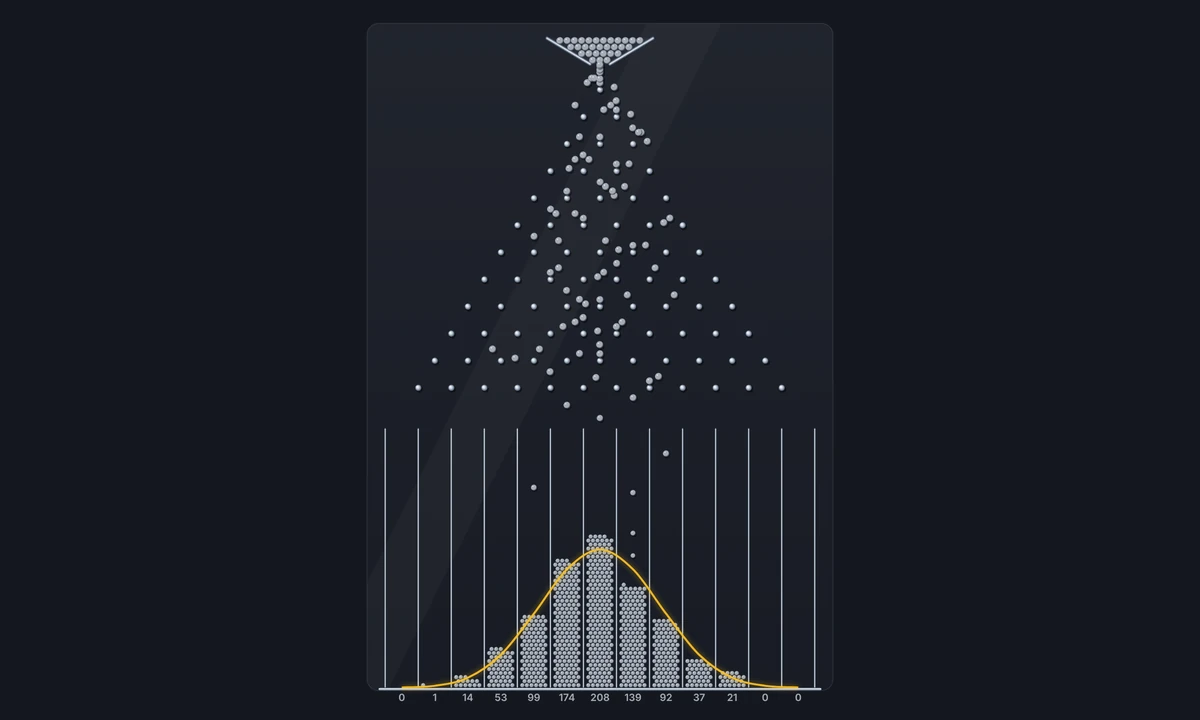
Drop balls through rows of pegs and watch a bell curve fill the bins. Change the rows, the bias, and the number of balls, and compare mean and spread with theory.
Optical illusions
Play with 13 classic optical illusions in your browser, most made from your own photo: colour from grey, an afterimage, a spinning spiral, a hidden picture, the café wall, the Fraser spiral, drifting wheels and more. Tick Reveal the trick to see how each one works.
Ready to try it?
Open PictorX in your browser — no install, no credit card required to start.
Go to Editor