
Brachistochrone
Brachistochrone is Greek for shortest time. It is the track along which a ball, starting from rest and sliding without friction, gets from one point to a lower point fastest. The answer is not the straight line but a cycloid, the curve traced by a point on a rolling wheel.
The question
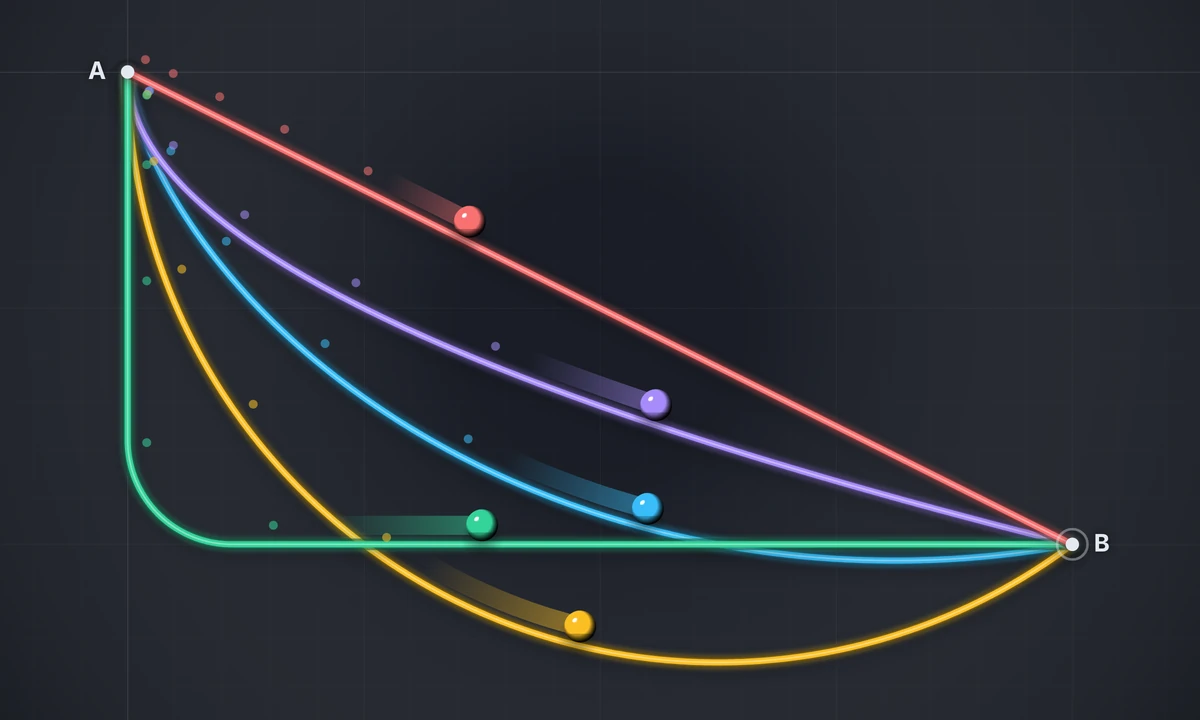
Take two points: A, and a lower point B that is not straight below it. Which track between them gets a ball from A to B in the shortest time? The ball starts at rest, gravity pulls it, and nothing else acts on it: no friction, no air.
Why not the straight line
The straight line is the shortest path, but on it the ball gathers speed slowly. A track that drops steeply first makes the ball fast early, and it keeps that speed for the rest of the way. A longer path at a higher speed can take less time. The best track is a balance between length and speed.
Galileo's guess
In 1638 Galileo showed that a ball gets down faster along an arc of a circle than along the straight chord. He suspected the circle was the fastest track of all. It is fast, but not the fastest. The circle is in the race so you can watch it come close and lose.
Bernoulli's challenge
In 1696 Johann Bernoulli challenged the mathematicians of Europe to find the curve. His brother Jakob, Leibniz, l'Hôpital, and Newton sent solutions. Newton's arrived without his name, and Bernoulli is said to have recognized him as the lion by its claw. The problem helped start the calculus of variations, the mathematics of finding the best curve.
The cycloid
Roll a wheel along a straight line and watch one point on its rim. It traces a row of arches: a cycloid. Turn one arch upside down and start it at A, and it is the brachistochrone. Johann Bernoulli found it by treating the falling ball like a ray of light, which always takes the path of shortest time.
When the cycloid dips below the finish
If B is far to the side and not very deep, the fastest track goes below B and climbs back up to it. Going deeper buys speed that more than pays for the climb. Try the Shallow finish favorite: the cycloid ball drops far below the line to B and still arrives first.
The tautochrone
The cycloid has a second gift. In a bowl shaped like a cycloid, a ball let go from any height reaches the bottom in the same time: π√(a/g), where a is the radius of the rolling wheel. Christiaan Huygens found this in 1659 and used it to design pendulum clocks that keep time however wide they swing. In a round bowl the balls from higher up arrive later.
Try it in PictorX
Open the Brachistochrone race and five balls leave A together. The dots show where each ball was every tenth of a second. Drag B to move the finish, or draw your own track on the picture. Set Mode to Cycloid bowl or Circle bowl to compare the two bowls. The balls slide without friction. Real rolling balls are all slower by the same factor, so the order does not change.
Frequently asked questions
What does brachistochrone mean?
It is Greek: brachistos means shortest and chronos means time. The brachistochrone is the curve of fastest descent.
Is the brachistochrone the shortest path?
No. The shortest path is the straight line. The brachistochrone is longer, but the ball moves faster along it, so it arrives sooner.
What is the difference between the brachistochrone and the tautochrone?
Both are cycloids. The brachistochrone is the fastest track between two points. The tautochrone is the bowl in which a ball reaches the bottom in the same time from any starting height.
Does friction change the answer?
Yes, a little. With friction the fastest track is no longer an exact cycloid, though it looks much like one. This race leaves friction out, as the classic problem does.
Related tools
Brachistochrone race
Race balls from A to B on a straight ramp, a circle, a parabola, and a cycloid. The cycloid always wins, even when it dips below the finish. Draw your own track.
Pendulum wave
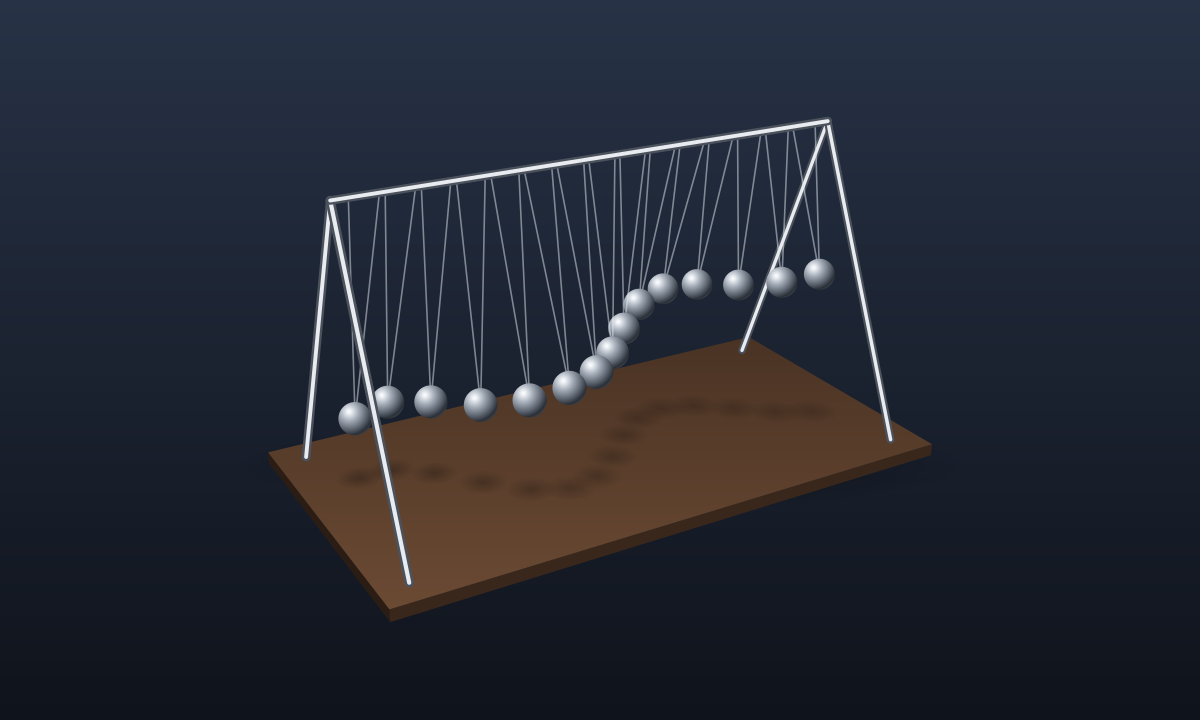
Fifteen pendulums, each a little shorter than the last. Let them go together and watch them drift into waves, split into rows, and swing in step again.
Pendulum wave
How a pendulum wave works: why the length of a pendulum sets its period, how one extra swing per cycle makes waves, rows, and groups, and why the pendulums line up again.
Newton's cradle
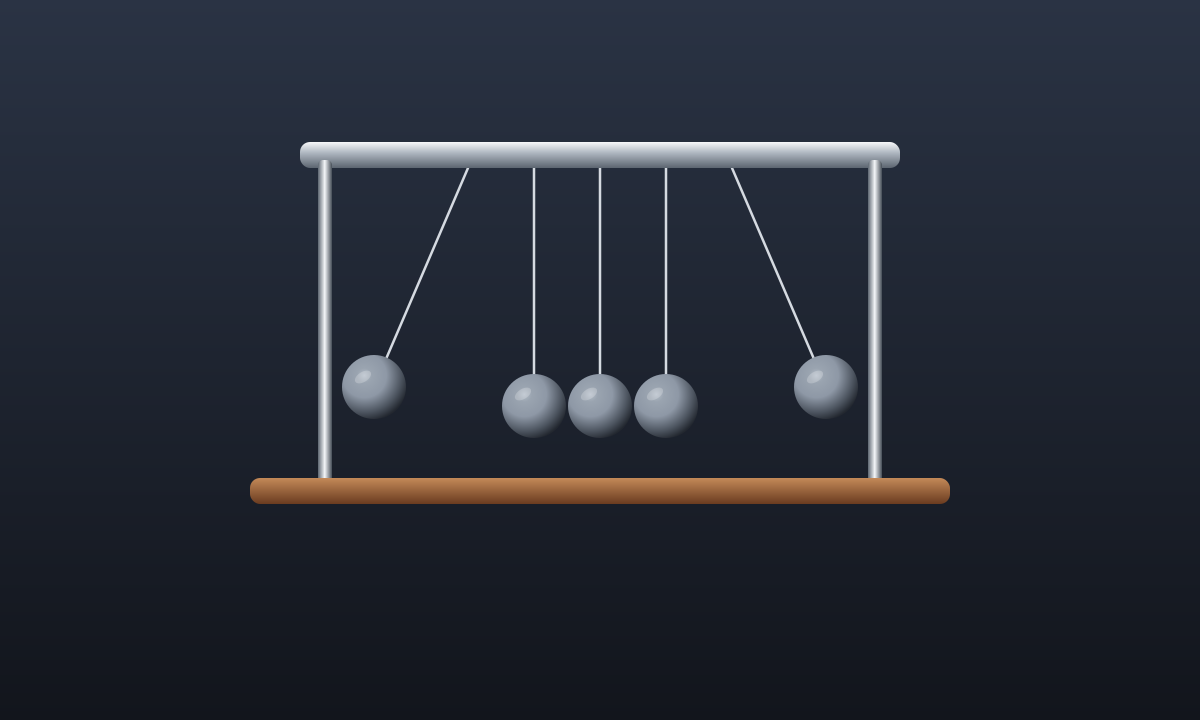
Lift a steel ball and let it fall. The click sends that motion out the other side. Watch height turn into motion as the cradle swings.
Newton's cradle
How Newton's cradle passes motion through a row of steel balls: conservation of momentum, conservation of energy, an elastic click, and why air and sound eventually stop it.
Spirograph
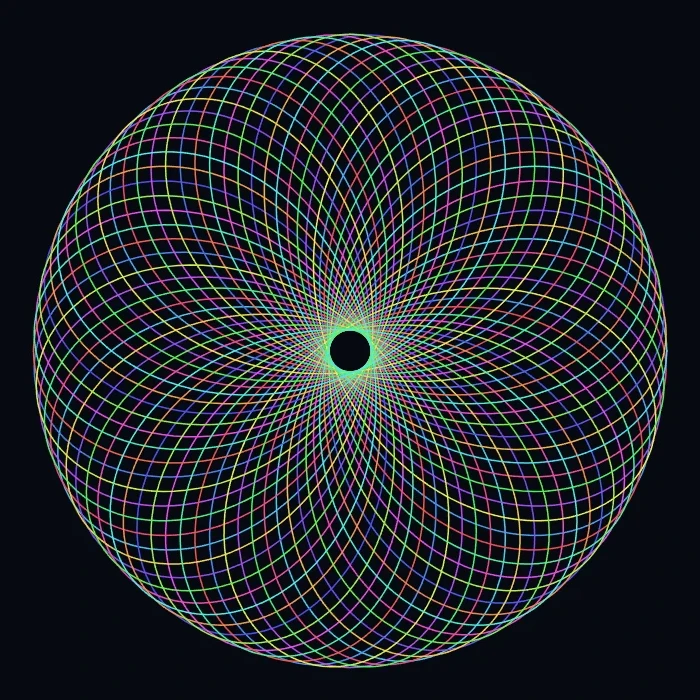
Draw hypotrochoids and epitrochoids in your browser. Tune R, r, and pen offset, animate the curve, randomize styles, and save a PNG.
Ready to try it?
Open PictorX in your browser — no install, no credit card required to start.
Try the brachistochrone race