
Snell's law of refraction
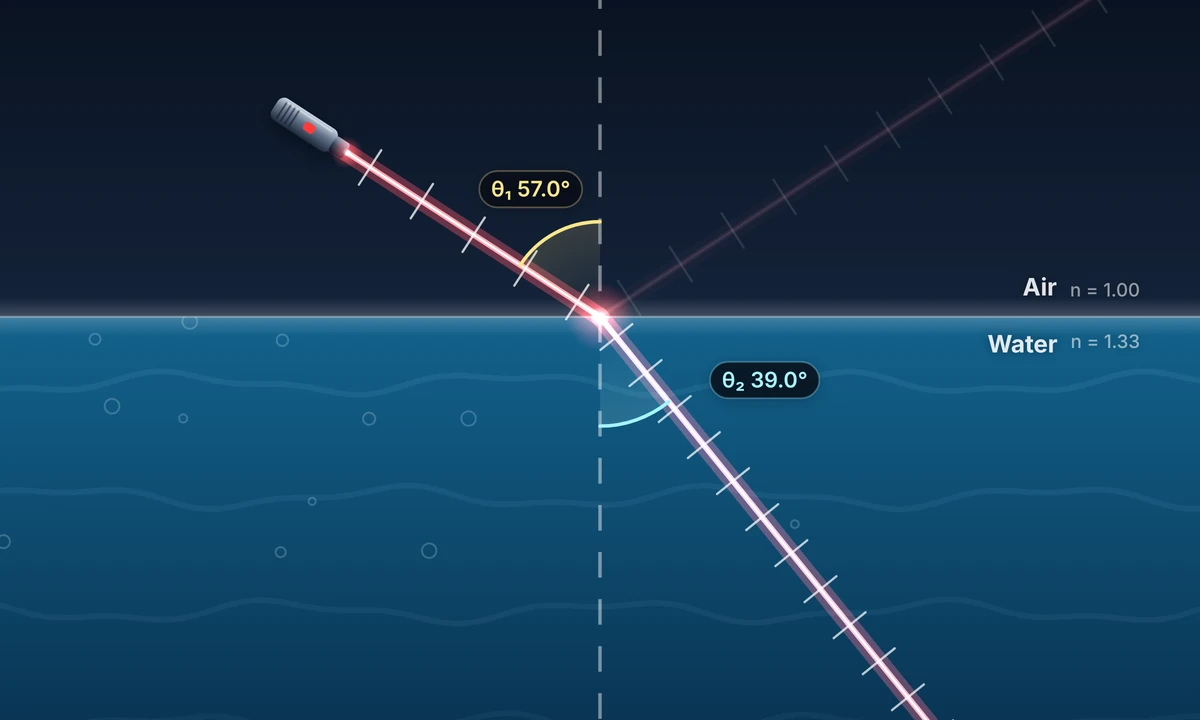
A straw in a glass of water looks broken at the surface. Light changes direction when it passes from one material into another, and Snell's law says by how much. Behind it lies a simple idea: light takes the fastest path.
Who discovered it
The Persian scholar Ibn Sahl described the law of refraction in Baghdad in 984, in a book on burning mirrors and lenses. In Europe, Thomas Harriot found it in 1602 and Willebrord Snellius in 1621, but neither published it. René Descartes did, in 1637, which is why it is known in France as the Snell–Descartes law.
Fermat's principle of least time
In 1662 Pierre de Fermat derived the law from one idea: light goes from one point to another along the path that takes the least time. Light is slower in water than in air, so the fastest path spends less of its length in the water, and it bends at the surface exactly as Snell's law says.
The lifeguard
Richard Feynman explained Fermat's principle with a lifeguard who has to reach a swimmer in trouble. Running is faster than swimming, so the best place to enter the water is not on the straight line but further along the beach, where sin θ₁ / v₁ = sin θ₂ / v₂. It is the same equation, with running and swimming speeds in place of the speeds of light.
The refractive index
The refractive index n of a material says how many times slower light moves in it than in a vacuum: about 1.00 for air, 1.33 for water, around 1.5 for glass, and 2.42 for diamond. With indices, Snell's law reads n₁ sin θ₁ = n₂ sin θ₂. Part of the light is always reflected too: straight on, about 2% at water and 4% at glass, rising toward 100% as the beam skims the surface.
Total internal reflection
From a dense material into a thinner one, light bends away from the normal. Past the critical angle, where sin θc = n₂ / n₁, it cannot get out at all and is reflected completely. This keeps light inside optical fibers, and the small critical angle of diamond, 24.4°, traps light in a cut stone until it leaves through the top.
Light and the brachistochrone
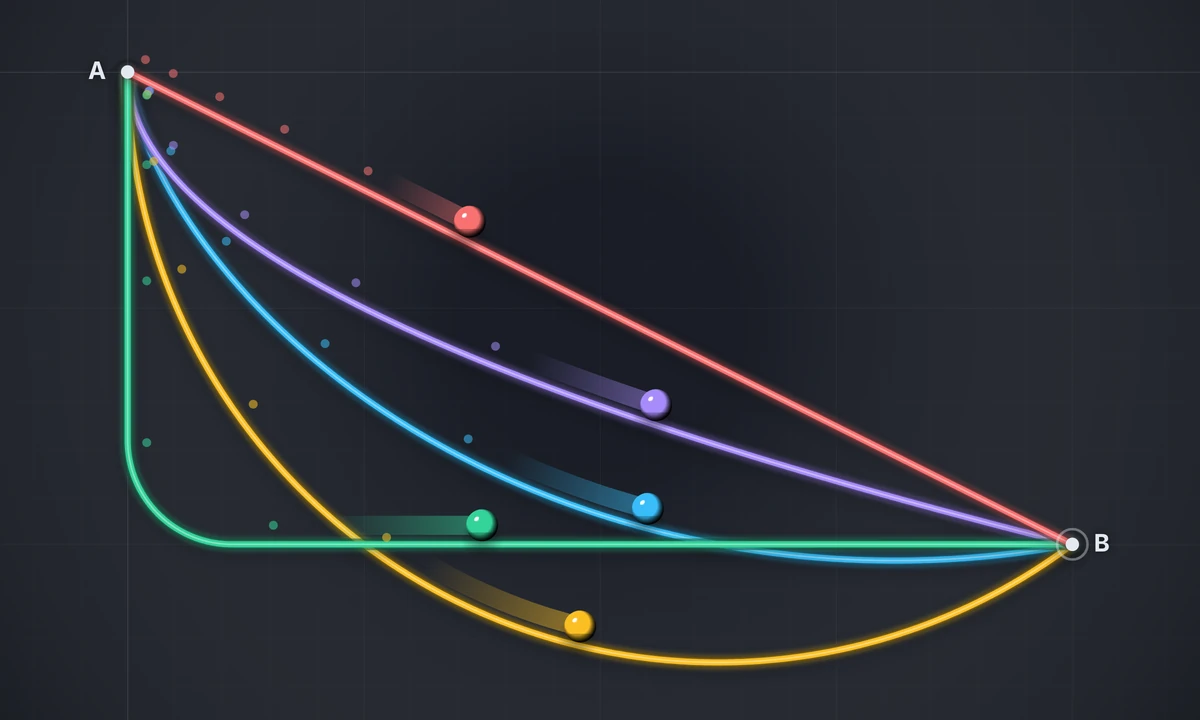
In 1696 Johann Bernoulli asked which curve lets a bead slide from one point to a lower one in the shortest time. His own solution used light: after falling a height y the bead moves at √(2gy), so he imagined light in layers that speed it up in the same way. Snell's law across all the layers bends the light into a cycloid, the brachistochrone.
Try it in PictorX
Open Snell's Law and pick a scene. In Lifeguard, drag the lifeguard, the swimmer, and the ring on the shore, and press Race. In Light beam, choose the two materials and drag the laser; Angles shows the normal and the angles, and Wave crests shows the crests bunching up in the slower material. In Brachistochrone, raise Number of layers and drag the end point to watch the light path close in on the cycloid.
Frequently asked questions
Who discovered Snell's law?
Ibn Sahl described it in 984. Thomas Harriot and Willebrord Snellius found it again in 1602 and 1621, and René Descartes published it in 1637.
Why is it called Snell's law?
Snellius is the Latin name of the Dutch mathematician Willebrord Snel van Royen, who found the law in 1621 but never published it.
What is the refractive index of water?
About 1.33. Light in water moves at about 225,000 km per second, three quarters of its speed in a vacuum.
Does PictorX upload anything?
No. Everything is drawn on a canvas in your browser. Save downloads a PNG, and Edit opens that image in the PictorX editor.
Related tools
Snell's Law & Light Refraction
See why light bends. Race a lifeguard across sand and sea, shine a laser from air into water, glass, or diamond, and watch light through thin layers trace the brachistochrone.
Brachistochrone race
Race balls from A to B on a straight ramp, a circle, a parabola, and a cycloid. The cycloid always wins, even when it dips below the finish. Draw your own track.
Brachistochrone
What the brachistochrone is: why the cycloid beats the straight line, how Bernoulli's 1696 challenge was solved, and why a cycloid bowl is also the tautochrone.
Pendulum wave
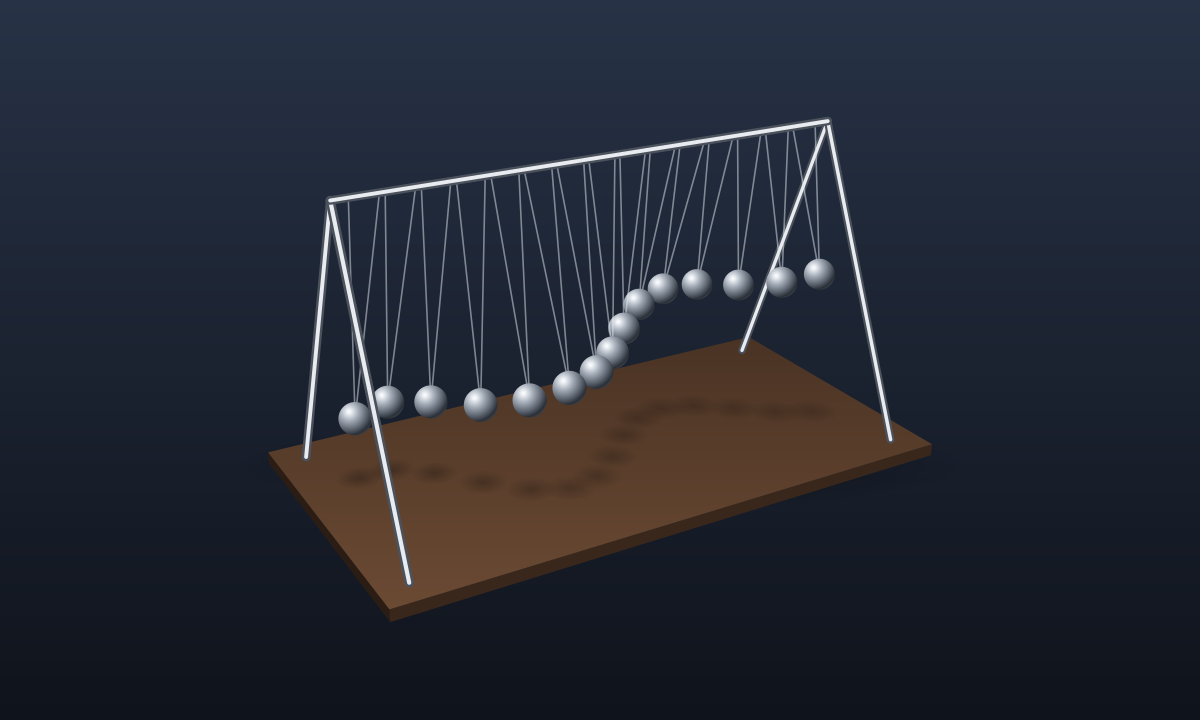
Fifteen pendulums, each a little shorter than the last. Let them go together and watch them drift into waves, split into rows, and swing in step again.
Galton board
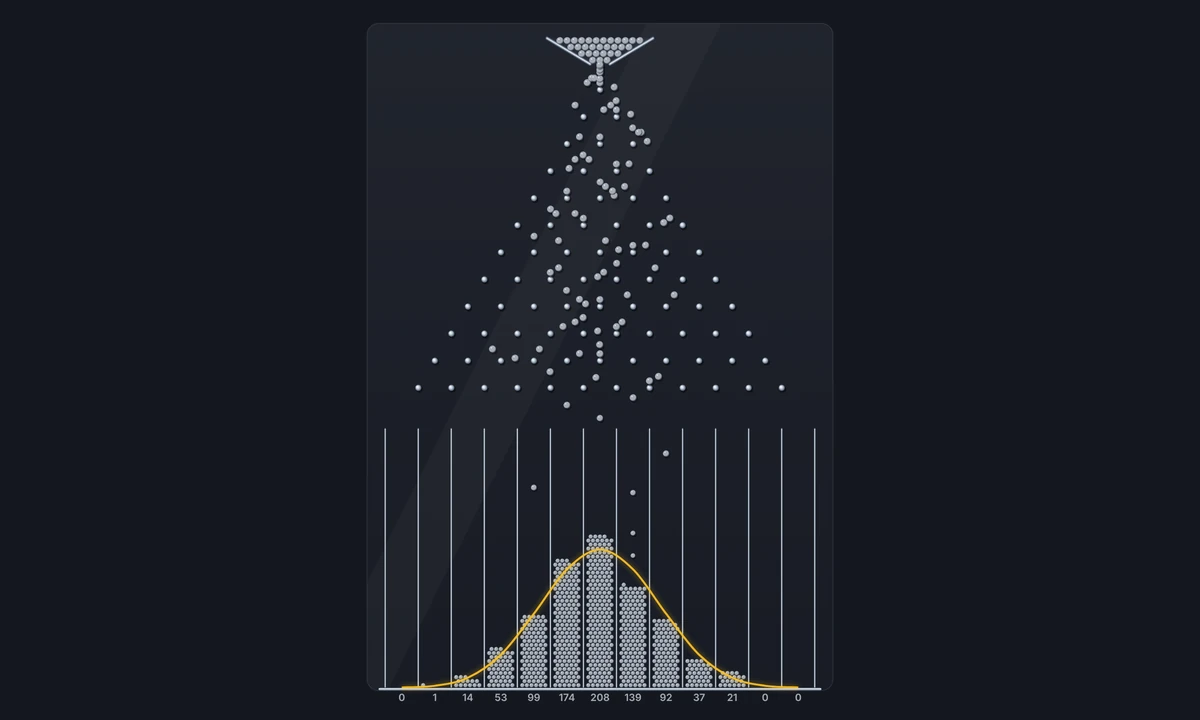
Drop balls through rows of pegs and watch a bell curve fill the bins. Change the rows, the bias, and the number of balls, and compare mean and spread with theory.
Optical illusions
Play with 13 classic optical illusions in your browser, most made from your own photo: colour from grey, an afterimage, a spinning spiral, a hidden picture, the café wall, the Fraser spiral, drifting wheels and more. Tick Reveal the trick to see how each one works.
Ready to try it?
Open PictorX in your browser — no install, no credit card required to start.
Try Snell's Law