
Newton's cradle
A Newton's cradle is a row of identical steel balls hung so they just touch. Lift one and let go. It hits the row and stops, and only the ball at the far end swings up. The balls in the middle look still. The motion went through them.
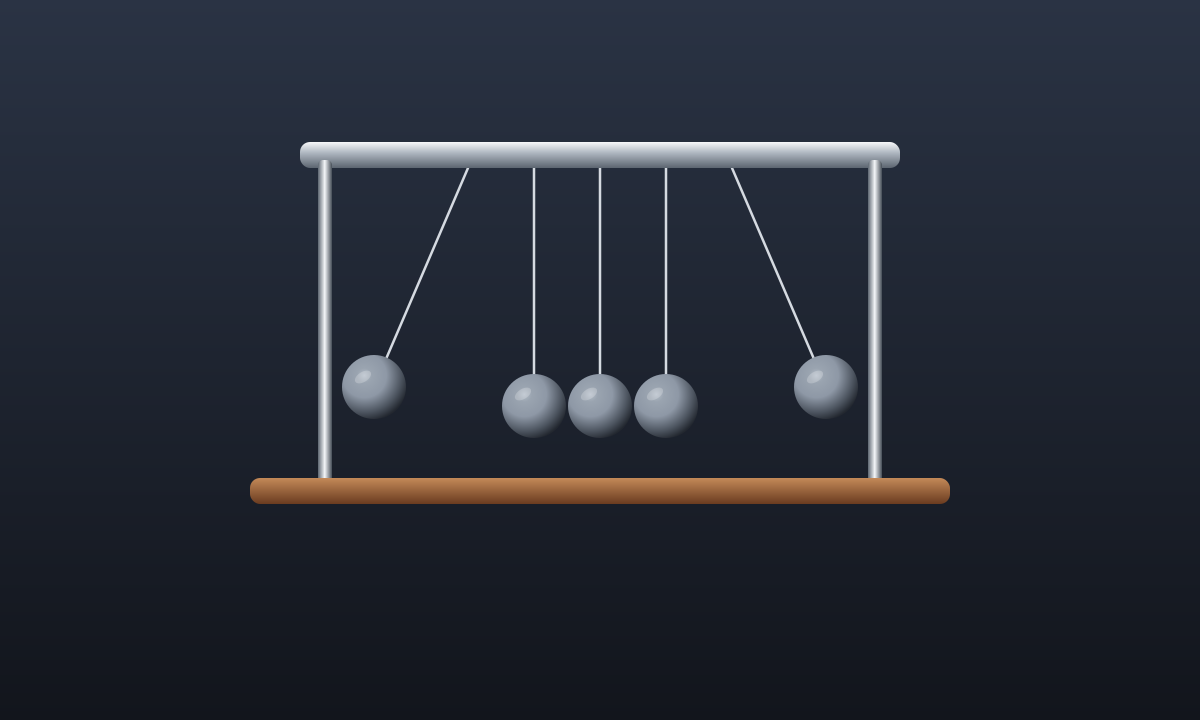
A row of identical balls
A Newton's cradle is a frame and a row of identical metal balls on strings of equal length. At rest the balls just touch. Each ball is the same pendulum: the same mass, the same length, the same swing.
What you see
You lift a ball at one end and let go. It falls and strikes the next ball. The energy and the momentum travel through the balls in the middle, which barely move. Only the ball at the other end swings up, at nearly the same speed. Lift two balls, and two swing out the other side. Lift three, and three swing out. The number that leaves matches the number that arrived.
Conservation of momentum
Momentum is mass times velocity. In a closed system the total does not change. The click is so brief that the strings do not have time to pull, so for that instant the balls are a closed system. The momentum that arrives on one side leaves on the other. Over the rest of the swing the strings do pull sideways. The horizontal momentum of the balls alone is not constant then. The frame holds the difference.
Conservation of energy
Kinetic energy is the energy of motion. Potential energy is the energy of height. A lifted ball holds potential energy. As it falls, that becomes kinetic energy. The click passes the kinetic energy on, and the far ball climbs until the motion has become height again. Then it falls back, and the cradle repeats.
An elastic collision
An elastic collision keeps kinetic energy as motion. Very little is spent on heat or on denting the steel. That is why the outgoing ball is almost as fast as the incoming one. Momentum alone would allow other splits. One ball could leave at twice the speed, or every ball could creep forward together. Those splits waste kinetic energy. The elastic click is the split that keeps both laws, and it is the one the cradle shows: the same number of balls, at the same speed, on the other side.
Why it eventually stops
The cradle is not perfectly elastic, and it is not in a vacuum. Air resistance drags on every swing. Each click spends a little more energy as sound and as a tiny compression of the metal. The swings grow shorter until the balls hang still.
Try it in PictorX
Open Newton's cradle and one ball is already raised. Drag either end to choose the height, or set Balls and Lift. Balls runs from 3 to 7. Friction is the air, and Bounce is how elastic the click is. The readout shows the speed at each end, then height, motion, and their sum. Save a PNG, or open the picture in the PictorX editor.
Frequently asked questions
Why does only the far ball move?
The balls have equal mass and the click is nearly elastic. The only result that keeps both momentum and energy is the incoming ball stopping and the far ball leaving at the same speed. The middle balls pass that disturbance through and stay put.
Why do two balls send two balls out?
Two balls arrive together at one speed. Two balls leaving at that speed keeps both momentum and energy. One ball leaving at twice the speed would keep the momentum and throw the energy away.
Is momentum conserved the whole time?
During the click, yes. Over a full swing the strings pull, so the horizontal momentum of the balls changes and the frame takes the difference. Energy, apart from air and the click, is what stays constant.
Why does Newton's cradle stop?
Air resistance slows every swing, and each click loses a little energy as sound and heat. With friction at zero and a perfectly elastic bounce, the simulated cradle keeps swinging.
Related tools
Newton's cradle
Lift a steel ball and let it fall. The click sends that motion out the other side. Watch height turn into motion as the cradle swings.

N-Body System
Watch Newton's gravity move stars, planets, and moons in 3D in your browser. Turn the view, and see stable orbits, resonances, slingshots, Trojans, and a chaotic cluster.
Gravity between many bodies
How Newton's law of gravitation turns a handful of masses into orbits, resonances, Lagrange points, slingshots, and chaos.
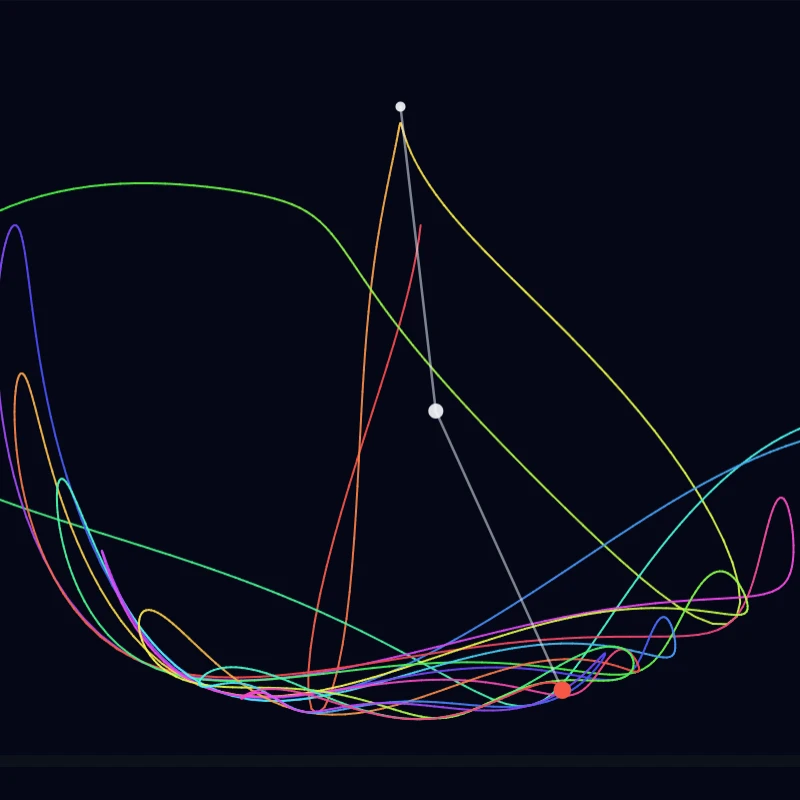
Double Pendulum
Simulate a classical double pendulum in your browser. Paint chaotic tip trails, long-exposure paths, or distort a soft field—then save a PNG.
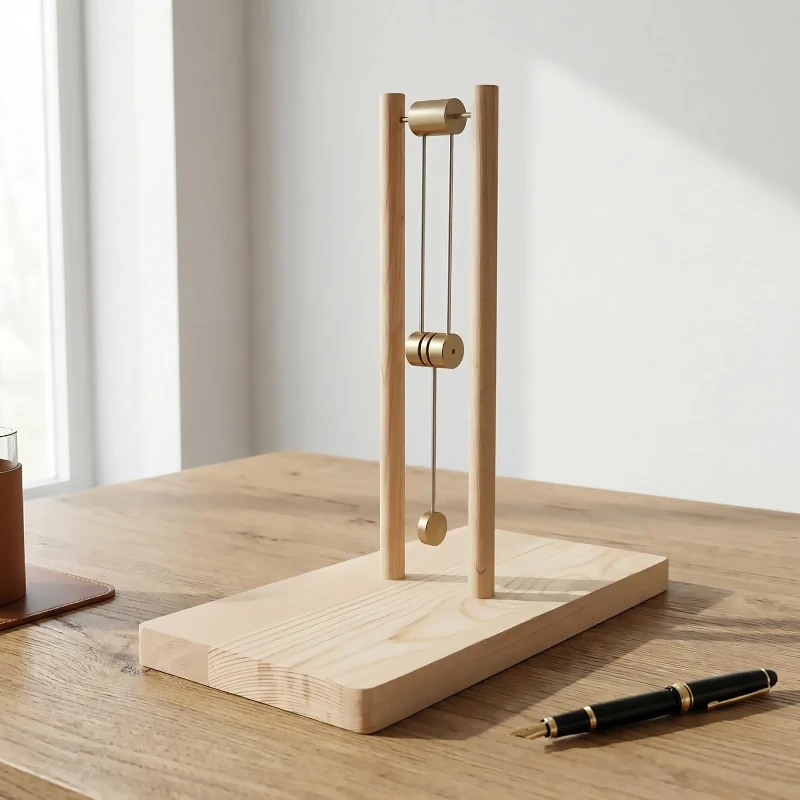
The double pendulum
How a double pendulum turns simple gravity into chaos: coupled angles, sensitive dependence on initial conditions, and why its tip paints stunning light trails in PictorX.
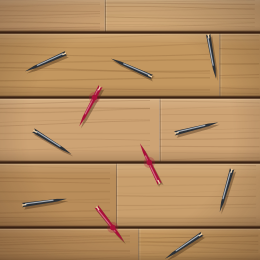
Buffon's Needle
Drop needles on a lined floor in your browser. Count the crossings and watch Buffon's 1777 experiment estimate π.
Ready to try it?
Open PictorX in your browser — no install, no credit card required to start.
Try Newton's cradle