
Gambler's fallacy
After eight heads in a row, surely tails is due? It is not. A coin has no memory, and the chance of heads on the next flip is still exactly 50%. This simulator flips a coin by itself, 100 times a second, keeps track of every streak, and shows what came right after each one. A fair coin flips by itself, 100 times a second. Set a streak length and watch what comes right after every streak that long: the same face again about half the time, however long the streak was. The coin has no memory. Turn on Only the flips after a streak to see each of those moments. Click the coin to flip it once.
How it works
- Press Flip and let the coin run. The tape shows the latest flips with the streaks marked.
- Set a streak length, such as 5, and turn on Only the flips after a streak to see each of those moments.
- Read the chart: after a streak of any length, the next flip is the same about half the time.
A coin has no memory
Each flip of a fair coin is independent of all the flips before it. The coin does not know that it just came up heads eight times, and the chance of heads on the ninth flip is ½, as on any other flip. Believing that tails is now due is the gambler's fallacy. Its mirror image, believing that a streak will go on because it is hot, is just as wrong for a coin.
Why streaks feel wrong
People expect random sequences to switch between heads and tails more often than they really do. In 100 flips a run of at least five heads or five tails in a row turns up almost every time, and runs of seven or more in about half of all sequences. When we see such a run we suspect a pattern, and our sense of fairness wants it corrected. The coin has no such urge.
Monte Carlo, 1913
The most famous case happened at the Monte Carlo Casino on 18 August 1913, when the ball in a roulette game fell on black 26 times in a row. Gamblers lost fortunes betting on red, sure that the streak had to end. The chance of red was the same on every spin: 18 pockets out of 37, just under one half.
Then why does it even out?
Over many flips the share of heads does approach 50%, but not because tails catches up. An early lead of a few heads is simply drowned out by the thousands of flips that follow. The difference between the numbers of heads and tails even tends to grow, roughly like √N, while the share settles. That is the law of large numbers, and it needs no memory.
Frequently asked questions
What is the gambler's fallacy?
The mistaken belief that after a streak of one outcome the other outcome becomes more likely, for example that tails is due after many heads. For independent events like coin flips the chances stay the same.
After 8 heads in a row, what is the chance of heads?
Exactly 50% for a fair coin. The chance of eight heads in a row, seen from before the first flip, is 1/256, but once they have happened the next flip is a fresh 50/50.
Why is the chart not exactly 50% for long streaks?
Long streaks are rare, so those bars rest on few cases and wobble. The error bars show the range that would contain the true chance in 95% of runs. With more flips they shrink around 50%.
Is the gambler's fallacy the same as the hot hand?
They are opposites. The gambler's fallacy expects a streak to end; the hot-hand belief expects it to go on. For a fair coin both are wrong. Whether people, such as basketball players, can really have a hot hand is still debated.
Does this upload anything?
No. Everything is calculated and drawn on a canvas in your browser. Save downloads a PNG. Edit opens that image in the PictorX editor.
Related tools

The gambler's fallacy
Why a coin has no memory: independent events, the chance of a streak versus the chance of the next flip, the 1913 Monte Carlo roulette streak, how often long runs appear, and why the law of large numbers needs no correction.
Rolling dice
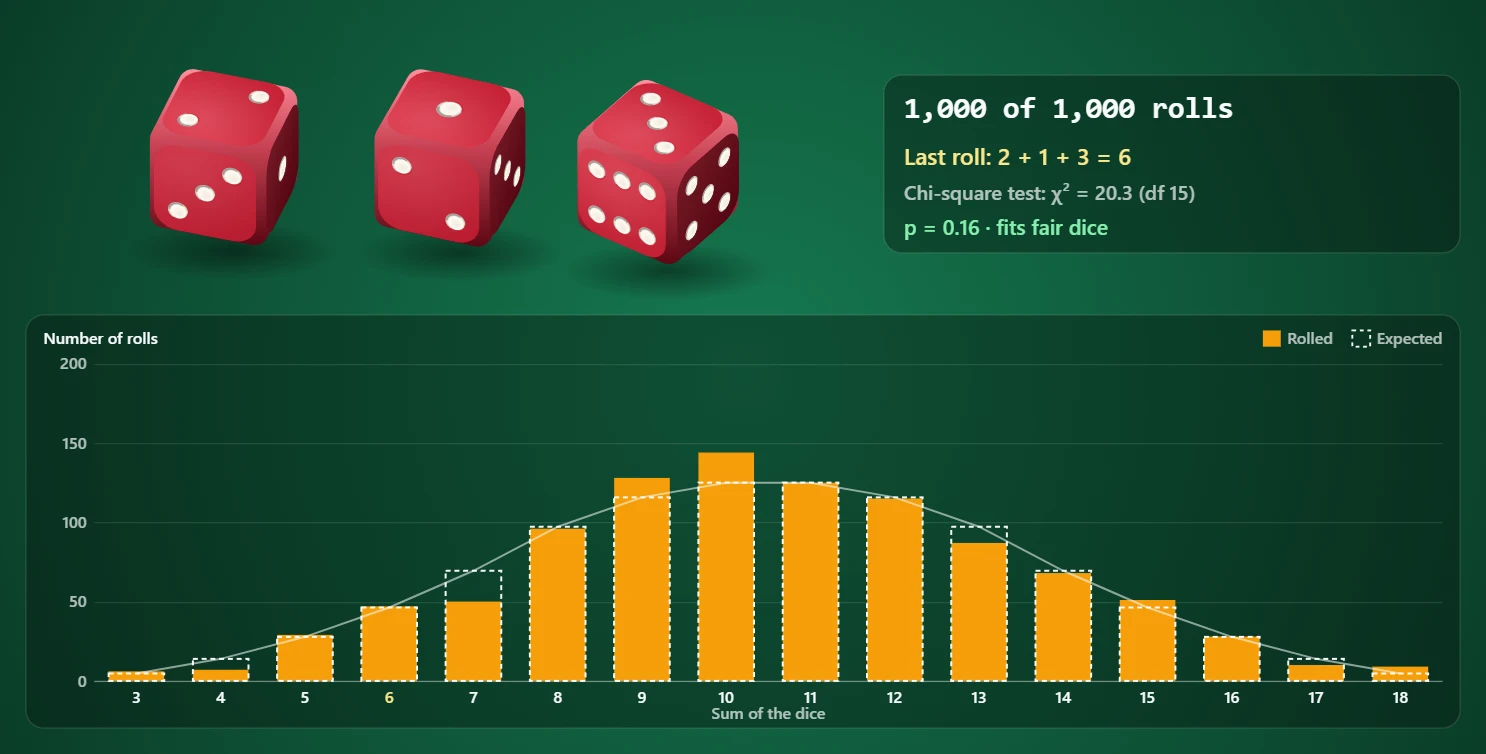
Roll one, two or three dice a thousand times and compare the bar chart of how often each result came up with the expected frequencies. See why 7 is the most common sum.

The Monty Hall problem
Pick one of three doors, watch Monty open one with a goat, then stay or switch. Play yourself or let the computer play 1,000 games and see switching win two times out of three.

Hi-Lo card counting
Learn Hi-Lo card counting at a blackjack table in your browser: +1, 0 or −1 for every card, the running count, the true count and the bet. Practise the count, count down a deck, or play a million rounds.
Monte Carlo π
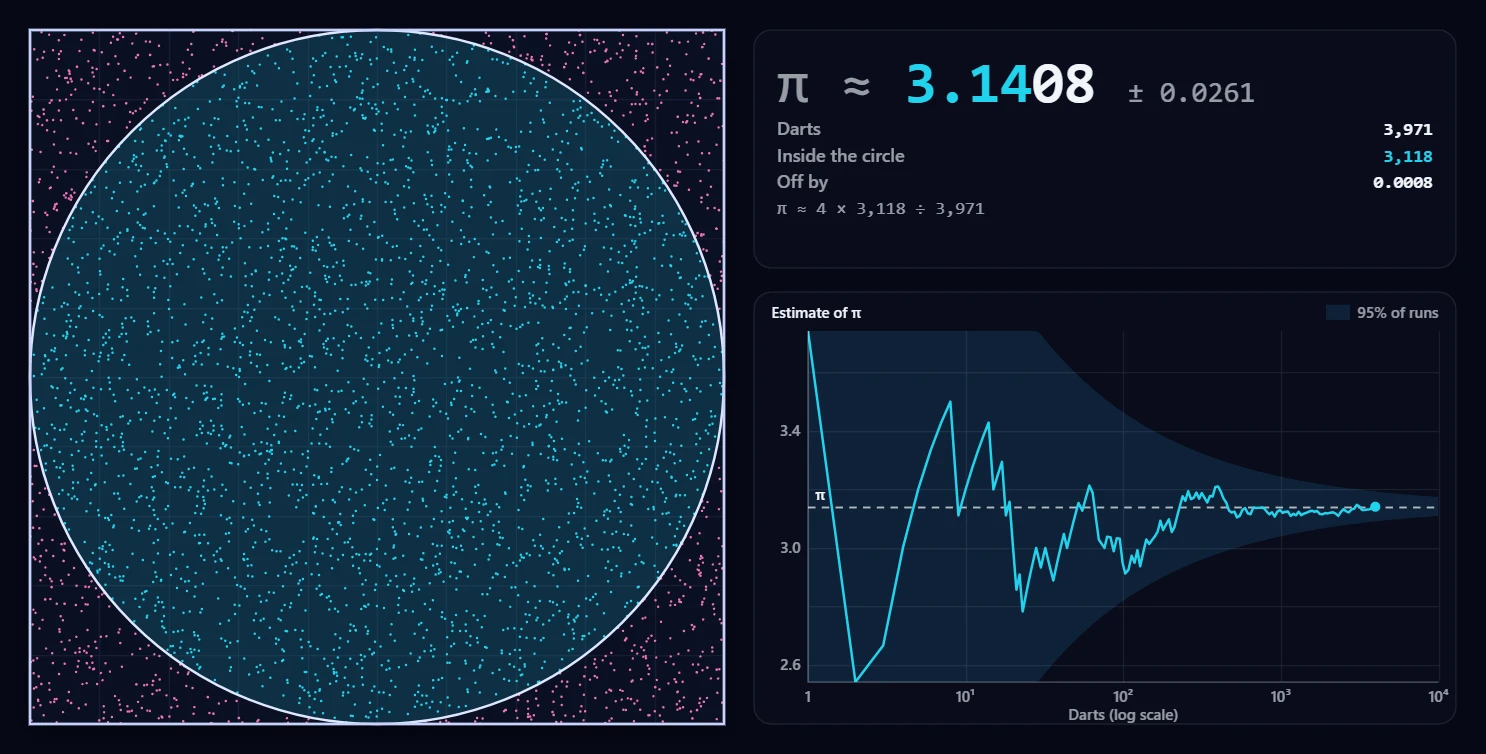
Throw thousands of random darts at a square with a circle in it and watch the share that lands inside turn into π. Start, stop, and follow the estimate as it converges.
Galton board
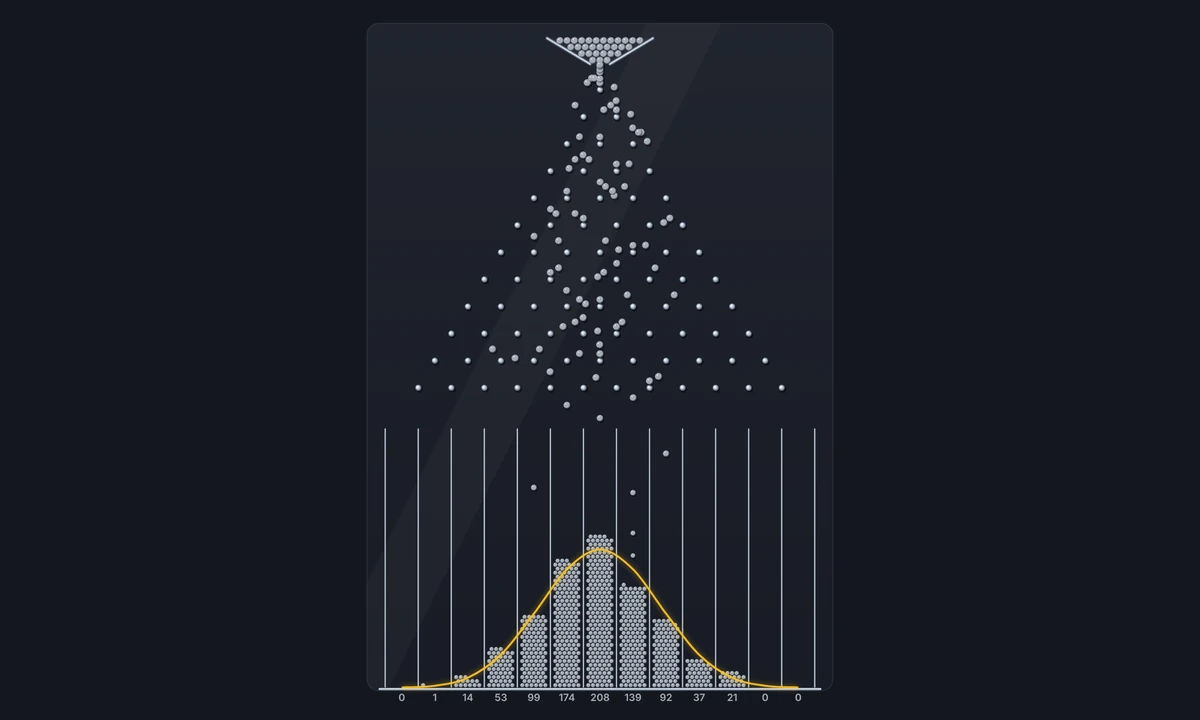
Drop balls through rows of pegs and watch a bell curve fill the bins. Change the rows, the bias, and the number of balls, and compare mean and spread with theory.

Buffon's Needle
Drop needles on a lined floor in your browser. Count the crossings and watch Buffon's 1777 experiment estimate π.
Ready to try it?
Open PictorX in your browser — no install, no credit card required to start.
Go to Editor