
Rolling dice
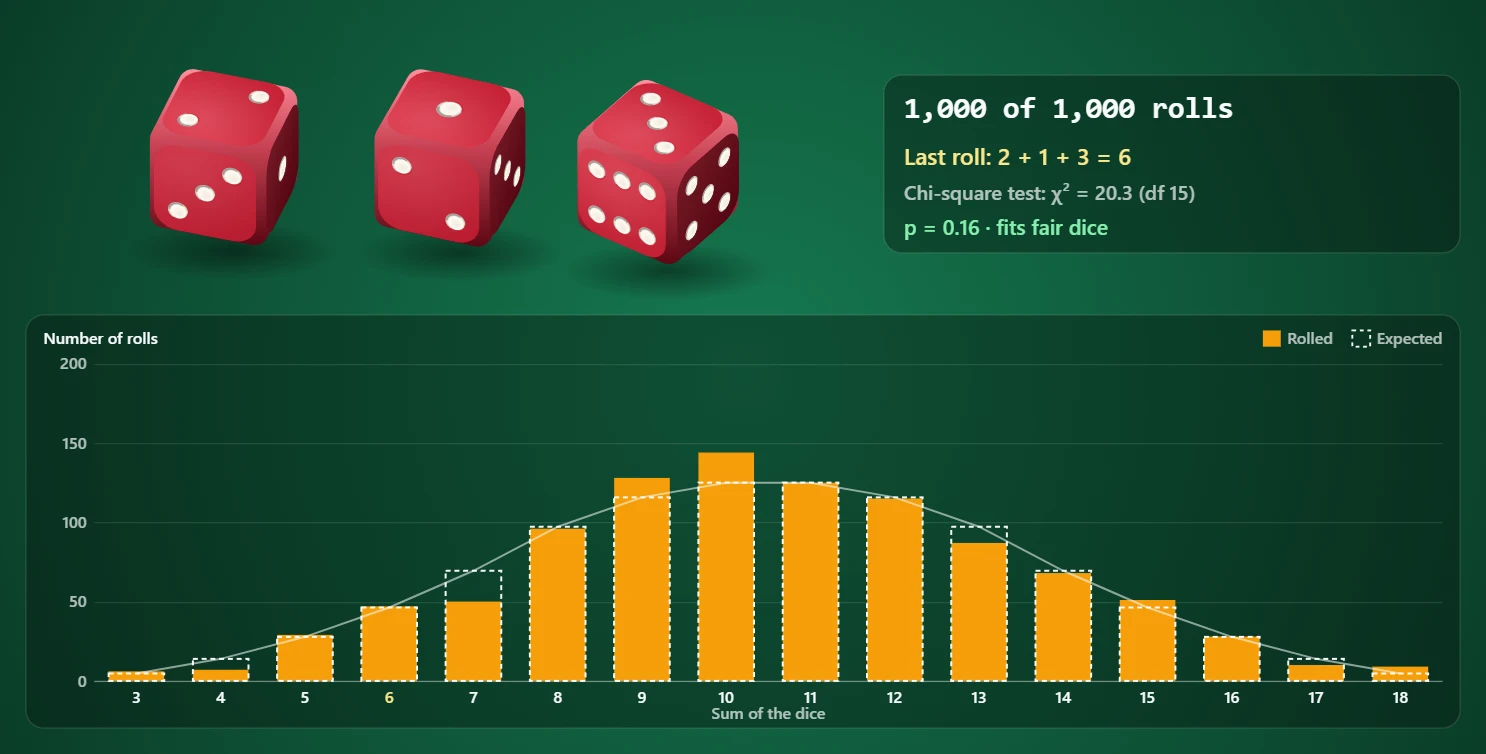
Roll a die once and anything from 1 to 6 can happen. Roll it a thousand times and a pattern appears: every face comes up about 1/6 of the time. With two dice the sums are not equally likely at all: 7 comes up six times as often as 2 or 12. Roll the dice and watch the bars grow towards the expected frequencies. Press Roll to throw the dice again and again, and watch the bars grow. The dashed outlines show how often each face or sum should come up. With two dice, 7 is the most common sum: six of the 36 ways to land make 7. Click the dice to roll once.
How it works
- Choose one, two or three dice and press Roll. The dice tumble and the bar of each result grows.
- Compare each bar with its dashed outline: the expected number of rolls for fair dice.
- Try a loaded die, five dice for a bell curve, or 10,000 rolls, and read the chi-square test.
One die: a flat chart
A fair die has six faces and each comes up with probability 1/6. After 60 rolls you expect each face 10 times, but you will rarely see exactly 10: counts of 6 or 14 are perfectly normal. After 1,000 rolls each face is expected about 167 times, and the bars look much flatter in proportion. The differences grow in absolute terms but shrink as a share of the rolls: that is the law of large numbers.
Two dice: why 7 wins
Two dice can land in 6 × 6 = 36 equally likely ways. Only one of them gives 2 (1 + 1) and one gives 12 (6 + 6), but six give 7: 1 + 6, 2 + 5, 3 + 4, 4 + 3, 5 + 2 and 6 + 1. So 7 has probability 6/36 = 1/6 and 2 only 1/36. The fractions under the bars count these ways, and the chart becomes a triangle.
Three or more dice: the bell curve
With three dice there are 216 ways to land, and the sums 10 and 11 are the most likely, with 27 ways each. Add more dice and the chart turns into a bell curve: the central limit theorem says that a sum of many independent random numbers is approximately normally distributed.
Is the die fair? The chi-square test
How far may the bars be from the outlines before you suspect the dice? The chi-square test adds up (observed − expected)² / expected over all bars. If the dice are fair, a value at least as large as the one measured happens with probability p. A p below 0.05 is a warning sign. Pick the loaded die, whose six comes up twice as often as each other face, and after a few hundred rolls the test catches it.
Frequently asked questions
What is the most common sum with two dice?
7. Six of the 36 equally likely ways to land add up to 7, so its probability is 1/6. The sums 2 and 12 can each be made in only one way: 1/36.
If I roll a die 600 times, will each number come up 100 times?
On average yes, but rarely exactly. A spread of about 9 either side of 100 is normal. The share of each face gets closer to 1/6 the more you roll.
Why does the chart with many dice look like a bell?
Because of the central limit theorem: the sum of many independent random numbers is close to a normal distribution. Middle sums can be made in far more ways than extreme ones.
How can I tell if a die is loaded?
Roll it many times and compare the counts with 1/6 each. The chi-square test in the app turns the differences into a p-value; a p-value below 0.05 after many rolls means the die is unlikely to be fair.
Does this upload anything?
No. Everything is calculated and drawn on a canvas in your browser. Save downloads a PNG. Edit opens that image in the PictorX editor.
Related tools
Dice probability
Dice probability explained: why each face has a chance of 1/6, how to count the ways to roll a sum, expected versus observed frequencies, the bell curve of many dice, and the chi-square test for a fair die.

Marbles from a vase
Draw marbles from a vase without looking and without putting them back. Follow every draw in a tree diagram: 5/9 × 4/8 = 5/18 for two red marbles. Then let the computer draw 1,000 rounds.
Galton board
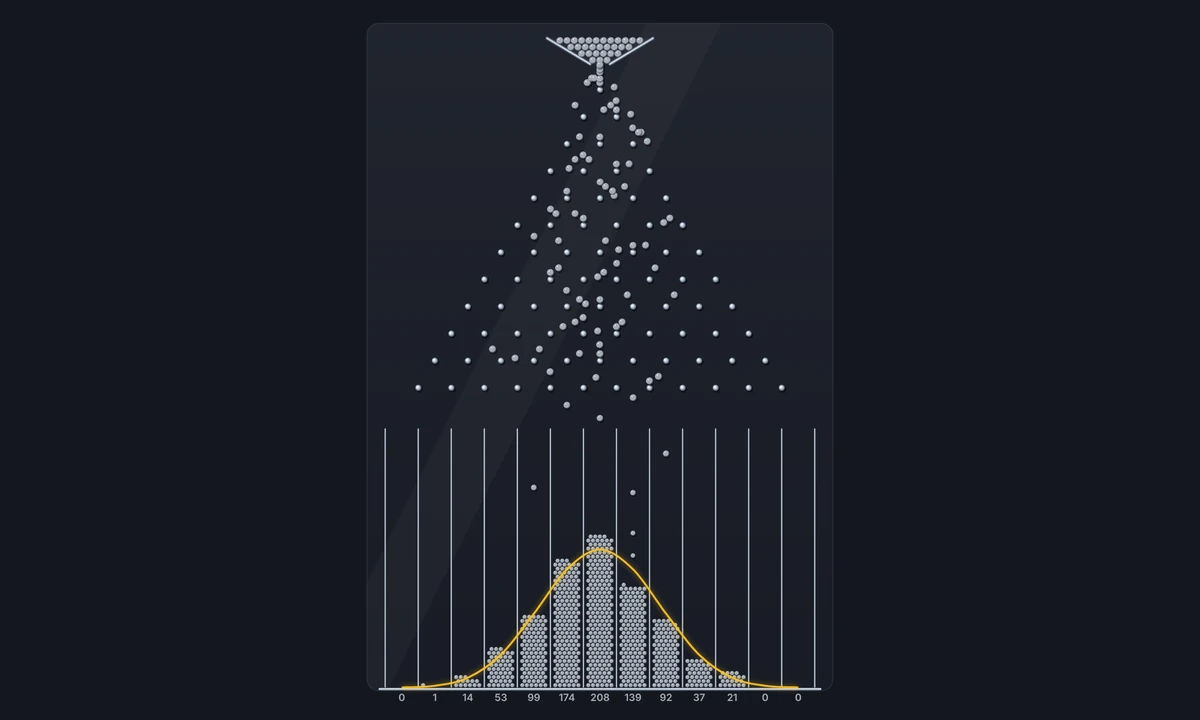
Drop balls through rows of pegs and watch a bell curve fill the bins. Change the rows, the bias, and the number of balls, and compare mean and spread with theory.

Gambler's fallacy
Flip a fair coin 100 times a second and see what comes after every streak of 5 or 8 heads in a row. It is still 50/50: the coin has no memory.
Monte Carlo π
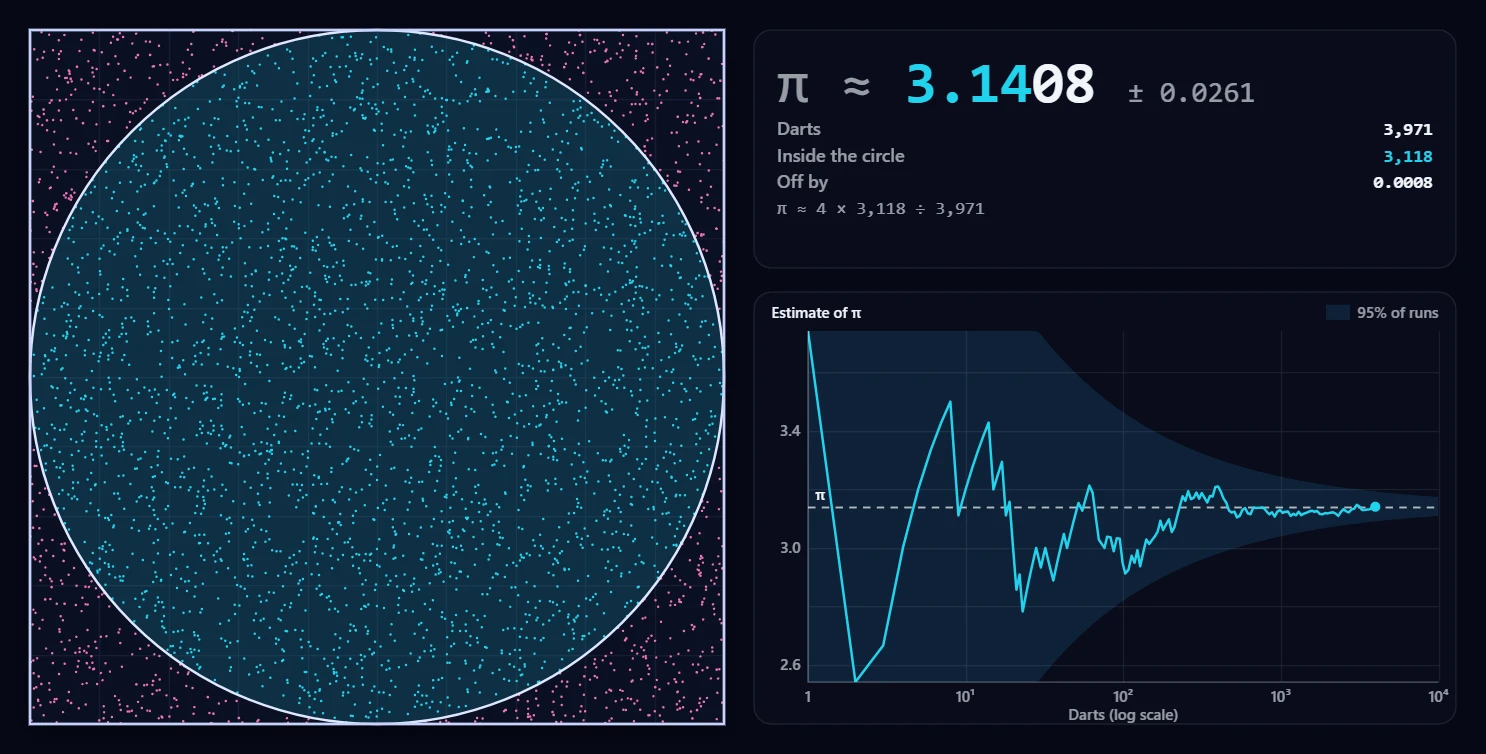
Throw thousands of random darts at a square with a circle in it and watch the share that lands inside turn into π. Start, stop, and follow the estimate as it converges.

The Monty Hall problem
Pick one of three doors, watch Monty open one with a goat, then stay or switch. Play yourself or let the computer play 1,000 games and see switching win two times out of three.

Yahtzee
Play Yahtzee free in your browser. Roll five dice up to three times, hold the ones you want and fill 13 boxes. Play solo, with up to 4 players or against the computer.
Ready to try it?
Open PictorX in your browser — no install, no credit card required to start.
Go to Editor