
The Monty Hall problem
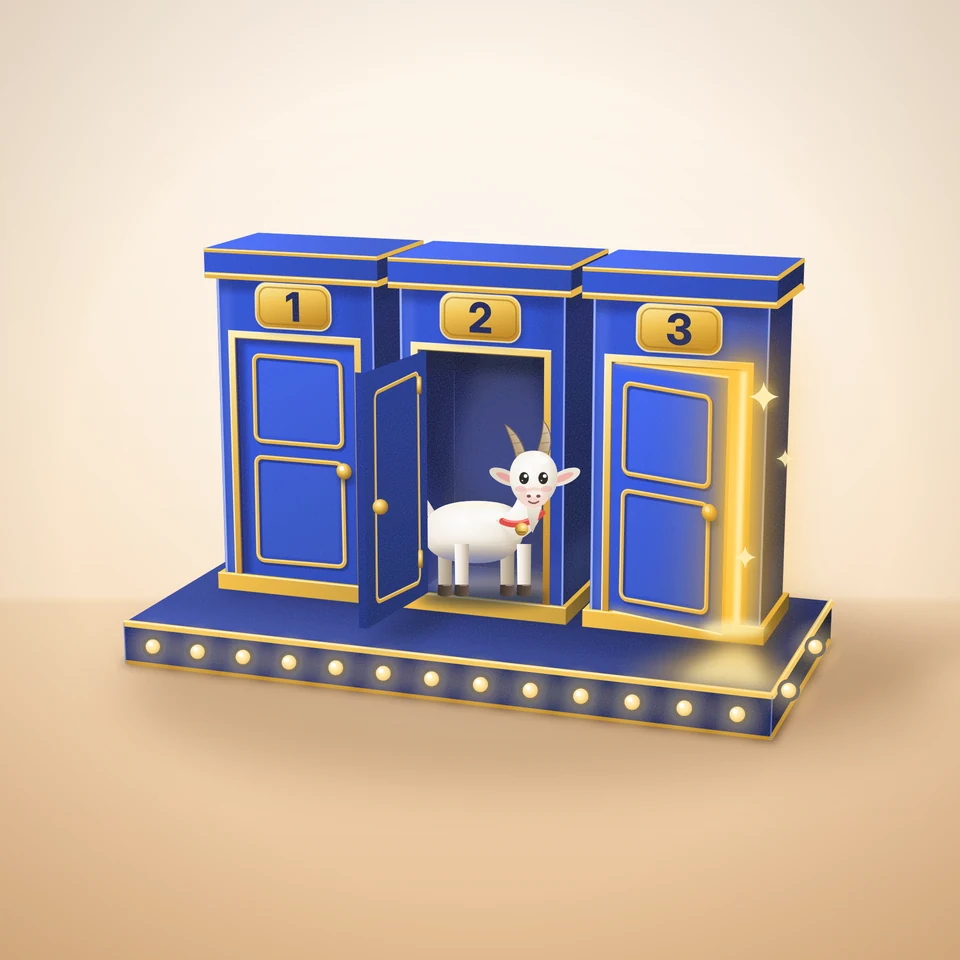
Behind one of three doors is a car, behind the other two are goats. You pick a door. The host, who knows where the car is, opens another door and shows a goat. Should you switch to the last closed door? Most people say it does not matter. It does: switching doubles your chance of winning, from 1/3 to 2/3. Click a door. Monty, who knows where the car is, opens another door with a goat. Then stay with your door or switch to the one he left closed. Switching wins two times out of three. Press Play automatically to let the computer play 1,000 games and watch the win rates settle at 1/3 and 2/3.
How it works
- Click a door. Monty opens another door with a goat behind it.
- Stay with your door or switch to the other closed door, and see what you won.
- Press Play automatically to run 1,000 games and watch the win rates settle at 1/3 for staying and 2/3 for switching.
Why switching wins
Your first pick is right with probability 1/3, and then switching loses. It is wrong with probability 2/3, and then the car is behind one of the two other doors. Monty must open the one with the goat, so the door he leaves closed hides the car. Switching wins exactly when your first pick was wrong: two times out of three.
The hundred-door version
Imagine 100 doors. You pick one, and Monty opens 98 of the others, all goats, leaving one closed. Would you stick with your 1-in-100 first guess? Switching now wins 99 times out of 100. With three doors the same reasoning gives 2/3. Try both with the Doors setting.
It depends on what Monty knows
The argument needs a host who knows where the car is and always opens a door with a goat. If Monty opens one of the other doors at random, he sometimes reveals the car and the game is spoiled. In the games where he happens to show a goat, staying and switching both win half the time. Choose Monty forgets where the car is and watch both bars settle at 50%.
A puzzle that fooled mathematicians
The puzzle is named after Monty Hall, host of the American game show Let's Make a Deal. It became famous in 1990, when Marilyn vos Savant answered it in Parade magazine: switch. Thousands of readers wrote in to say she was wrong, many of them with a doctorate. Even Paul Erdős, one of the most prolific mathematicians of the century, was only convinced when he saw a computer simulation.
Frequently asked questions
Should you switch in the Monty Hall problem?
Yes. Switching wins with probability 2/3 and staying with 1/3, as long as the host knows where the car is and always opens a door with a goat.
Why is it not 50/50 after a door is opened?
Because the host's choice is not random: he never opens your door and never the car. When your first pick is a goat, which happens 2/3 of the time, he is forced to leave the car closed. The two closed doors are not equally likely.
What happens if Monty does not know where the car is?
Then he sometimes opens the car by accident. In the games where he happens to open a goat, staying and switching each win half the time. Try Opens doors at random.
How many games does it take to see the 2/3?
After 100 games the win rates can still be ten or more percentage points off. After 1,000 games they are usually within about four points of 1/3 and 2/3, and after 10,000 games within one or two.
Does this upload anything?
No. Everything is calculated and drawn on a canvas in your browser. Save downloads a PNG. Edit opens that image in the PictorX editor.
Related tools
The Monty Hall problem
The Monty Hall problem explained: why switching wins 2/3 of the time, a table of all cases, Bayes' theorem, the many-doors version, the host who does not know, and the 1990 controversy.

The birthday paradox
In a group of 23 people the chance that two share a birthday is 50.7%, and with 57 people it is 99%. See all 253 pairs, the calendar and the curve, and test thousands of random groups in your browser.

Marbles from a vase
Draw marbles from a vase without looking and without putting them back. Follow every draw in a tree diagram: 5/9 × 4/8 = 5/18 for two red marbles. Then let the computer draw 1,000 rounds.

Gambler's fallacy
Flip a fair coin 100 times a second and see what comes after every streak of 5 or 8 heads in a row. It is still 50/50: the coin has no memory.

Hi-Lo card counting
Learn Hi-Lo card counting at a blackjack table in your browser: +1, 0 or −1 for every card, the running count, the true count and the bet. Practise the count, count down a deck, or play a million rounds.
Rolling dice
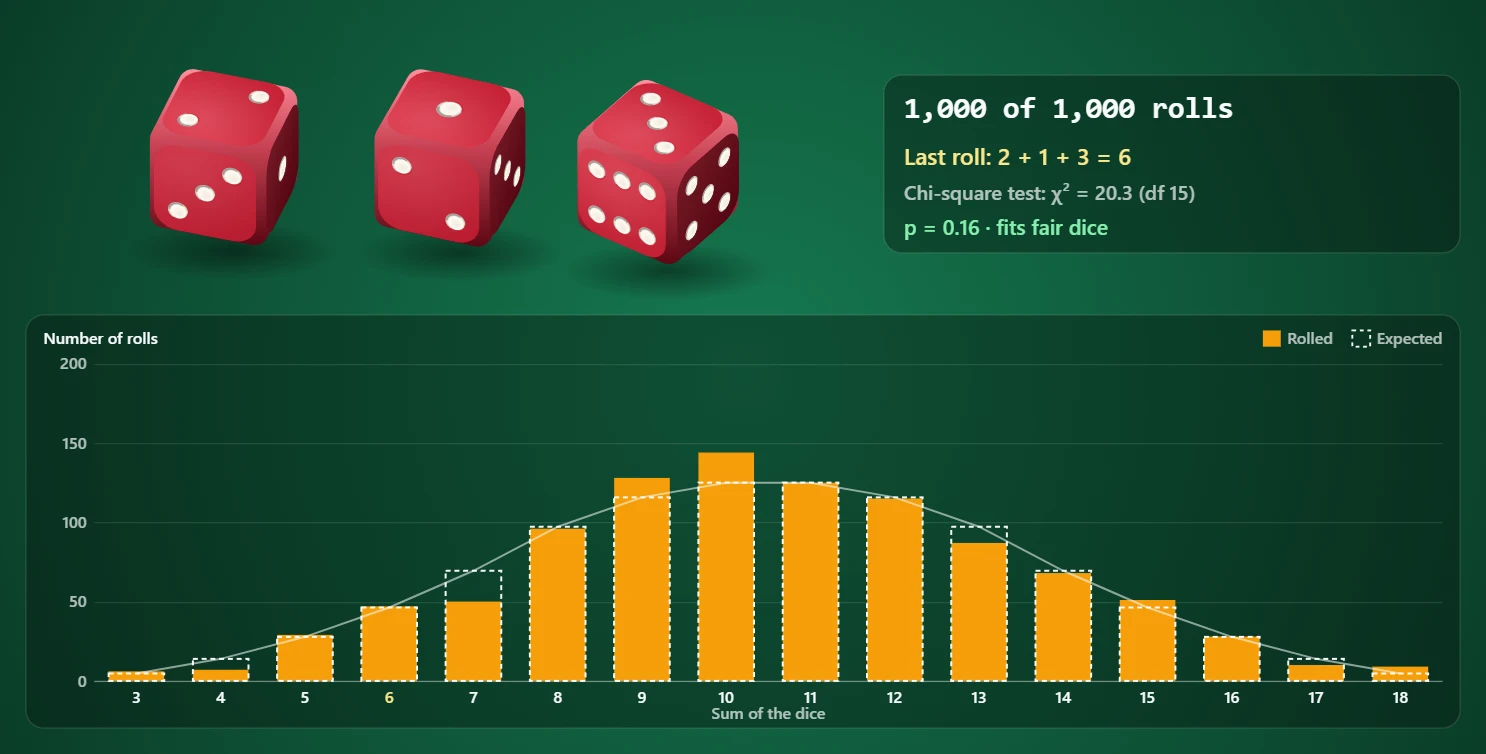
Roll one, two or three dice a thousand times and compare the bar chart of how often each result came up with the expected frequencies. See why 7 is the most common sum.
Monte Carlo π
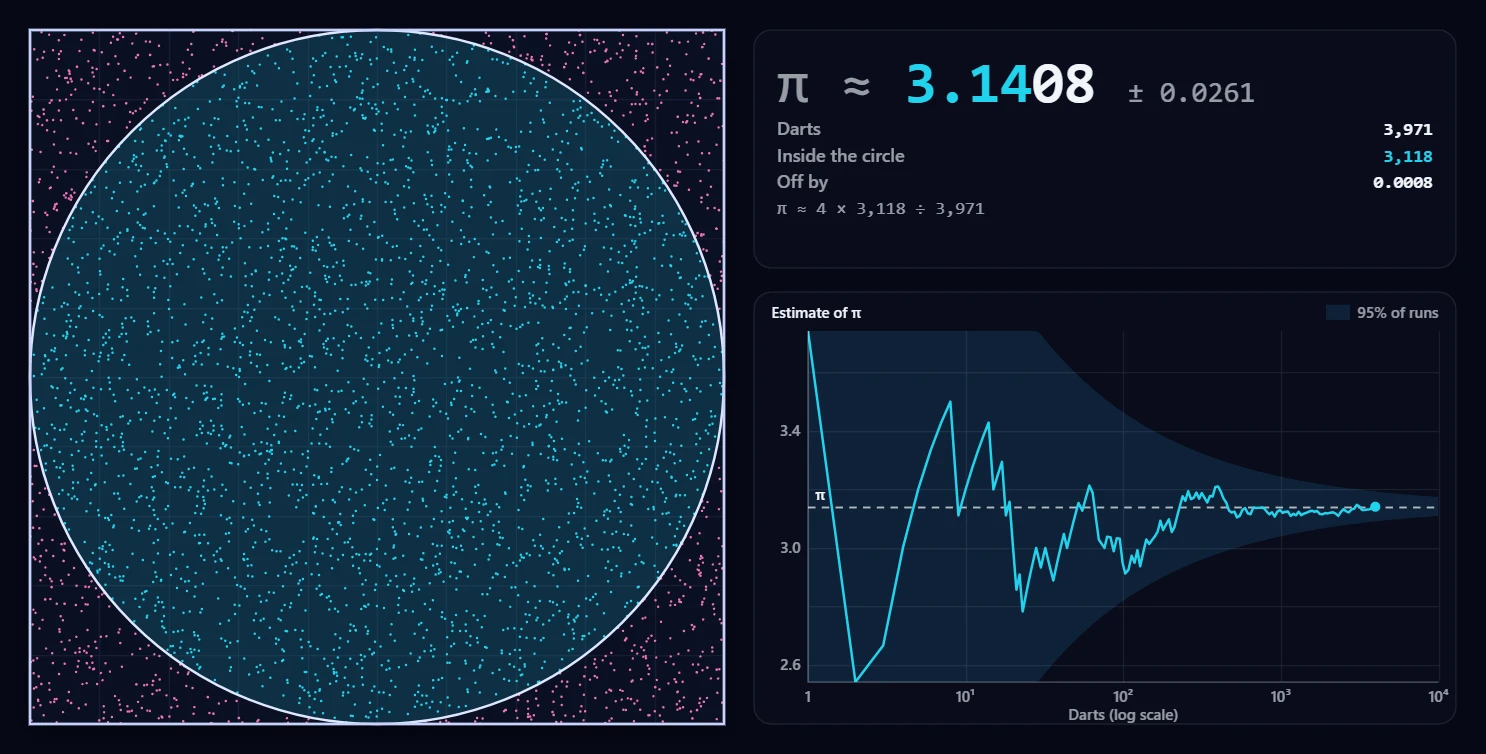
Throw thousands of random darts at a square with a circle in it and watch the share that lands inside turn into π. Start, stop, and follow the estimate as it converges.

Buffon's Needle
Drop needles on a lined floor in your browser. Count the crossings and watch Buffon's 1777 experiment estimate π.
Galton board
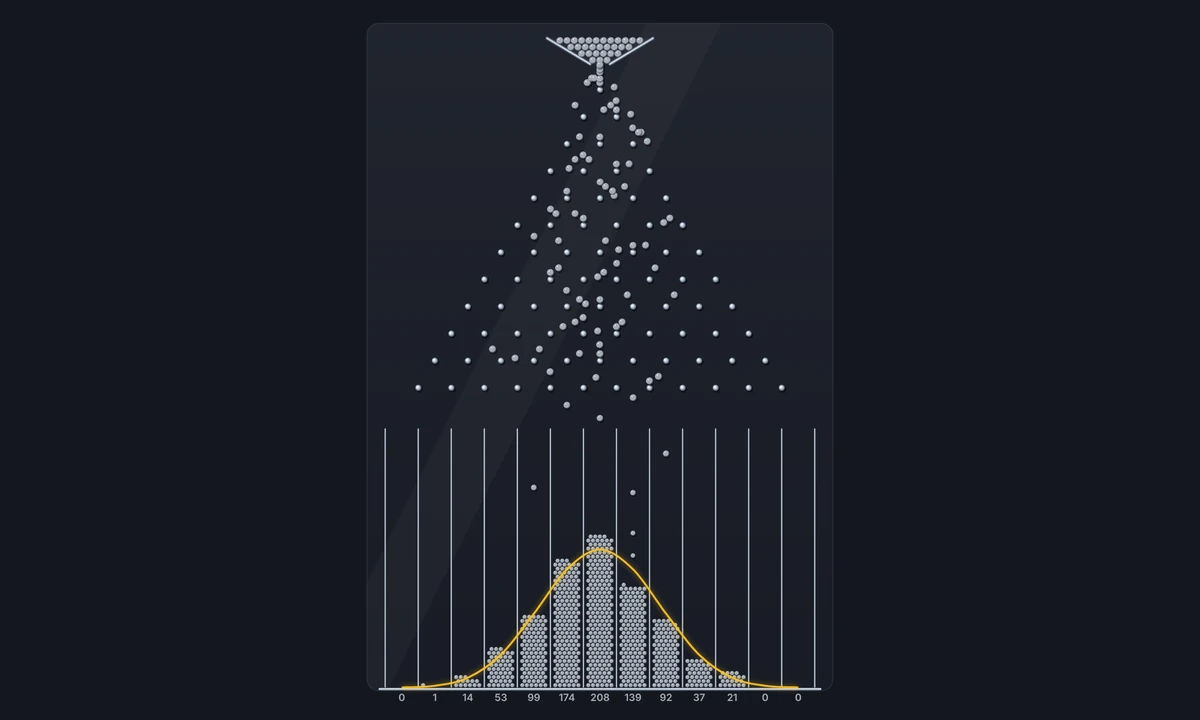
Drop balls through rows of pegs and watch a bell curve fill the bins. Change the rows, the bias, and the number of balls, and compare mean and spread with theory.
Ready to try it?
Open PictorX in your browser — no install, no credit card required to start.
Go to Editor