
The gambler's fallacy
The gambler's fallacy is the belief that past results of a random process change the chances of the next one. It feels natural, it has cost fortunes, and it is wrong whenever the trials are independent.

Independent events
Two events are independent when knowing the outcome of one does not change the probability of the other. Coin flips, dice rolls and roulette spins are independent: the coin, the die and the wheel keep no record of earlier results. For a fair coin the chance of heads on flip 9, given heads on flips 1 to 8, is simply the chance of heads: ½.
A streak is unlikely, the next flip is not
Before you start, eight heads in a row have probability (½)⁸ = 1/256, and nine heads in a row 1/512. The step from eight to nine is a factor ½: the chance of one more head. The fallacy confuses the chance of the whole streak, which is small, with the chance of the next flip once the streak has happened, which is ½. Every particular sequence of nine flips, such as HTTHHTHTH, is exactly as unlikely as nine heads.
How often streaks appear
Long runs are much more common than intuition says. In 100 flips of a fair coin the longest run of heads or tails is usually 6, 7 or 8 long, and a run of at least 5 shows up in nearly every sequence. Asked to write down a random sequence, people switch between heads and tails too often and avoid long runs. That is one way teachers spot invented coin-flip homework.
Monte Carlo, 1913
On 18 August 1913 the ball at a roulette table in the Monte Carlo Casino fell on black 26 times in a row. As the streak grew, players piled their bets on red, convinced that the wheel had to correct itself. Each spin still had the same chance of red, 18 of the 37 pockets. The gambler's fallacy is also called the Monte Carlo fallacy after that evening.
The law of large numbers needs no memory
If the coin does not compensate, why does the share of heads approach ½? Because a fixed surplus is diluted. Ten extra heads among 20 flips is a big deviation; the same ten among a million flips are invisible. The difference between heads and tails typically grows like √N, while the share converges, because √N/N shrinks. The law of averages is often misread as a force that pushes results back; it is only this dilution.
When the past does matter
When trials are not independent, earlier results do change the chances. Drawing cards without putting them back changes the deck: after many red cards, black ones are more likely. A biased wheel or a tired player can produce real patterns too. The fallacy is to assume such a dependence where there is none, as with a fair coin, a fair die or a lottery draw.
Explore it in PictorX
Open the Gambler's fallacy simulator and the coin flips by itself, 100 times a second. The tape shows the latest flips: runs of at least the chosen streak length are shaded, and the flip right after them gets a coloured ring that tells whether it was the same face or the other one. Turn on Only the flips after a streak to list those moments, newest first, with the share that was the same. The chart shows that share for streaks of 1 to 10 or more, with 95% error bars around 50%. When a streak reaches your length a callout says so, and then shows the next flip. Slow motion flips twice a second; click the coin to flip it yourself.
Frequently asked questions
Is the gambler's fallacy the same as the Monte Carlo fallacy?
Yes. The second name comes from a roulette game at the Monte Carlo Casino in 1913, where black came up 26 times in a row and players lost heavily betting on red.
Does a coin balance out heads and tails?
Only in proportion. Over many flips the share of heads approaches 50%, but the coin does not correct a lead; the lead is diluted by the flips that follow.
What is the chance of 10 heads in a row?
(½)¹⁰ = 1/1024, seen from before the first flip. But after nine heads, the chance that the tenth is heads is ½.
What is the inverse gambler's fallacy?
Concluding from an unlikely result, such as a double six, that many rolls must have happened before it. A roll is just as likely to be a double six whether it is the first roll or the thousandth.
Why does the app count overlapping streaks?
Because every flip is a new test of the claim. After the 5th, 6th and 7th head of a run of seven, five heads in a row had just happened, and each of those moments asks what the next flip will be.
Related tools
Gambler's fallacy
Flip a fair coin 100 times a second and see what comes after every streak of 5 or 8 heads in a row. It is still 50/50: the coin has no memory.

The Monty Hall problem
Pick one of three doors, watch Monty open one with a goat, then stay or switch. Play yourself or let the computer play 1,000 games and see switching win two times out of three.
The Monty Hall problem
The Monty Hall problem explained: why switching wins 2/3 of the time, a table of all cases, Bayes' theorem, the many-doors version, the host who does not know, and the 1990 controversy.
Rolling dice
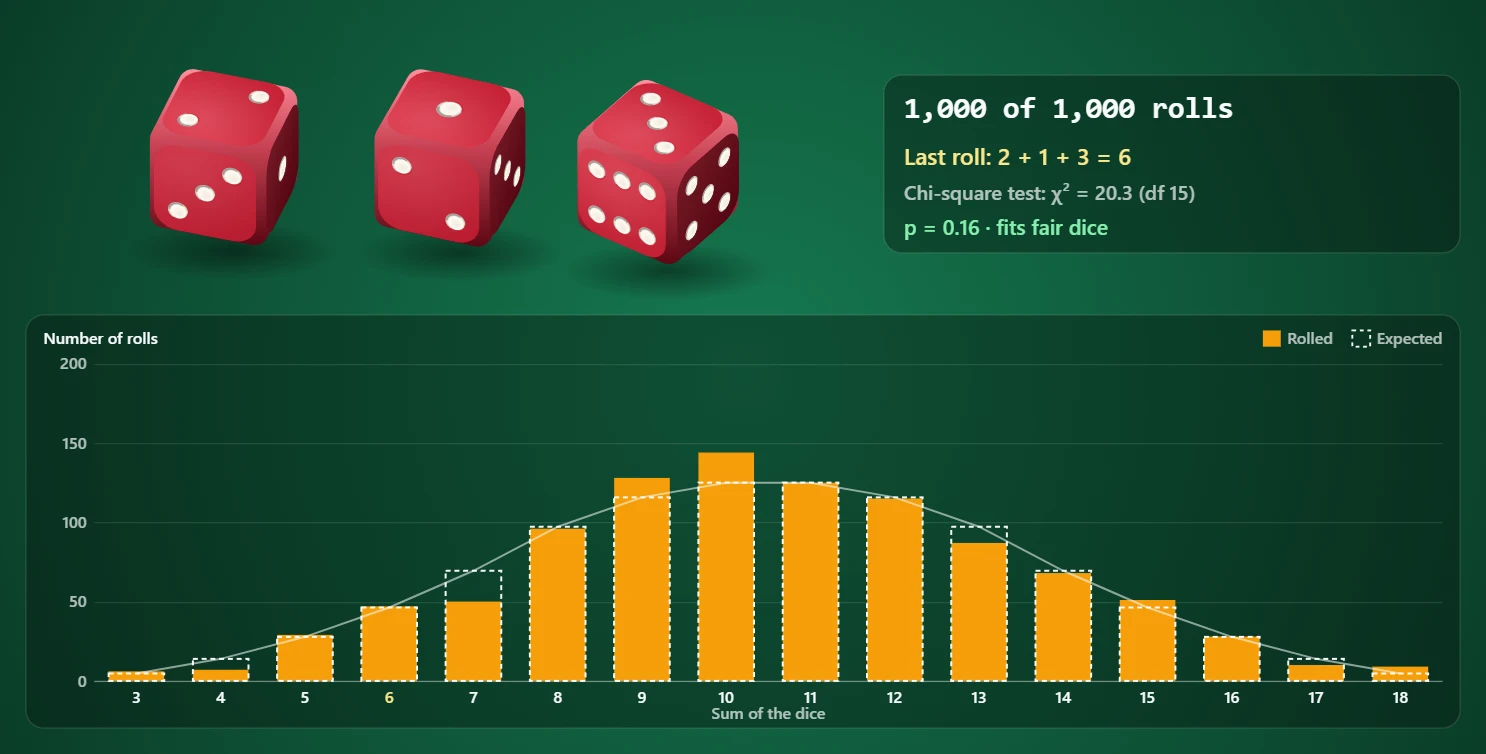
Roll one, two or three dice a thousand times and compare the bar chart of how often each result came up with the expected frequencies. See why 7 is the most common sum.
Dice probability
Dice probability explained: why each face has a chance of 1/6, how to count the ways to roll a sum, expected versus observed frequencies, the bell curve of many dice, and the chi-square test for a fair die.
Monte Carlo π
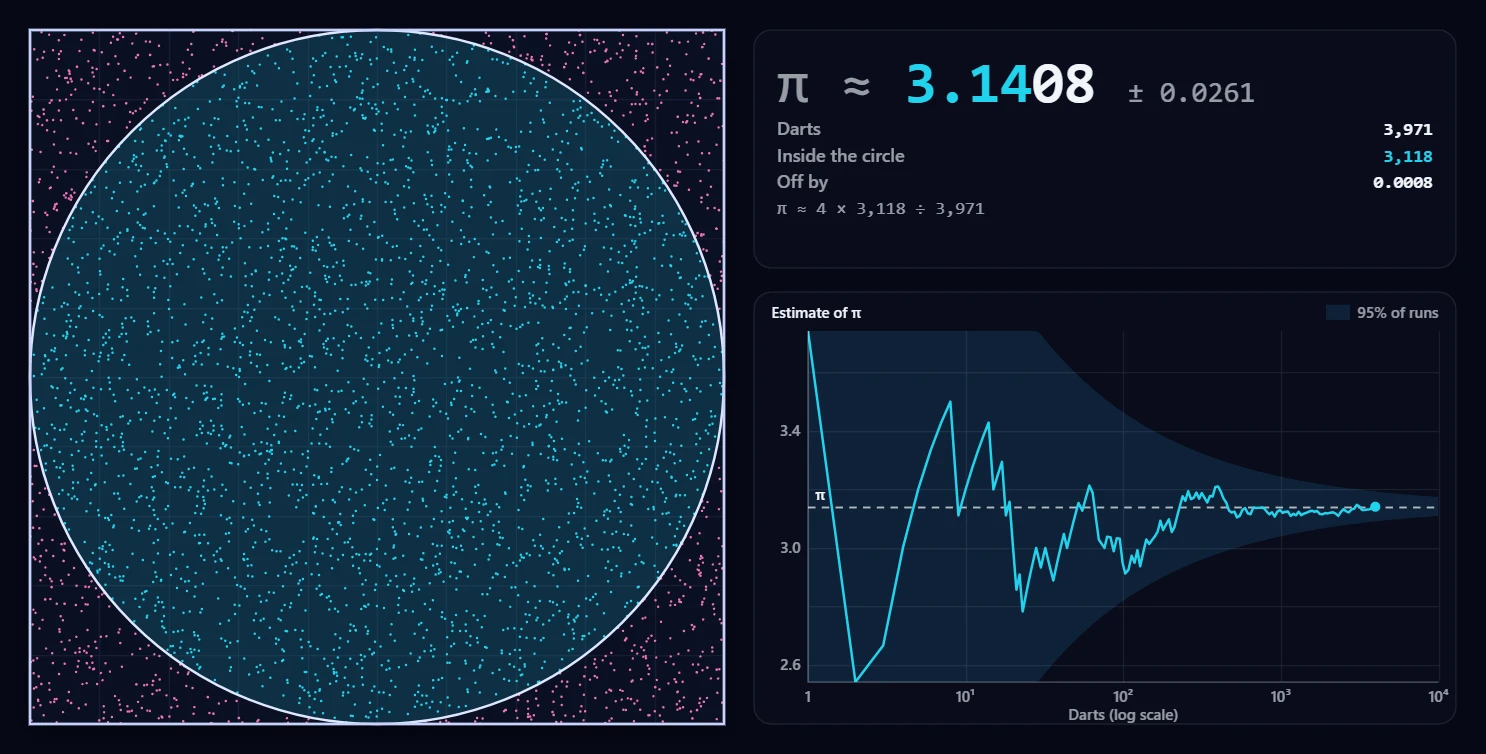
Throw thousands of random darts at a square with a circle in it and watch the share that lands inside turn into π. Start, stop, and follow the estimate as it converges.
Ready to try it?
Open PictorX in your browser — no install, no credit card required to start.
Try the Gambler's fallacy simulator