
Fractions, from Egyptian papyrus to lowest terms
A fraction describes a part of a whole: half a pizza, three quarters of an hour, 2/5 of a class. Fractions are older than decimals by thousands of years, and the simple trick of simplifying them with the greatest common divisor goes back to Euclid.
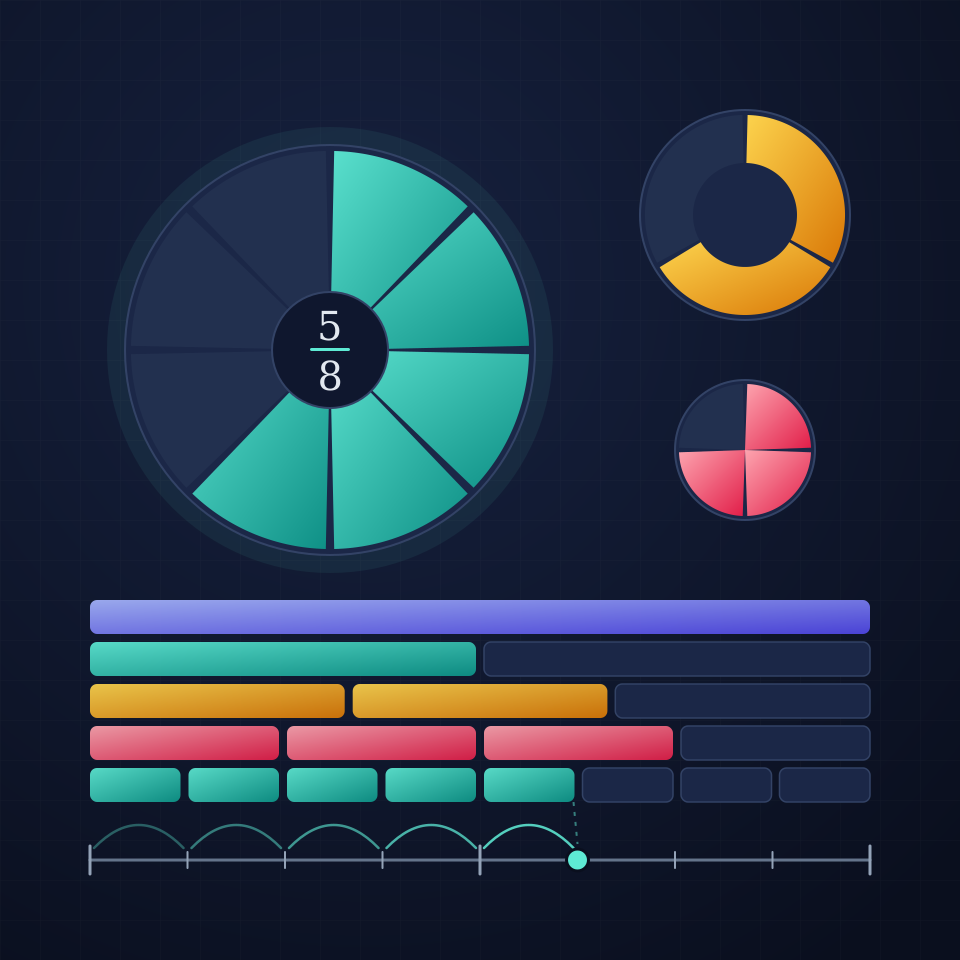
What is a fraction?
A fraction a/b has a numerator a on top and a denominator b underneath. The denominator says into how many equal parts the whole is split, the numerator how many of those parts you take. When the numerator is larger than the denominator, as in 7/4, the fraction is improper and can also be written as the mixed number 1 3/4. Many fractions describe the same amount: 1/2, 2/4 and 50/100 all mean one half.
Simplifying with the GCD
To bring a fraction to lowest terms, divide the numerator and the denominator by their greatest common divisor. For 18/24 the GCD is 6, so 18/24 = 3/4. The GCD is found quickly with Euclid's algorithm from around 300 BC: keep replacing the larger number by the remainder after dividing by the smaller one. 24 and 18 give remainder 6, then 18 and 6 give remainder 0, so the GCD is 6.
Egyptian fractions
Scribes in ancient Egypt wrote almost every fraction as a sum of different unit fractions, fractions with numerator 1, with 2/3 as a special exception. The Rhind Mathematical Papyrus, copied around 1550 BC, opens with a table that splits 2/n into such sums, for example 2/5 = 1/3 + 1/15. The system survived for centuries: in 1202 Fibonacci described a simple greedy method that always works, taking the largest unit fraction that still fits each time.
Frequently asked questions
Why can the denominator not be 0?
A fraction a/b is the number that gives a when multiplied by b. With b = 0 every product is 0, so no number works for a non-zero a, and every number works for 0/0. Either way there is no single answer, so division by zero is left undefined.
How do you divide fractions?
Multiply by the reciprocal of the second fraction, which is the same fraction turned upside down. So 3/4 divided by 2/5 equals 3/4 x 5/2 = 15/8, or 1 7/8 as a mixed number.
What are equivalent fractions?
Fractions that describe the same amount, such as 2/3, 4/6 and 10/15. You get one from another by multiplying or dividing the numerator and denominator by the same non-zero number. The simplified fraction is the one with the smallest possible numbers.
Related tools
Fraction calculator
A free online fraction calculator: add, subtract, multiply, divide, simplify and compare fractions and mixed numbers, with the steps explained and a picture.
Calculator
A free online calculator with a basic and a scientific mode: trigonometry, logarithms, powers, roots, factorials, memory and history, with the correct order of operations.
Matrix calculator
A free online matrix calculator: add, subtract, multiply, transpose and invert matrices up to 6x6, with determinant, rank, powers and exact fractions.
Statistics calculator
A free online statistics calculator: paste numbers and get the mean, median, mode, variance, standard deviation, quartiles and a histogram instantly.
Ready to try it?
Open PictorX in your browser — no install, no credit card required to start.
Open the Fraction calculator