
Compound interest, from Fibonacci to the number e
Compound interest means you earn interest not only on what you saved, but also on interest you already received. Here is how it differs from simple interest, how the standard formula works, a quick rule for doubling time, and the mathematicians who worked it all out.
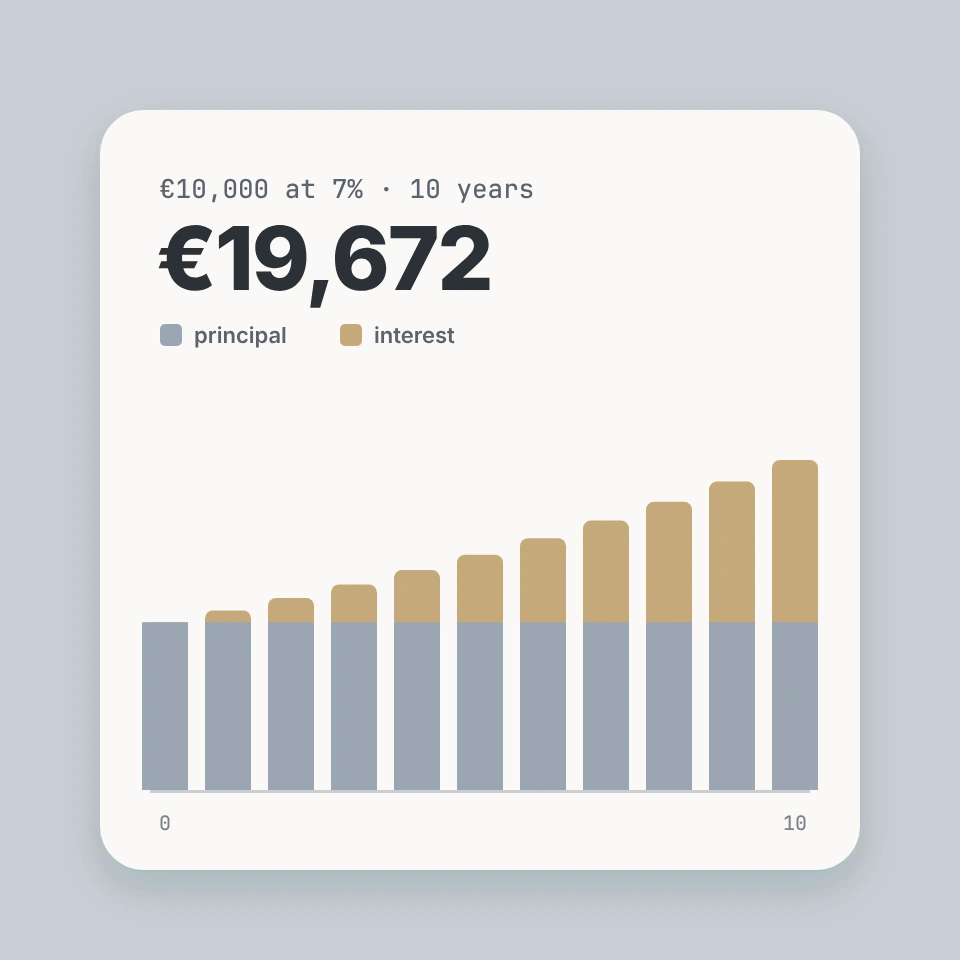
Simple and compound interest
With simple interest you are paid only on the original amount. Put 1,000 away at 5% and you receive 50 every year, so after 20 years you have 2,000. With compound interest each year's interest is added to the balance and earns interest too: the first year still gives 50, but the second gives 52.50, and after 20 years the balance is about 2,653. The difference starts small and becomes large, because the growth is exponential instead of linear. The same mechanism works against you on debt such as credit cards, where unpaid interest is added to what you owe.
The formula A = P(1 + r/n)^(nt)
A is the final amount, P the starting amount, r the annual rate as a decimal (5% is 0.05), n the number of times interest is added per year and t the number of years. Example: 1,000 at 5% compounded monthly for 10 years gives 1,000 × (1 + 0.05/12)^120 ≈ 1,647. Compounding yearly gives 1,629, so more frequent compounding helps, but by less and less. If n grows without limit you get continuous compounding, A = Pe^(rt), which here gives about 1,649. Regular contributions are handled by adding each deposit and letting it grow for the remaining time, which is what the calculator does month by month.
The rule of 72
To estimate how long money takes to double, divide 72 by the annual rate in percent. At 6% that is 72 / 6 = 12 years; the exact answer is 11.9. At 3% it is about 24 years, at 9% about 8. The rule works well between roughly 4% and 12%; for continuous compounding 69.3 is more accurate, and some people use 70 for low rates. It also works backwards: to double in 10 years you need about 7.2% a year. The same trick shows how quickly inflation halves purchasing power: at 3% inflation, prices double in about 24 years. The rule was already described by Luca Pacioli in 1494.
History - from Fibonacci to Bernoulli and e
Interest on loans appears on Babylonian clay tablets about 4,000 years ago, and some already ask how long it takes for a debt to double. In 1202 Leonardo of Pisa, known as Fibonacci, included worked problems on interest and compound growth in his Liber Abaci, the book that also brought Hindu-Arabic numerals to European merchants. In 1683 Jacob Bernoulli asked what happens if interest of 100% a year is added ever more often: twice a year gives 2.25, monthly 2.613, daily 2.7146. He saw that (1 + 1/n)^n approaches a fixed limit between 2 and 3. Leonhard Euler later named it e, showed that it is about 2.71828, and made it central to mathematics, from continuous compounding to natural growth and decay.
Frequently asked questions
Does compounding more often make a big difference?
Less than most people expect. At 5% a year, yearly compounding gives an effective 5.00%, monthly 5.12% and continuous 5.13%. The rate itself, the time and the amount you add matter far more.
Why does starting early matter so much?
Because most of the growth happens at the end. At 7%, money doubles roughly every 10 years, so 40 years gives about 16 times the original amount while 30 years gives only 8 times. Ten extra years at the start can be worth more than decades of extra saving later.
Why is e linked to interest?
Because it was discovered through interest. If 1 grows at 100% a year and the interest is added infinitely often, the result after one year is exactly e, about 2.718. That is why continuous compounding uses e^(rt).
Related tools
Compound interest calculator
A free compound interest calculator with a clear growth chart: starting amount, monthly or yearly contributions, compounding frequency, inflation, a year-by-year table and CSV export.
Currency converter
A free online currency converter with live exchange rates: convert euros, pounds, dollars, yen and more than 150 other currencies, with favourites and an offline fallback.
VAT calculator
A free online VAT calculator: add or remove VAT with rates for the Netherlands, Belgium, Germany, France, the UK and more, and print a simple invoice overview.
Calculator
A free online calculator with a basic and a scientific mode: trigonometry, logarithms, powers, roots, factorials, memory and history, with the correct order of operations.
Ready to try it?
Open PictorX in your browser — no install, no credit card required to start.
Open the Compound interest calculator