
The Collatz Conjecture
The Collatz Conjecture, also called the 3n+1 problem, is one of the best-known unsolved riddles in mathematics. The rules are simple enough for a child. A general proof has eluded the world's best mathematicians.

The rules
Choose any positive integer n and apply two rules again and again. If the number is even, divide it by 2. If the number is odd, multiply it by 3 and add 1. The conjecture says that every starting value eventually reaches 1. At 1 you fall into an infinite loop: 1 → 4 → 2 → 1.
An example: start at 6
6 is even, so 6/2 = 3. 3 is odd, so 3×3+1 = 10. Then 10 → 5 → 16 → 8 → 4 → 2 → 1. The values shoot up and down before they collapse, which is why these sequences are also called hailstone numbers.
Why it is so hard
Computers have checked every integer far past 2×10²¹, and each one ends at 1. A watertight proof is still missing. Paul Erdős once said that mathematics is simply not ready for this kind of problem. In 2019 Terence Tao proved that the conjecture holds for almost all numbers — a major breakthrough that still leaves the absolute case open. A Japanese company has offered a prize of 120 million yen (about €750,000) for a definitive solution.
Method 1: the geometric tree
Instead of plotting n against step count, treat the sequence as navigation on the plane. Each point has a position (x, y) and a heading θ. A step of length L moves x' = x + L cos θ and y' = y + L sin θ, and L shrinks as the numbers grow, in proportion to n / (1 + n^1.3), so high climbs curl up into fronds. The next heading depends on parity: even numbers turn by a small angle α, odd numbers turn the other way by β. Designers often choose α ≠ β — for example α = 0.15 and β = 0.28 — because a typical sequence has more even steps than odd ones, and the imbalance gives the coral its organic curl. Grow many sequences from 1, or walk backwards from the trunk at 1 toward the leaves.
Method 2: the complex Collatz fractal
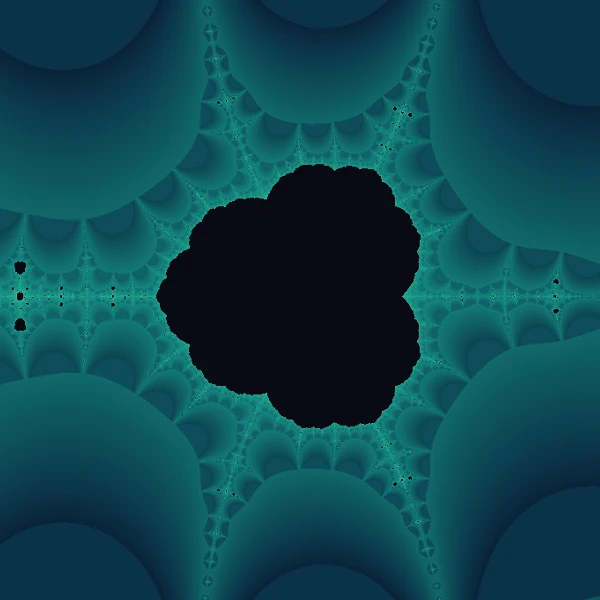
The usual Collatz map is discrete. To paint a Mandelbrot-style fractal you need a smooth function on the whole complex plane. A trigonometric switch does that: f(z) = (z/2) cos²(πz/2) + (3z+1) sin²(πz/2) On an even integer, cos² = 1 and sin² = 0, so f reduces to z/2. On an odd integer the weights swap and f reduces to 3z+1. Sine and cosine are defined between the integers as well, so every pixel z0 = x + yi can be iterated. Colour records how many steps it takes for |z| to escape a radius R. The infinitely detailed boundary between escape and capture is the fractal.
Explore it in PictorX
Open Collatz Conjecture to grow hailstone corals, walk a single sequence, or zoom the continuous fractal in your browser. Tune the turn angles, pick a starting number, change the palette, and save a PNG. Pair it with Fractal Generator or Lorenz Attractor for more mathematical play.
Frequently asked questions
Who stated the Collatz Conjecture?
Lothar Collatz circulated the 3n+1 problem in the 1930s. It is also called the Ulam conjecture, the Kakutani problem, and the hailstone problem.
Is every number known to reach 1?
Every integer that has been checked does, including values far above 2×10²¹. That is strong evidence, not a proof that every integer does.
What did Terence Tao prove?
In 2019 he showed that almost all starting values eventually become smaller than any given function that goes to infinity, however slowly. That is close to the conjecture, but it still allows exceptional numbers.
How is the Collatz fractal built?
A trigonometric formula agrees with n/2 and 3n+1 on the integers and stays smooth everywhere else. Iterating it on complex starting points and colouring by escape time produces the fractal.
Related tools
The Collatz Conjecture
Explore the Collatz 3n+1 problem in your browser. Walk hailstone sequences, grow a geometric Collatz tree, and zoom the continuous Collatz fractal.

Langton's Ant
Run Langton's Ant in your browser. Watch symmetry, chaos and the 104-step highway, then try multi-colour rules, several ants, a hex grid and turmites.
Explore the wonderful world of Fractals
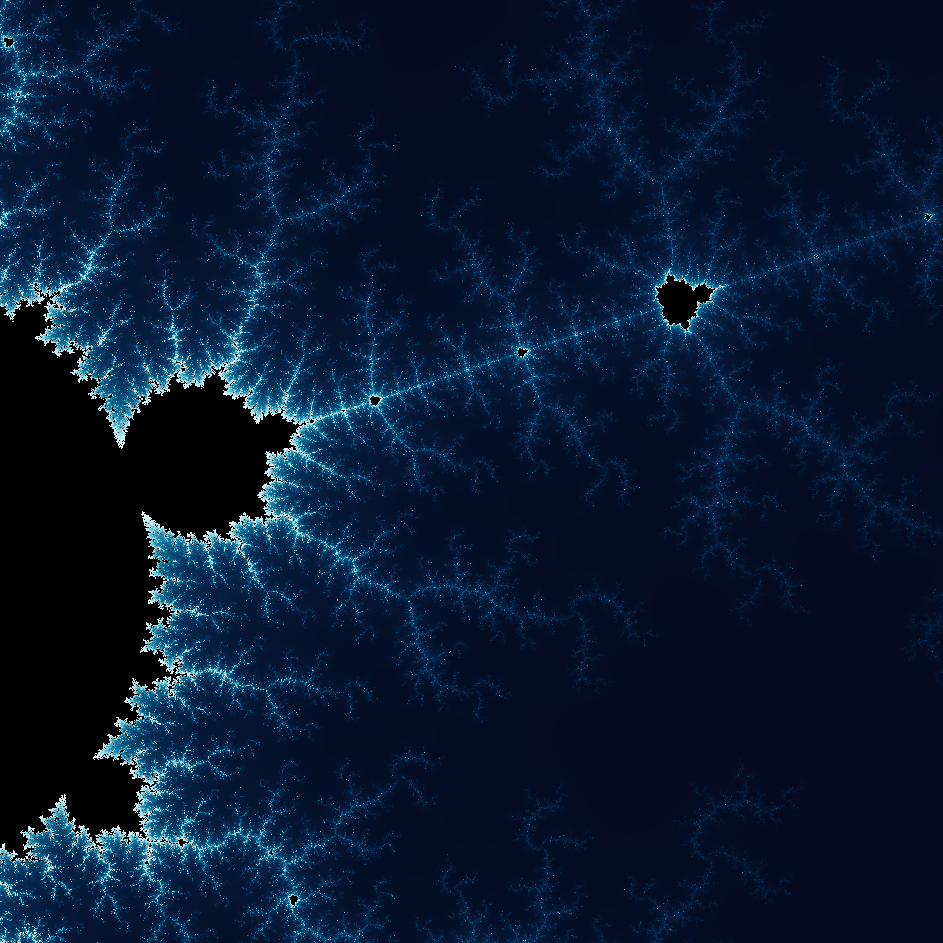
Explore the wonderful world of Fractals. Fractals are complex, detailed geometric patterns found throughout the natural world.
Fractals
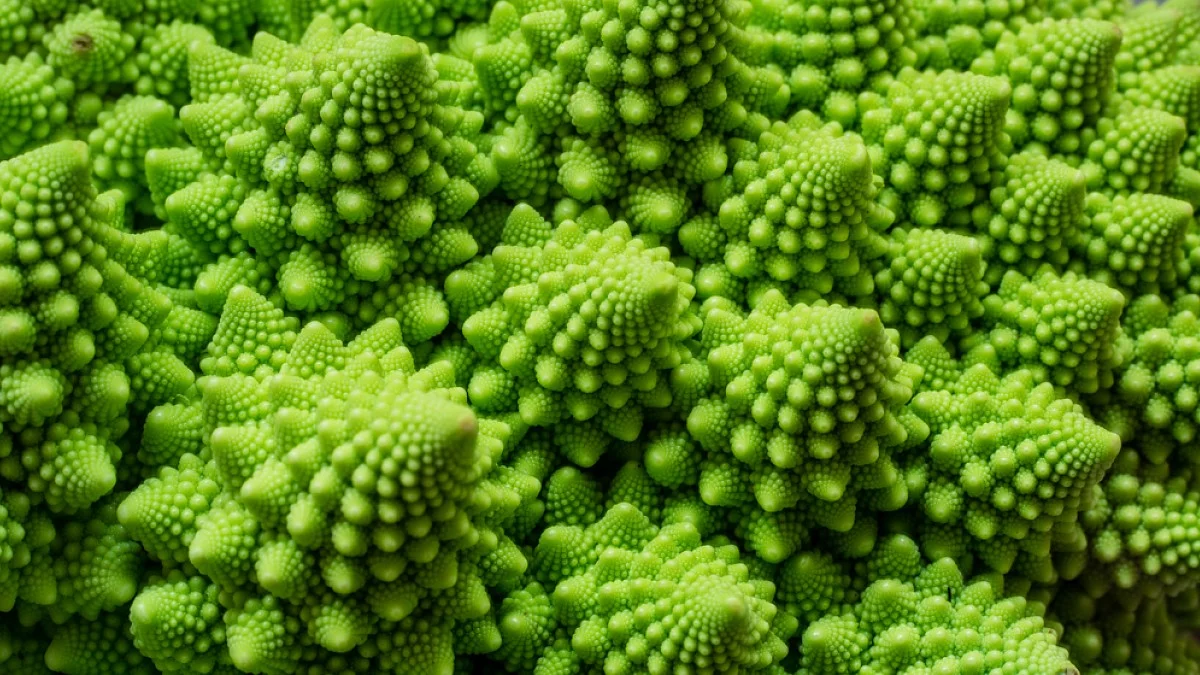
Learn how the Mandelbrot set, Julia sets, Newton fractals, and Nova fractals are generated—and why zooming never runs out of detail.
Lorenz Attractor
Interactive Lorenz attractor: tune a, b, f, rotate in 3D, try neon/ink/smoke looks, and save a PNG.
The Lorenz Attractor
How Edward Lorenz's weather equations revealed chaos theory: the butterfly attractor, sensitive dependence on initial conditions, and why long-term forecasts fail.
Ready to try it?
Open PictorX in your browser — no install, no credit card required to start.
Try Collatz Conjecture