
How mortgage repayment works
Every loan is repaid from two parts: interest on what you still owe, and principal that brings the debt down. How those two are split each month depends on the repayment type. Here is how annuity, linear and interest-only compare, how the annuity payment is calculated, and why the term and the rate matter so much.
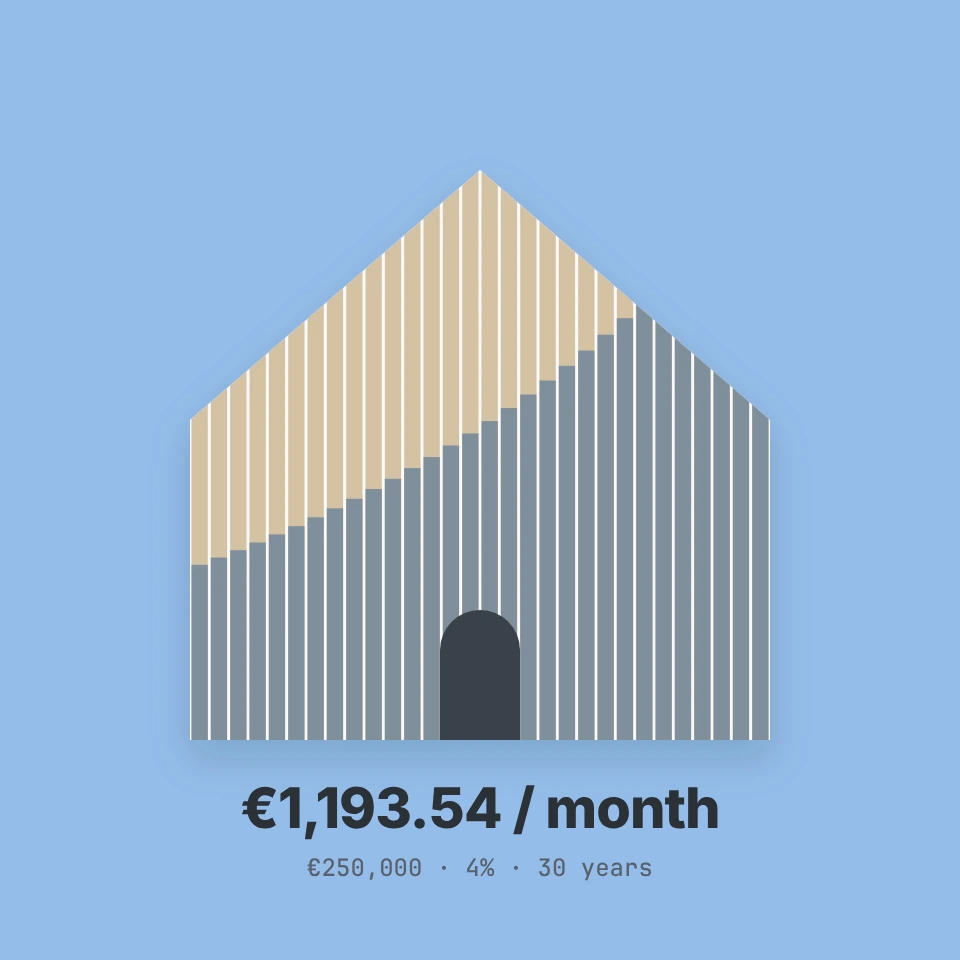
Annuity, linear and interest-only
With an annuity you pay the same amount every month. At the start most of it is interest, and as the balance falls the principal part grows. With linear repayment you repay the same principal every month, so the payment starts high and falls steadily, and the total interest is lower. With interest-only you pay just the interest, the balance never falls, and the whole loan is repaid in one go at the end, which makes it the most expensive option over the full term.
The annuity formula
The fixed monthly payment is M = P·r / (1 − (1 + r)^−n), where P is the loan, r the monthly rate (the yearly rate divided by 12) and n the number of months. Example: 200,000 at 4% for 30 years gives r = 0.04 / 12 ≈ 0.00333 and n = 360, so M ≈ 954.83 a month. Over 360 months you pay about 343,739, of which about 143,739 is interest. If the rate is 0%, the formula reduces to P / n.
The effect of the term
A longer term lowers the monthly payment but raises the total interest, because you owe the money for longer. Using the same 200,000 at 4%: over 30 years the payment is about 954.83 and the interest about 143,739, while over 20 years the payment rises to about 1,211.96 and the interest falls to about 90,871. Ten years shorter costs about 257 more a month but saves almost 53,000 in interest.
The effect of the interest rate
Small changes in the rate have a large effect over a long term. For 200,000 over 30 years, 3% gives a payment of about 843.21 and about 103,555 interest, 4% gives about 954.83 and 143,739, and 5% gives about 1,073.64 and 186,512. Each extra percentage point adds roughly 110 to 120 a month and more than 40,000 in interest, which is why fixing a rate or paying extra early can matter so much.
Frequently asked questions
Why is an early annuity payment mostly interest?
Interest is charged on the balance, and the balance is highest at the start. Because the payment stays the same, less is left for principal in the early months. As the balance falls, the interest part shrinks and the principal part grows.
When is interest-only used?
Mostly for short bridging loans, buy-to-let property, or when the loan will be repaid from savings, an investment or a sale. The monthly payment is low, but the balance stays the same, so you need a reliable plan to repay the full amount at the end.
Why might my lender's figures differ?
Lenders may count interest by day instead of by month, round each payment, add fees or insurance, or change a variable rate over time. Tax rules also differ by country. Use this calculator to understand and compare options, and rely on your lender's offer for the exact amounts.
Related tools
Mortgage calculator
A free mortgage and loan calculator: monthly payment, total interest and payoff date for annuity, linear or interest-only repayment, with a chart, an amortisation table and CSV export.
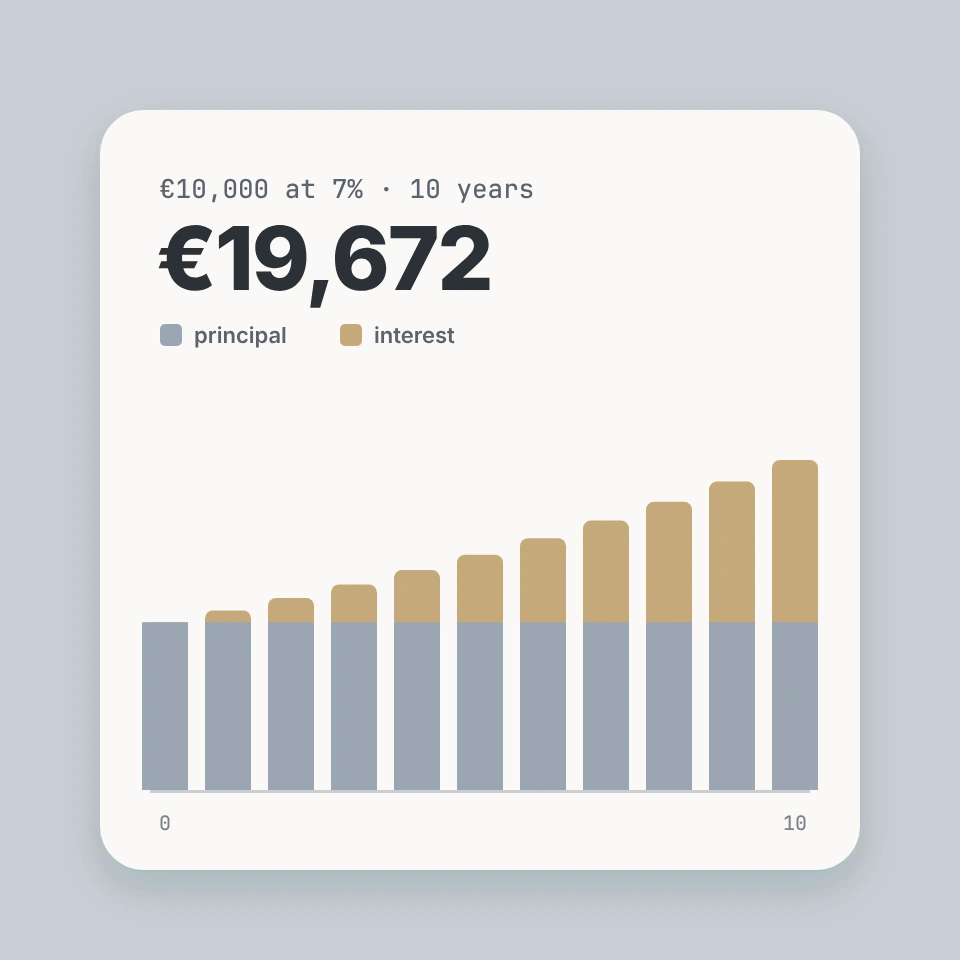
Compound interest calculator
A free compound interest calculator with a clear growth chart: starting amount, monthly or yearly contributions, compounding frequency, inflation, a year-by-year table and CSV export.
Currency converter
A free online currency converter with live exchange rates: convert euros, pounds, dollars, yen and more than 150 other currencies, with favourites and an offline fallback.
Calculator
A free online calculator with a basic and a scientific mode: trigonometry, logarithms, powers, roots, factorials, memory and history, with the correct order of operations.
Ready to try it?
Open PictorX in your browser — no install, no credit card required to start.
Open the Mortgage calculator