
Galton board
A Galton board is a board with rows of pegs and a row of bins at the bottom. Balls dropped in at the top bounce left or right at each peg. No single ball can be predicted, but a thousand of them always pile up into the same shape: a bell curve.
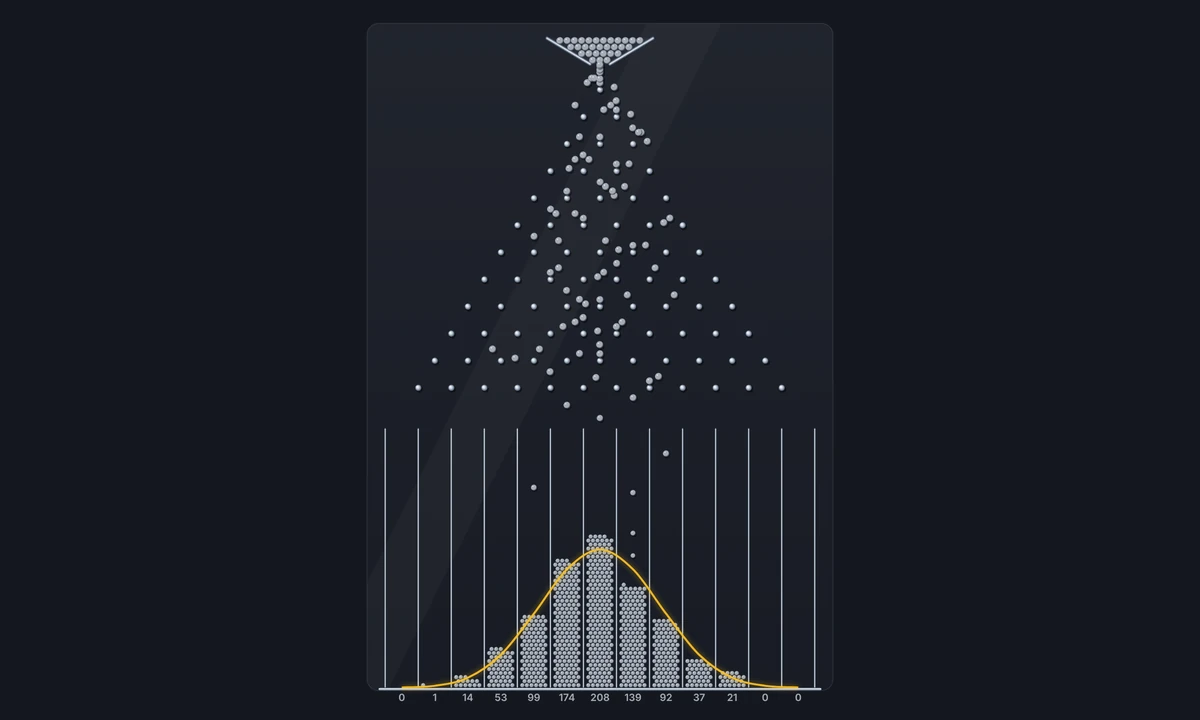
Francis Galton's machine
Francis Galton, a Victorian scientist with a passion for heredity and statistics, built the first board in the 1870s. He described it in his book Natural Inheritance in 1889. He called it a quincunx, after the pattern of five dots on a die, which the staggered pegs repeat.
One bounce at a time
At every peg a ball goes left or right with equal chance, like a coin toss. After n rows it has made n such choices. Its bin is the number of times it went right. The order does not matter: right then left ends in the same place as left then right.
Pascal's triangle counts the paths
Write 1 at the top peg. At every other peg, add the two numbers above it. That is Pascal's triangle, and each number counts the paths that reach that peg. The last row gives the paths into each bin. For 12 rows it runs 1, 12, 66, 220, 495, 792, 924 and back down.
The binomial distribution
Divide the paths into a bin by all 2ⁿ paths, and you have the chance of landing there. That is the binomial distribution. On a fair board the mean is n/2 and the standard deviation is √n/2. With a bias p the mean becomes n·p and the spread √(n·p·(1−p)).
From bins to a bell curve
As the rows increase, the bars of the binomial distribution trace out the smooth normal curve, the bell curve. Abraham de Moivre showed this in 1733. It is a first case of the central limit theorem: add up many small, independent random steps, and the total follows a bell curve.
Why the bins are never exact
Each ball is random, so the bins scatter around their expected heights. A bin that should hold about N balls is usually off by about √N. Drop 100 balls and the shape is rough. Drop 5000 and it hugs the curve.
Galton and regression to the mean
Galton used the board in his work on heredity. He noticed that very tall parents tend to have children who are tall, but closer to the average. He called this regression to the mean, an idea now used all across statistics.
Try it in PictorX
Open the Galton board and the balls start falling at once. Rows sets the number of bounces, Balls how many fall, and Bias the chance of going right. The bell curve shows the expected heights, and the numbers under the bins count the balls. Turn on Pascal's triangle to see the paths, then save a PNG.
Frequently asked questions
Who invented the Galton board?
Francis Galton built it in the 1870s and described it in 1889 in his book Natural Inheritance.
What is the difference between the binomial and the normal distribution?
The binomial distribution counts the successes in a fixed number of yes-or-no trials, like the right bounces on a board. The normal distribution is the smooth bell curve it approaches when the number of trials is large.
Why is it called a quincunx?
A quincunx is the pattern of five dots on a die: four in the corners and one in the middle. The staggered rows of pegs repeat that pattern.
Does a real Galton board give a perfect bell curve?
Not quite. Real balls hit each other and can bounce more than one step at a time, which widens the bell a little. The bounces in this simulation are independent, as on an ideal board.
Related tools
Galton board
Drop balls through rows of pegs and watch a bell curve fill the bins. Change the rows, the bias, and the number of balls, and compare mean and spread with theory.
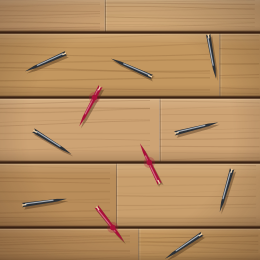
Buffon's Needle
Drop needles on a lined floor in your browser. Count the crossings and watch Buffon's 1777 experiment estimate π.
Buffon's Needle
Buffon's 1777 needle problem: why a needle dropped on parallel lines estimates π, how the short-needle chance 2l/(πd) comes from the area under a sine curve, and why the experiment converges slowly.
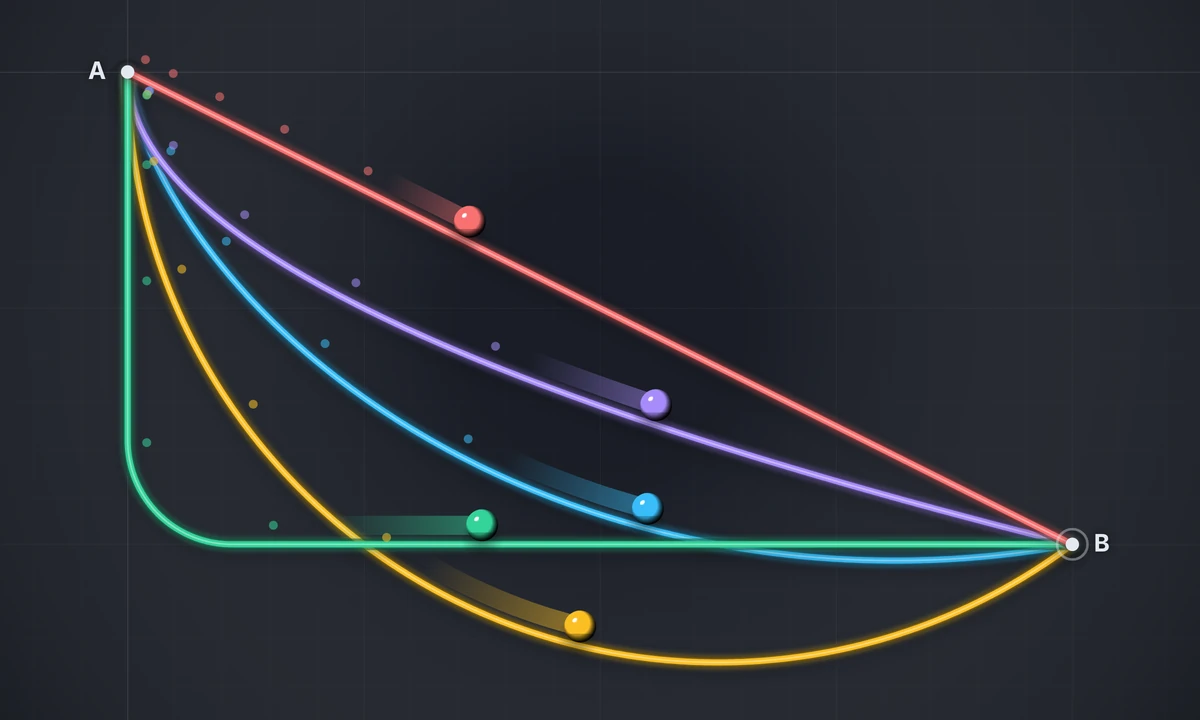
Brachistochrone race
Race balls from A to B on a straight ramp, a circle, a parabola, and a cycloid. The cycloid always wins, even when it dips below the finish. Draw your own track.
Brachistochrone
What the brachistochrone is: why the cycloid beats the straight line, how Bernoulli's 1696 challenge was solved, and why a cycloid bowl is also the tautochrone.
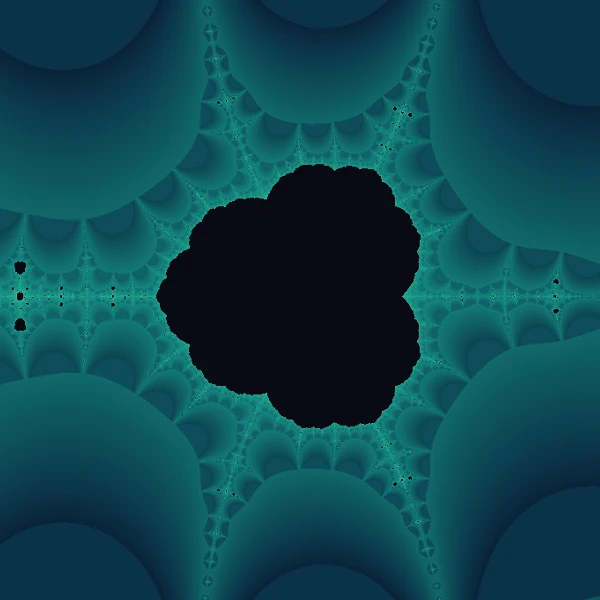
The Collatz Conjecture
Explore the Collatz 3n+1 problem in your browser. Walk hailstone sequences, grow a geometric Collatz tree, and zoom the continuous Collatz fractal.
Ready to try it?
Open PictorX in your browser — no install, no credit card required to start.
Try the Galton board