
How calculators work
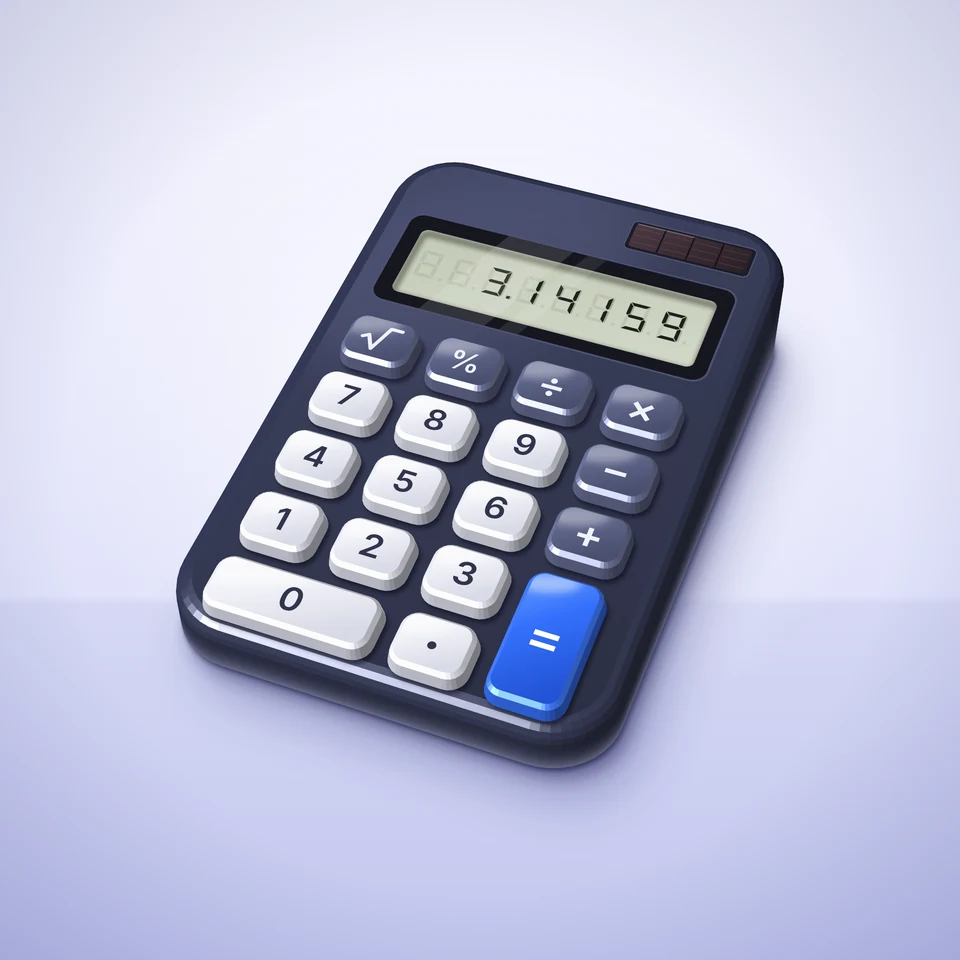
A calculator looks simple: you press some keys and an answer appears. Behind the display, though, lies a clever chain of steps, and a history of counting tools that goes back thousands of years.
From key press to answer
Every key press becomes a token: a number, an operator, a bracket or a function. When you press =, the calculator reads the tokens in order, works out which operations must come first and then calculates the answer step by step. Inside the chip, numbers are stored in binary, which is why some decimals, such as 0.1, can only be stored approximately.
Order of operations
Mathematicians agree on a fixed order so that a sum means the same to everyone: brackets first, then powers and roots, then multiplication and division, and finally addition and subtraction. In English this is often remembered as BODMAS or PEMDAS. That is why 2 + 3 × 4 is 14: the multiplication comes before the addition. Simple calculators that work strictly from left to right give 20 instead.
Scientific functions
Functions such as sin, ln and √ are not stored in a giant table. The calculator works them out with series and clever algorithms that add up small steps until the answer is accurate enough. Many pocket calculators use a method called CORDIC, which needs only additions, subtractions and shifts of digits.
From abacus to slide rule
The abacus, with beads on rods or counters on lines, was used in Mesopotamia, China and Rome for thousands of years. In 1617 John Napier described his calculating rods, and his logarithms soon made the slide rule possible, which engineers used until the 1970s. In 1642 Blaise Pascal built the Pascaline, a machine with gears that could add and subtract.
The pocket calculator
Mechanical calculators filled offices in the nineteenth and early twentieth centuries. In the 1960s the first electronic desktop calculators appeared, and in the early 1970s chips became small and cheap enough for calculators that fit in a pocket. In 1972 the HP-35 became the first scientific pocket calculator, and within a few years the slide rule had all but disappeared.
Frequently asked questions
Why does 0.1 + 0.2 sometimes give 0.30000000000000004?
Computers store numbers in binary, and 0.1 cannot be written exactly in binary. The tiny error shows up far behind the decimal point. This calculator rounds to 12 significant digits, so you see 0.3.
Why do some calculators give 20 for 2 + 3 × 4?
Simple calculators work out each step as soon as you press the next operator, from left to right. Scientific calculators, including this one, follow the order of operations and give 14.
What is the factorial of a number?
The factorial n! is the product of all whole numbers from 1 to n, so 5! = 1 × 2 × 3 × 4 × 5 = 120. By definition 0! = 1.
Related tools
Calculator
A free online calculator with a basic and a scientific mode: trigonometry, logarithms, powers, roots, factorials, memory and history, with the correct order of operations.

The Fibonacci sequence
Each Fibonacci number is the sum of the two before it. Watch the squares spiral, the ratios settle on the golden ratio, and Binet's formula rebuild the same numbers.

The Collatz Conjecture
Explore the Collatz 3n+1 problem in your browser. Walk hailstone sequences, grow a geometric Collatz tree, and zoom the continuous Collatz fractal.
Monte Carlo π
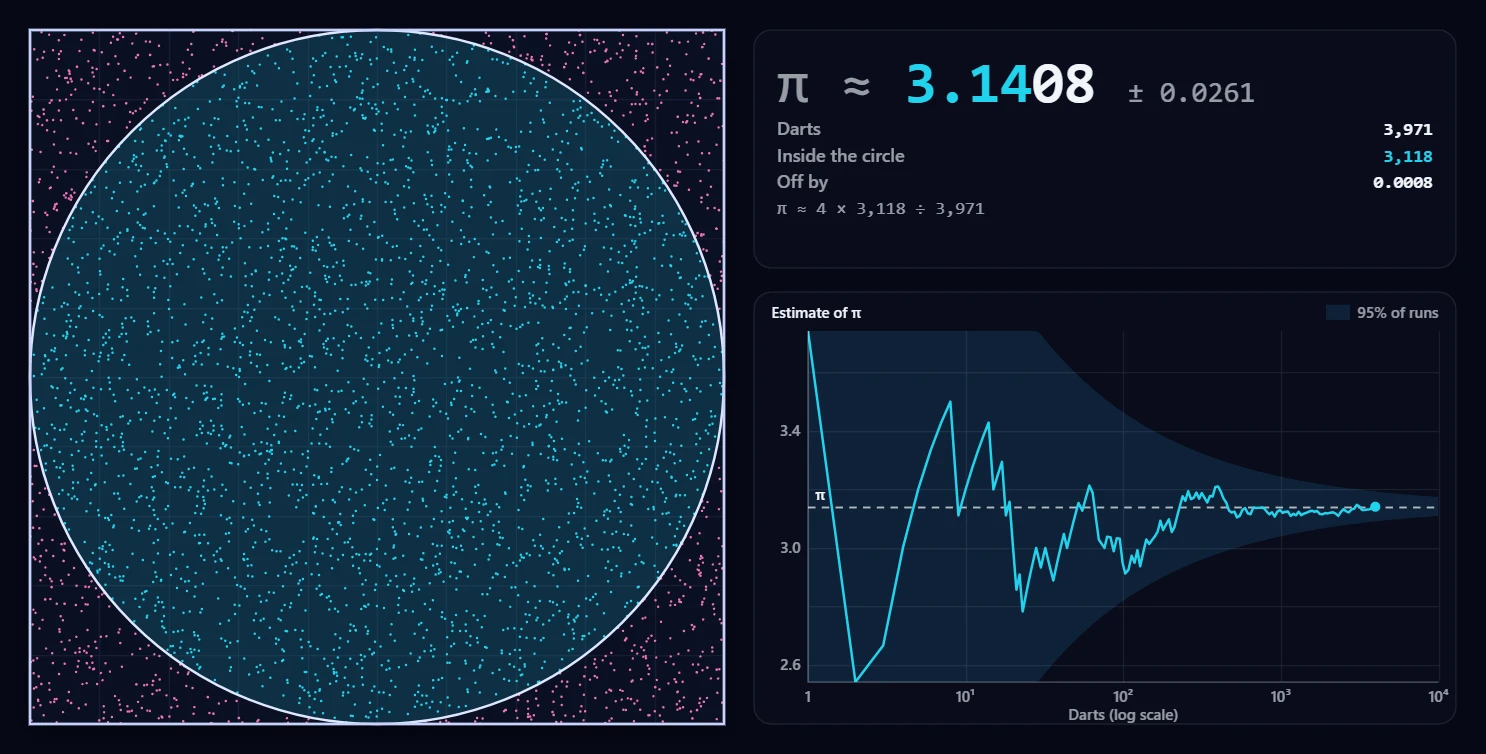
Throw thousands of random darts at a square with a circle in it and watch the share that lands inside turn into π. Start, stop, and follow the estimate as it converges.
Sieve of Eratosthenes
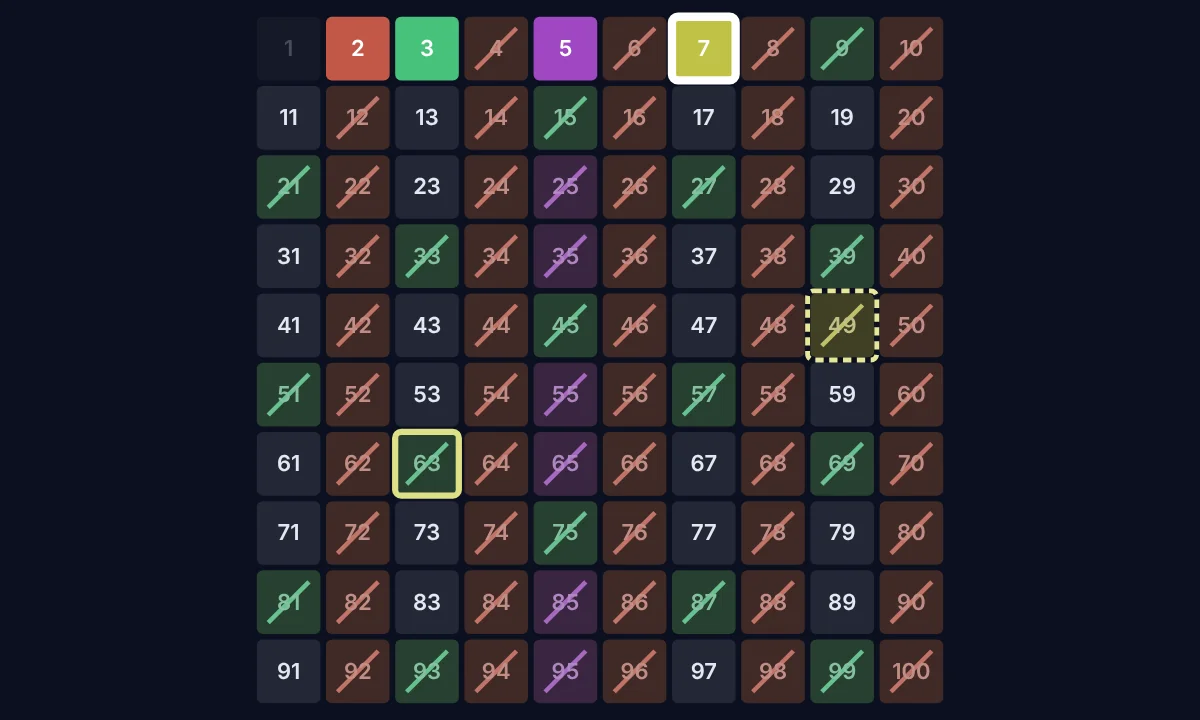
Watch the Sieve of Eratosthenes find the prime numbers up to 100, 200, 500 or 1000. Each prime crosses out its multiples in its own colour, step by step.
Ready to try it?
Open PictorX in your browser — no install, no credit card required to start.
Try the Calculator