
The Fibonacci sequence
Start with 0 and 1. Every next Fibonacci number is the sum of the two before it: 0, 1, 1, 2, 3, 5, 8, 13, 21, … Divide one term by the previous one and the quotients close in on the golden ratio, about 1.618. That is not a coincidence. The equation φ² = φ + 1 is the same rule as Fₙ = Fₙ₋₁ + Fₙ₋₂. PictorX draws the spiral, the ratios, Binet's formula, and a sunflower grown at the golden angle. Grow the squares into a spiral, chase the golden ratio, or compare Binet's formula.
How it works
- Open this page and watch the squares grow into a golden spiral.
- Switch to Ratios to see the quotients oscillate toward φ, or to Binet to compare the closed form.
- Open the sunflower, try Lucas numbers, then save a PNG or continue in the PictorX editor.
A rule with two memories
F₀ = 0 and F₁ = 1. For every later index, Fₙ = Fₙ₋₁ + Fₙ₋₂. The list is then fixed: 0, 1, 1, 2, 3, 5, 8, 13, 21, 34, 55, 89, … The squares in the spiral have those side lengths, so each new square fits the long side of the rectangle built so far.
Why the quotients find φ
The ratios 1/1, 2/1, 3/2, 5/3, 8/5, 13/8, 21/13 swing above and below a number near 1.618, and the swing shrinks. If they settle on a limit r, the recurrence divided by the previous term becomes r = 1 + 1/r. That is r² − r − 1 = 0. The positive root is the golden ratio φ = (1 + √5) / 2.
The same equation, then Binet
A pure geometric guess Fₙ = λⁿ turns the recurrence into λ² = λ + 1. The roots are φ and ψ = (1 − √5) / 2. Binet's formula mixes them, Fₙ = (φⁿ − ψⁿ) / √5. Because |ψ| < 1, the second power fades, and Fₙ is the integer nearest to φⁿ / √5. Lucas numbers 2, 1, 3, 4, 7, 11, … obey the same rule, so their ratios approach φ as well.
Frequently asked questions
What is the Fibonacci sequence?
The sequence with F₀ = 0, F₁ = 1, and Fₙ = Fₙ₋₁ + Fₙ₋₂. It begins 0, 1, 1, 2, 3, 5, 8, 13, 21, 34, …
Why does the ratio approach the golden ratio?
If the quotients settle, the recurrence forces that limit r to satisfy r = 1 + 1/r, so r² − r − 1 = 0. The positive solution is φ = (1 + √5) / 2.
What is Binet's formula?
Fₙ = (φⁿ − ψⁿ) / √5, where ψ = (1 − √5) / 2. The ψ term shrinks, so Fₙ is the integer closest to φⁿ / √5.
What is the golden angle?
One full turn divided by φ², about 137.5°. Seeds placed at that angle, with radius growing like the square root of the count, draw the spirals of a sunflower. The visible spiral counts are Fibonacci numbers.
Does the math run in my browser?
Yes. The sequence, the spiral, the ratios, and the seeds are computed on your device. Save a PNG or open the canvas in the PictorX editor.
Related tools
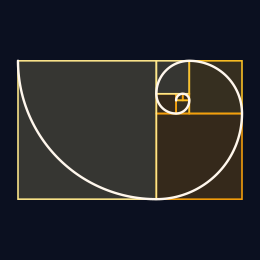
The Fibonacci sequence
Why consecutive Fibonacci numbers approach the golden ratio, how that limit falls out of the recurrence, and how Binet's formula rebuilds each term from φ.

Recamán's sequence
Start at 0. Each step hops backward by n when that spot is positive and new, and jumps forward otherwise. Watch the semicircles, the missing numbers, and a melody from the same hops.

The Collatz Conjecture
Explore the Collatz 3n+1 problem in your browser. Walk hailstone sequences, grow a geometric Collatz tree, and zoom the continuous Collatz fractal.
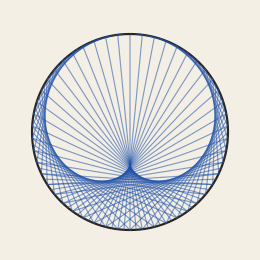
Multiplication Circles
Join each number on a circle to its multiple. Draw a times table, a cardioid, or a string figure on paper, chalk, or wood.
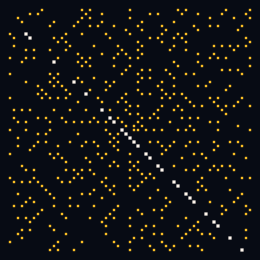
Ulam spiral
Draw the Ulam spiral in your browser. Mark the primes, read the quadratic on each diagonal, and open Euler's unbroken run of 40 primes.

Buffon's Needle
Drop needles on a lined floor in your browser. Count the crossings and watch Buffon's 1777 experiment estimate π.

Langton's Ant
Run Langton's Ant in your browser. Watch symmetry, chaos and the 104-step highway, then try multi-colour rules, several ants, a hex grid and turmites.
Ready to try it?
Open PictorX in your browser — no install, no credit card required to start.
Go to Editor