
The Fibonacci sequence
The Fibonacci sequence is the list of numbers in which each term is the sum of the two before it. The same rule forces the ratio of consecutive terms toward the golden ratio, and it is the reason Binet's formula works.
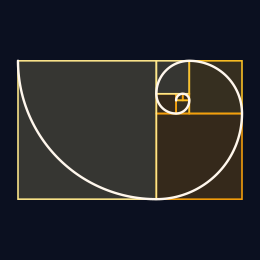
Two numbers and a sum
The sequence usually starts at F₀ = 0 and F₁ = 1. For every n at least 2, Fₙ = Fₙ₋₁ + Fₙ₋₂. Nothing else is involved: no extra factor, and no test for even or odd. From those two seeds the list is completely determined: 0, 1, 1, 2, 3, 5, 8, 13, 21, 34, 55, 89, …
The first few terms
F₂ = 1 + 0 = 1. F₃ = 1 + 1 = 2. F₄ = 2 + 1 = 3. F₅ = 3 + 2 = 5. Each step only looks one place and two places back. The Lucas sequence uses the same addition with different seeds, 2 and 1, and runs 2, 1, 3, 4, 7, 11, 18, … The app can plot either sequence. The squares of the spiral use the Fibonacci sides 1, 1, 2, 3, 5, 8, … so each new square matches the long side of the rectangle already drawn.
Why the ratios approach one number
Write rₙ = Fₙ / Fₙ₋₁. The first quotients are 1/1 = 1, 2/1 = 2, 3/2 = 1.5, 5/3 ≈ 1.6667, 8/5 = 1.6, 13/8 = 1.625, 21/13 ≈ 1.6154. They swing above and below a value near 1.618, and the swing gets smaller. Suppose the quotients settle on a limit r. Then for large n, Fₙ / Fₙ₋₁ and Fₙ₋₁ / Fₙ₋₂ are both about r. Divide the recurrence by Fₙ₋₁: Fₙ / Fₙ₋₁ = 1 + Fₙ₋₂ / Fₙ₋₁. In the limit that is r = 1 + 1/r. Multiply through by r and the equation is r² = r + 1, or r² − r − 1 = 0. The quadratic formula gives r = (1 ± √5) / 2. The positive root is the golden ratio φ = (1 + √5) / 2 ≈ 1.6180339887.

The equation hidden in the rule
Look for solutions of the shape Fₙ = λⁿ. The recurrence becomes λⁿ = λⁿ⁻¹ + λⁿ⁻². Divide by λⁿ⁻² and you get λ² = λ + 1, the same equation as before. Its roots are φ = (1 + √5) / 2 and ψ = (1 − √5) / 2. ψ is about −0.618, so |ψ| < 1 and its powers shrink toward 0. Every sequence that obeys the Fibonacci rule is a mix of these two powers. The golden ratio is not an extra fact glued on afterwards. The equation φ² = φ + 1 is the recurrence written for a pure geometric sequence.
Binet's formula
The mix that starts at 0 and 1 is Binet's formula, Fₙ = (φⁿ − ψⁿ) / √5. Because |ψ| < 1, the second power soon becomes tiny, and Fₙ is almost φⁿ / √5. The missing piece is smaller than 1/2 for every n, so rounding φⁿ / √5 to the nearest integer gives the exact Fibonacci number. The app lists the exact term, the power of φ, and the shrinking error side by side.
A linear rule, unlike Collatz
Fibonacci numbers follow a linear recurrence: the next term is a fixed combination of the previous ones, and it does not matter whether they are even or odd. The Collatz sequence uses a nonlinear parity rule, n/2 or 3n+1, and nobody has proved that every start reaches 1. The Fibonacci rule is solved completely. Its closed form, its growth, and the golden-ratio limit all come from one quadratic equation. Change the two seeds, as the Lucas sequence does, and the limit is still φ, because the limit lives in the rule.
The golden angle
One full turn divided by φ² is about 137.5078°. Place seeds at that fixed angle, and let the radius grow like the square root of the seed's index, and the dots pack into spirals. The spirals you can count are consecutive Fibonacci numbers. That is the sunflower view in the app.
Explore it in PictorX
Open the Fibonacci sequence to grow the squares into a spiral, plot the ratios against φ, check Binet's formula, or scatter seeds at the golden angle. Switch to Lucas numbers and the ratios still approach φ. Drag to move, scroll to zoom, then save a PNG or open the canvas in the PictorX editor. Pair it with the Collatz Conjecture or Multiplication Circles for more pictures drawn from a short rule.
Frequently asked questions
What is the Fibonacci sequence?
The sequence defined by F₀ = 0, F₁ = 1, and Fₙ = Fₙ₋₁ + Fₙ₋₂. It begins 0, 1, 1, 2, 3, 5, 8, 13, 21, 34, 55, 89, …
Why does the ratio approach the golden ratio?
If the quotients of consecutive terms settle on a limit r, the recurrence forces r = 1 + 1/r, so r² − r − 1 = 0. The positive solution is φ = (1 + √5) / 2 ≈ 1.6180339887.
What is Binet's formula?
Fₙ = (φⁿ − ψⁿ) / √5, with ψ = (1 − √5) / 2. The power of ψ shrinks, so Fₙ is the integer closest to φⁿ / √5.
Do Lucas numbers do the same thing?
Yes. Lucas numbers start at 2 and 1 and then use the same sum. Their consecutive ratios also approach φ, because the limit comes from the recurrence, not from the two seeds.
Does the drawing leave my device?
No. The sequence, the spiral, the chart, and the seeds are computed in your browser. Save a PNG or open the canvas in the PictorX editor.
Related tools
The Fibonacci sequence
Each Fibonacci number is the sum of the two before it. Watch the squares spiral, the ratios settle on the golden ratio, and Binet's formula rebuild the same numbers.

The Collatz Conjecture
Explore the Collatz 3n+1 problem in your browser. Walk hailstone sequences, grow a geometric Collatz tree, and zoom the continuous Collatz fractal.

The Collatz Conjecture
The Collatz Conjecture is one of mathematics' most famous unsolved puzzles: simple even/odd rules, hailstone numbers, Erdős, Terence Tao, and two ways to see the data as geometry and a fractal.
Multiplication Circles
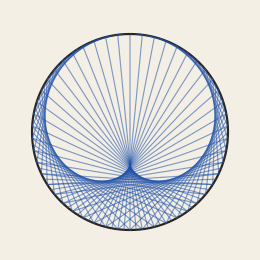
Join each number on a circle to its multiple. Draw a times table, a cardioid, or a string figure on paper, chalk, or wood.
Ulam spiral
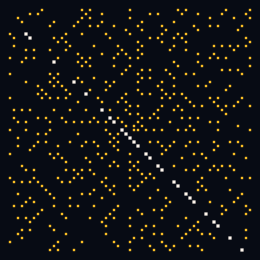
Draw the Ulam spiral in your browser. Mark the primes, read the quadratic on each diagonal, and open Euler's unbroken run of 40 primes.
The Ulam spiral
How Stanisław Ulam's 1963 spiral lays the integers on a square grid, why primes gather on quadratic diagonals, and where Euler's forty primes sit when the spiral starts at 41.
Ready to try it?
Open PictorX in your browser — no install, no credit card required to start.
Try the Fibonacci sequence