
The two envelopes paradox
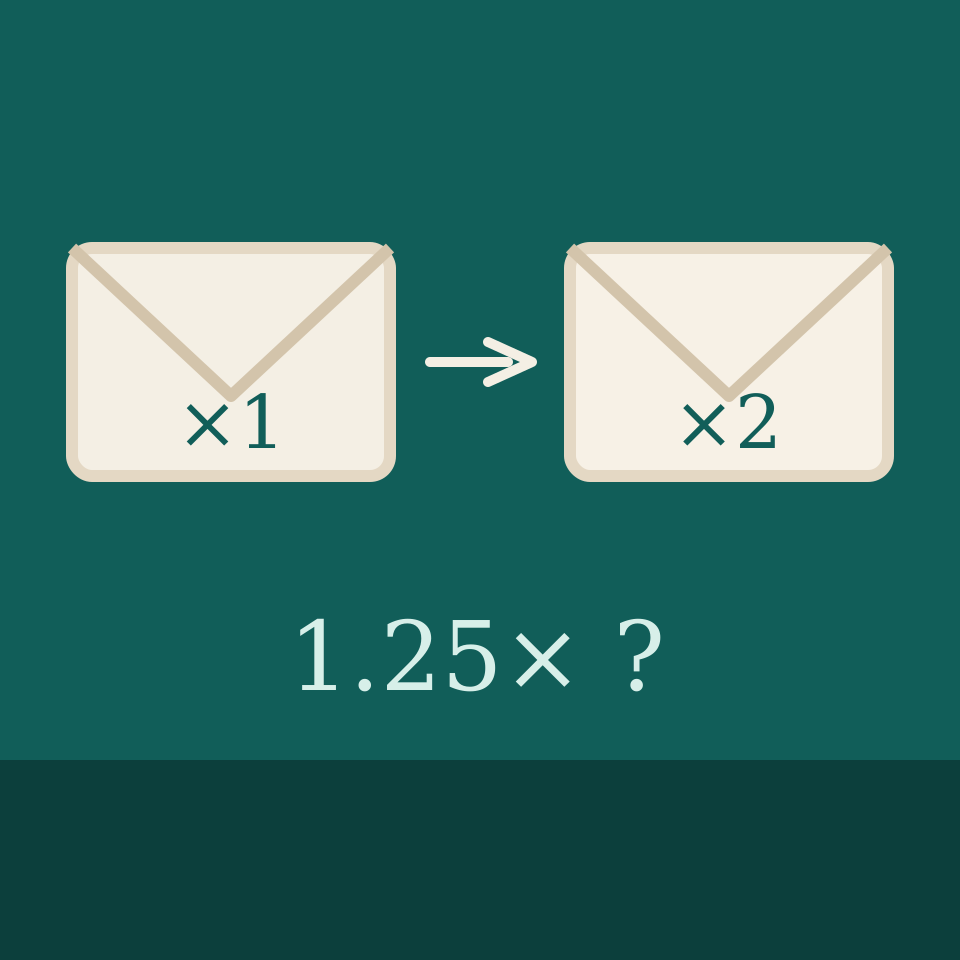
Two envelopes, one with twice as much as the other. You pick one. A short argument says the other is worth 1.25 times as much, so you should switch. The argument is wrong, and the reason is subtle.
The puzzle
You are given two envelopes. One contains twice as much money as the other. You pick one at random. You may keep it, or switch to the other. Should you switch?
The tempting argument
Call the amount in your envelope X. The other envelope holds either half of X or double X. If each were equally likely, the expected amount in the other envelope would be 0.5 × (X/2) + 0.5 × (2X) = 1.25X. That is more than X, so switching looks strictly better. The reasoning never used the value of X, so it seems to say: always switch, whatever you find.
Where it goes wrong
The two possibilities are not equally likely just because you can name them. "The other has double" means your envelope holds the smaller amount. "The other has half" means it holds the larger amount. Once the amount is fixed at a particular X, those are claims about how the pair was chosen, and they need not have the same probability. Without a rule for that choice, the expected value of switching is not defined, and 1.25 is not a result.
A fixed pair
Suppose the envelopes always contain 10 and 20, and you are given one at random. If you do not open yours, each envelope has expected amount 15. Switching changes nothing. If you open it and see 10, the other holds 20 and you should switch. If you see 20, the other holds 10 and you should stay. Following that rule, you always end with 20. The 1.25 argument would have told you to switch even when you were holding 20.
A range, and an infinite average
Suppose the smaller amount is a whole number drawn from 1 to 100, and the other envelope holds double. For many amounts you might open, half and double are equally likely and the other envelope really does average 1.25 times yours. For an odd amount, or any amount that can only be the smaller one, the other envelope has double. For the largest amounts you can only be holding the larger one, and switching loses. Over all pairs, blind switching still averages the same as staying. Switching only when the opened amount favors it does better.
There is also a rule on the powers of two, where the smaller amount is 2ⁿ with probability (1/3)·(2/3)ⁿ. Under that rule every finite amount you can open makes switching look better: 1.1 times yours, or double for the smallest amount. The average amount is infinite. Conditional expectations can all point one way while there is still no finite expected gain. A long simulation does not settle, because one rare huge pair moves the average by a lot.
Explore it
Open the app and the envelopes are closed: the verdict is that either choice is fine. Open yours and the chart marks where that amount sits. Above the line at 1, switching has the higher expectation. Below it, staying does. The dashed line at 1.25 is what the tempting argument claims for every amount. Run 10,000 pairs to see blind switching match staying, and a selective switch come out ahead, except for the powers of two, where the average does not settle.
Frequently asked questions
Is the two envelopes paradox a real contradiction?
No. The contradiction appears only if you grant a step that is not true: that half and double stay equally likely after the amount in your envelope is fixed. With a fully specified way of choosing the amounts, the expectations are well defined and there is no contradiction.
Is it ever right to switch?
Yes. If you open the envelope and the way the amounts were chosen makes the other one worth more on average, switch. If you have not opened it, switching does not change the expected amount.
Who stated the two envelopes paradox?
The puzzle has circulated since the mid-20th century. Maurice Kraitchik discussed a related exchange paradox in 1953, and the two-envelope form became a standard example in probability and decision theory. The difficulty is specifying the distribution of the amounts.
Why can every amount favor switching?
Because "better given whatever you see" does not imply "better overall" when the average is infinite. The law of total expectation needs a finite average before the conditional pieces can be added up. For the powers of two that average is infinite, so the pieces never become a finite gain.
Related tools
Two envelopes paradox
See why switching envelopes is not always better. Open one amount, compare the tempting 1.25 times average with the correct expectation, and run 10,000 pairs.

The Monty Hall problem
Pick one of three doors, watch Monty open one with a goat, then stay or switch. Play yourself or let the computer play 1,000 games and see switching win two times out of three.

The birthday paradox
In a group of 23 people the chance that two share a birthday is 50.7%, and with 57 people it is 99%. See all 253 pairs, the calendar and the curve, and test thousands of random groups in your browser.

Simpson's paradox
Explore Simpson's paradox: see how one option can do better in every group yet worse overall, with real data on kidney stone treatments, Berkeley admissions and batting averages, or your own numbers.

Gambler's fallacy
Flip a fair coin 100 times a second and see what comes after every streak of 5 or 8 heads in a row. It is still 50/50: the coin has no memory.
Ready to try it?
Open PictorX in your browser — no install, no credit card required to start.
Try the two envelopes