
Paradoks dwóch kopert
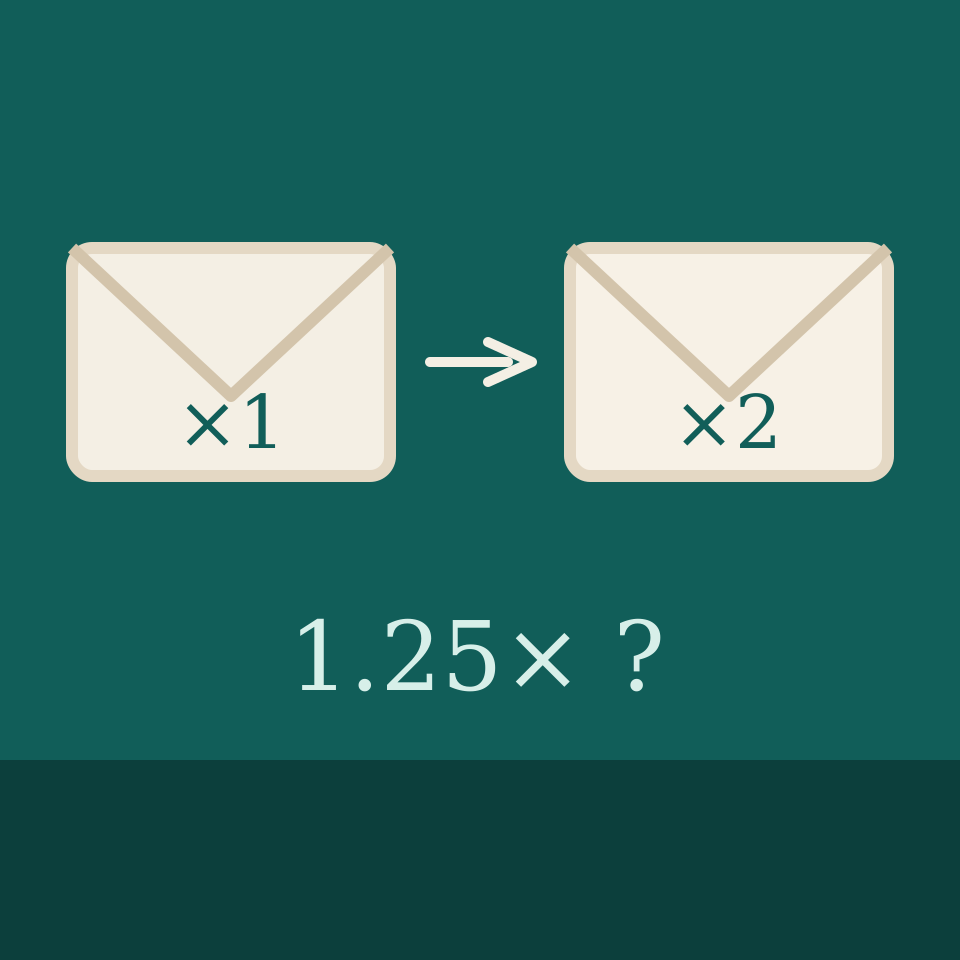
Dwie koperty, w jednej dwa razy więcej niż w drugiej. Bierzesz jedną. Krótki argument mówi, że druga jest warta 1,25 razy tyle, więc warto zamienić. Argument jest błędny, a powód subtelny.
The puzzle
You are given two envelopes. One contains twice as much money as the other. You pick one at random. You may keep it, or switch to the other. Should you switch?
The tempting argument
Call the amount in your envelope X. The other envelope holds either half of X or double X. If each were equally likely, the expected amount in the other envelope would be 0.5 × (X/2) + 0.5 × (2X) = 1.25X. That is more than X, so switching looks strictly better. The reasoning never used the value of X, so it seems to say: always switch, whatever you find.
Where it goes wrong
The two possibilities are not equally likely just because you can name them. "The other has double" means your envelope holds the smaller amount. "The other has half" means it holds the larger amount. Once the amount is fixed at a particular X, those are claims about how the pair was chosen, and they need not have the same probability. Without a rule for that choice, the expected value of switching is not defined, and 1.25 is not a result.
A fixed pair
Suppose the envelopes always contain 10 and 20, and you are given one at random. If you do not open yours, each envelope has expected amount 15. Switching changes nothing. If you open it and see 10, the other holds 20 and you should switch. If you see 20, the other holds 10 and you should stay. Following that rule, you always end with 20. The 1.25 argument would have told you to switch even when you were holding 20.
A range, and an infinite average
Suppose the smaller amount is a whole number drawn from 1 to 100, and the other envelope holds double. For many amounts you might open, half and double are equally likely and the other envelope really does average 1.25 times yours. For an odd amount, or any amount that can only be the smaller one, the other envelope has double. For the largest amounts you can only be holding the larger one, and switching loses. Over all pairs, blind switching still averages the same as staying. Switching only when the opened amount favors it does better.
There is also a rule on the powers of two, where the smaller amount is 2ⁿ with probability (1/3)·(2/3)ⁿ. Under that rule every finite amount you can open makes switching look better: 1.1 times yours, or double for the smallest amount. The average amount is infinite. Conditional expectations can all point one way while there is still no finite expected gain. A long simulation does not settle, because one rare huge pair moves the average by a lot.
Explore it
Open the app and the envelopes are closed: the verdict is that either choice is fine. Open yours and the chart marks where that amount sits. Above the line at 1, switching has the higher expectation. Below it, staying does. The dashed line at 1.25 is what the tempting argument claims for every amount. Run 10,000 pairs to see blind switching match staying, and a selective switch come out ahead, except for the powers of two, where the average does not settle.
Często zadawane pytania
Czy paradoks dwóch kopert to prawdziwa sprzeczność?
Nie. Sprzeczność pojawia się tylko wtedy, gdy przyjmie się krok, który nie jest prawdziwy: że połowa i dwukrotność pozostają jednakowo prawdopodobne po ustaleniu kwoty w kopercie. Przy w pełni określonym sposobie wyboru kwot wartości oczekiwane są dobrze określone i nie ma sprzeczności.
Czy zamiana bywa słuszna?
Tak. Jeśli otworzysz kopertę, a sposób wyboru kwot sprawia, że druga jest średnio więcej warta, zamień. Jeśli jej nie otworzyłeś, zamiana nie zmienia wartości oczekiwanej.
Kto sformułował paradoks dwóch kopert?
Zagadka krąży od połowy XX wieku. Maurice Kraitchik omówił w 1953 roku pokrewny paradoks wymiany, a postać z dwiema kopertami stała się standardowym przykładem w rachunku prawdopodobieństwa i teorii decyzji. Trudność polega na określeniu rozkładu kwot.
Czemu każda kwota może przemawiać za zamianą?
Bo „lepiej niezależnie od tego, co widzisz“ nie znaczy „lepiej ogółem“, gdy średnia jest nieskończona. Prawo całkowitej wartości oczekiwanej potrzebuje skończonej średniej, zanim da się dodać kawałki warunkowe. Przy potęgach dwójki ta średnia jest nieskończona, więc kawałki nigdy nie stają się skończonym zyskiem.
Powiązane narzędzia
Paradoks dwóch kopert
Zobacz, czemu zamiana nie zawsze jest lepsza. Otwórz kwotę, porównaj kuszącą średnią 1,25 razy z poprawną wartością oczekiwaną i uruchom 10 000 par.

Paradoks Monty’ego Halla
Paradoks Monty’ego Halla do sprawdzenia: wybierz jedne z trojga drzwi, patrz, jak Monty otwiera inne z kozą, a potem zostań albo zmień. Graj samodzielnie albo pozwól komputerowi rozegrać 1000 gier i zobacz, że zmiana wygrywa w dwóch przypadkach na trzy.

Paradoks dnia urodzin
W grupie 23 osób prawdopodobieństwo, że dwie mają urodziny tego samego dnia, wynosi 50,7%, a przy 57 osobach – 99%. Zobacz wszystkie 253 pary, kalendarz i krzywą oraz przetestuj tysiące losowych grup w przeglądarce.

Paradoks Simpsona
Poznaj paradoks Simpsona: zobacz, jak jedna opcja może wypadać lepiej w każdej grupie, a gorzej ogółem – na prawdziwych danych o leczeniu kamieni nerkowych, rekrutacji w Berkeley i średnich odbić w baseballu albo na własnych liczbach.

Błąd hazardzisty
Rzucaj uczciwą monetą 100 razy na sekundę i zobacz, co wypada po każdej serii 5 lub 8 orłów z rzędu. Wciąż jest 50/50: moneta nie ma pamięci.
Chcesz wypróbować?
Otwórz PictorX w swojej przeglądarce — do uruchomienia nie jest wymagana żadna instalacja ani karta kredytowa.
Wypróbuj dwie koperty