
Paradoxul celor două plicuri
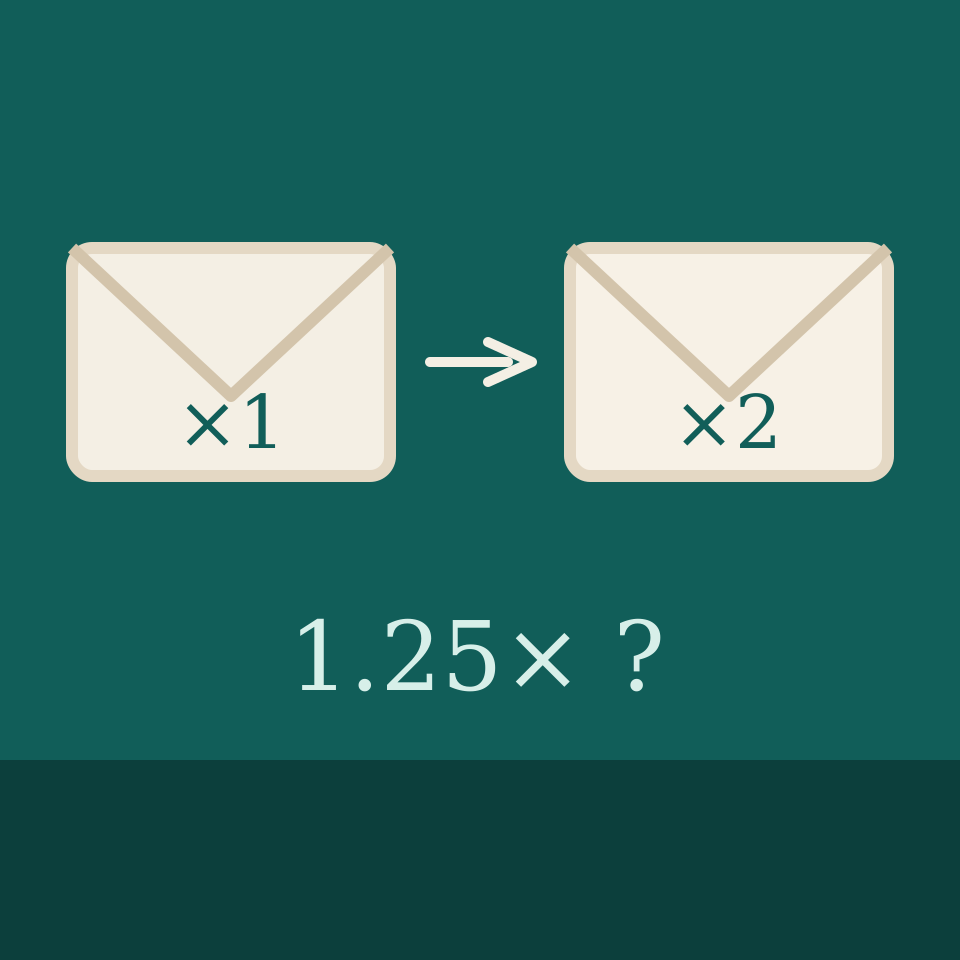
Două plicuri, unul cu de două ori mai mult decât celălalt. Luați unul. Un argument scurt spune că celălalt valorează de 1,25 ori mai mult, deci trebuie să schimbați. Argumentul este greșit, iar motivul este subtil.
The puzzle
You are given two envelopes. One contains twice as much money as the other. You pick one at random. You may keep it, or switch to the other. Should you switch?
The tempting argument
Call the amount in your envelope X. The other envelope holds either half of X or double X. If each were equally likely, the expected amount in the other envelope would be 0.5 × (X/2) + 0.5 × (2X) = 1.25X. That is more than X, so switching looks strictly better. The reasoning never used the value of X, so it seems to say: always switch, whatever you find.
Where it goes wrong
The two possibilities are not equally likely just because you can name them. "The other has double" means your envelope holds the smaller amount. "The other has half" means it holds the larger amount. Once the amount is fixed at a particular X, those are claims about how the pair was chosen, and they need not have the same probability. Without a rule for that choice, the expected value of switching is not defined, and 1.25 is not a result.
A fixed pair
Suppose the envelopes always contain 10 and 20, and you are given one at random. If you do not open yours, each envelope has expected amount 15. Switching changes nothing. If you open it and see 10, the other holds 20 and you should switch. If you see 20, the other holds 10 and you should stay. Following that rule, you always end with 20. The 1.25 argument would have told you to switch even when you were holding 20.
A range, and an infinite average
Suppose the smaller amount is a whole number drawn from 1 to 100, and the other envelope holds double. For many amounts you might open, half and double are equally likely and the other envelope really does average 1.25 times yours. For an odd amount, or any amount that can only be the smaller one, the other envelope has double. For the largest amounts you can only be holding the larger one, and switching loses. Over all pairs, blind switching still averages the same as staying. Switching only when the opened amount favors it does better.
There is also a rule on the powers of two, where the smaller amount is 2ⁿ with probability (1/3)·(2/3)ⁿ. Under that rule every finite amount you can open makes switching look better: 1.1 times yours, or double for the smallest amount. The average amount is infinite. Conditional expectations can all point one way while there is still no finite expected gain. A long simulation does not settle, because one rare huge pair moves the average by a lot.
Explore it
Open the app and the envelopes are closed: the verdict is that either choice is fine. Open yours and the chart marks where that amount sits. Above the line at 1, switching has the higher expectation. Below it, staying does. The dashed line at 1.25 is what the tempting argument claims for every amount. Run 10,000 pairs to see blind switching match staying, and a selective switch come out ahead, except for the powers of two, where the average does not settle.
Întrebări frecvente
Este paradoxul celor două plicuri o contradicție reală?
Nu. Contradicția apare doar dacă se acceptă un pas care nu este adevărat: că jumătatea și dublul rămân la fel de probabile după ce suma din plic este fixată. Cu un mod complet precizat de a alege sumele, așteptările sunt bine definite și nu există contradicție.
Este vreodată corect să schimbați?
Da. Dacă deschideți plicul și modul în care au fost alese sumele face celălalt mai valoros în medie, schimbați. Dacă nu l-ați deschis, schimbarea nu modifică valoarea așteptată.
Cine a formulat paradoxul celor două plicuri?
Enigma circulă de la mijlocul secolului XX. Maurice Kraitchik a discutat în 1953 un paradox al schimbului înrudit, iar forma cu două plicuri a devenit un exemplu standard în probabilități și teoria deciziei. Dificultatea este precizarea distribuției sumelor.
De ce poate orice sumă să favorizeze schimbarea?
Pentru că „mai bine orice ai vedea“ nu înseamnă „mai bine în total“ când media este infinită. Legea așteptării totale are nevoie de o medie finită înainte ca bucățile condiționate să poată fi adunate. Pentru puterile lui doi acea medie este infinită, deci bucățile nu devin niciodată un câștig finit.
Unelte conexe
Paradoxul celor două plicuri
Vedeți de ce schimbarea nu este întotdeauna mai bună. Deschideți o sumă, comparați media tentantă de 1,25 ori cu așteptarea corectă și rulați 10.000 de perechi.

Problema Monty Hall
Problema Monty Hall de încercat: alege una din trei uși, privește cum Monty deschide una cu o capră, apoi rămâi sau schimbă. Joacă tu sau lasă calculatorul să joace 1.000 de jocuri și vezi cum schimbarea câștigă de două ori din trei.

Paradoxul zilei de naștere
Într-un grup de 23 de persoane, șansa ca două să aibă aceeași zi de naștere este de 50,7%, iar cu 57 de persoane este de 99%. Vezi toate cele 253 de perechi, calendarul și curba și testează mii de grupuri aleatorii în browser.

Paradoxul lui Simpson
Explorați paradoxul lui Simpson: vedeți cum o opțiune poate fi mai bună în fiecare grup, dar mai slabă în total, cu date reale despre tratamentele pentru calculi renali, admiterile la Berkeley și mediile la bătaie din baseball sau cu propriile cifre.

Eroarea jucătorului
Aruncă o monedă corectă de 100 de ori pe secundă și vezi ce urmează după fiecare serie în care iese cap de 5 sau 8 ori la rând. E tot 50/50: moneda nu are memorie.
Ești gata să încerci?
Deschide PictorX în browser – fără instalare și fără card de credit.
Încearcă cele două plicuri