
दो लिफ़ाफ़ों का विरोधाभास
दो लिफ़ाफ़े, एक में दूसरे से दोगुना। आप एक चुनते हैं। एक छोटा तर्क कहता है कि दूसरा 1.25 गुना मूल्य का है, इसलिए बदलना चाहिए। वह तर्क ग़लत है, और कारण सूक्ष्म है।
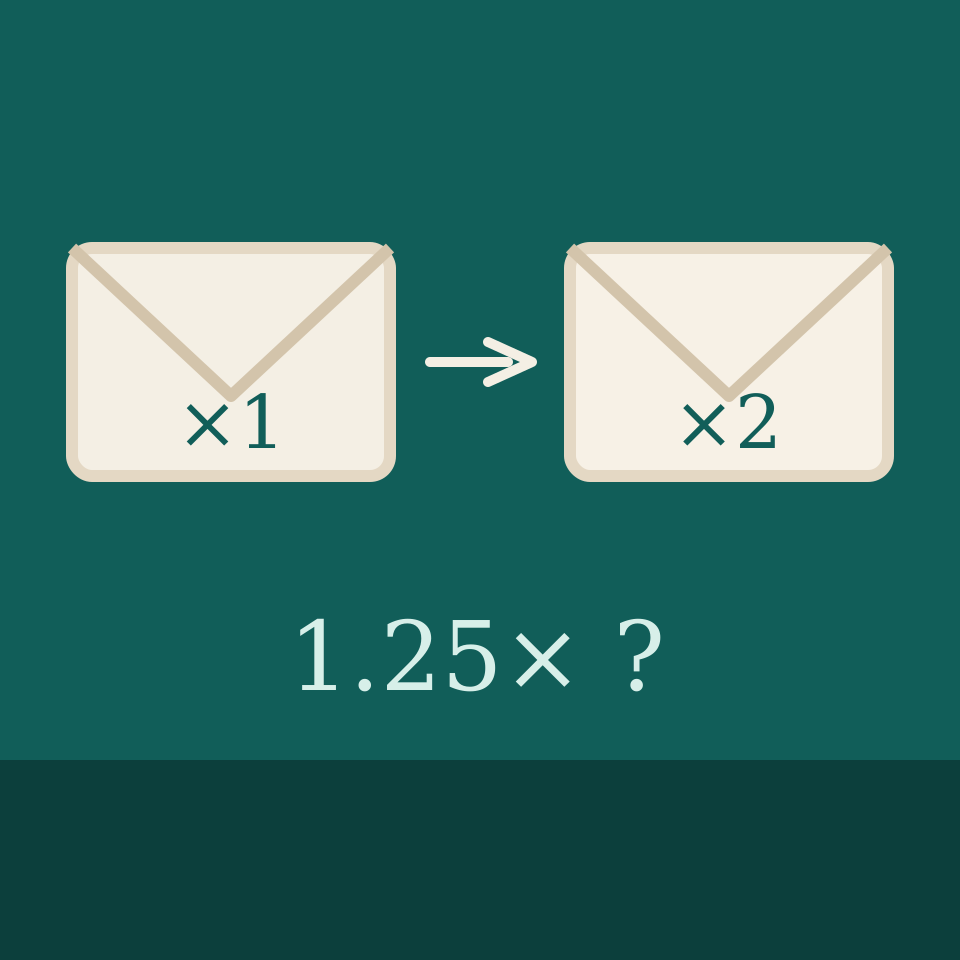
The puzzle
You are given two envelopes. One contains twice as much money as the other. You pick one at random. You may keep it, or switch to the other. Should you switch?
The tempting argument
Call the amount in your envelope X. The other envelope holds either half of X or double X. If each were equally likely, the expected amount in the other envelope would be 0.5 × (X/2) + 0.5 × (2X) = 1.25X. That is more than X, so switching looks strictly better. The reasoning never used the value of X, so it seems to say: always switch, whatever you find.
Where it goes wrong
The two possibilities are not equally likely just because you can name them. "The other has double" means your envelope holds the smaller amount. "The other has half" means it holds the larger amount. Once the amount is fixed at a particular X, those are claims about how the pair was chosen, and they need not have the same probability. Without a rule for that choice, the expected value of switching is not defined, and 1.25 is not a result.
A fixed pair
Suppose the envelopes always contain 10 and 20, and you are given one at random. If you do not open yours, each envelope has expected amount 15. Switching changes nothing. If you open it and see 10, the other holds 20 and you should switch. If you see 20, the other holds 10 and you should stay. Following that rule, you always end with 20. The 1.25 argument would have told you to switch even when you were holding 20.
A range, and an infinite average
Suppose the smaller amount is a whole number drawn from 1 to 100, and the other envelope holds double. For many amounts you might open, half and double are equally likely and the other envelope really does average 1.25 times yours. For an odd amount, or any amount that can only be the smaller one, the other envelope has double. For the largest amounts you can only be holding the larger one, and switching loses. Over all pairs, blind switching still averages the same as staying. Switching only when the opened amount favors it does better.
There is also a rule on the powers of two, where the smaller amount is 2ⁿ with probability (1/3)·(2/3)ⁿ. Under that rule every finite amount you can open makes switching look better: 1.1 times yours, or double for the smallest amount. The average amount is infinite. Conditional expectations can all point one way while there is still no finite expected gain. A long simulation does not settle, because one rare huge pair moves the average by a lot.
Explore it
Open the app and the envelopes are closed: the verdict is that either choice is fine. Open yours and the chart marks where that amount sits. Above the line at 1, switching has the higher expectation. Below it, staying does. The dashed line at 1.25 is what the tempting argument claims for every amount. Run 10,000 pairs to see blind switching match staying, and a selective switch come out ahead, except for the powers of two, where the average does not settle.
अक्सर पूछे जाने वाले प्रश्न
क्या दो लिफ़ाफ़ों का विरोधाभास सचमुच अंतर्विरोध है?
नहीं। अंतर्विरोध तभी दिखता है जब आप एक ग़लत कदम मान लें: कि राशि तय हो जाने के बाद भी आधा और दोगुना समान रूप से संभावित रहते हैं। राशियाँ चुनने का तरीका पूरी तरह बताया हो तो अपेक्षाएँ अच्छी तरह परिभाषित होती हैं और कोई अंतर्विरोध नहीं रहता।
क्या बदलना कभी सही होता है?
हाँ। यदि आप लिफ़ाफ़ा खोलें और राशियाँ चुनने का तरीका दूसरे को औसतन अधिक मूल्यवान बनाए, तो बदलें। यदि आपने नहीं खोला, तो बदलना अपेक्षित राशि नहीं बदलता।
दो लिफ़ाफ़ों का विरोधाभास किसने रखा?
यह पहेली 20वीं सदी के मध्य से चल रही है। मौरिस क्राइटचिक ने 1953 में एक संबंधित विनिमय विरोधाभास पर चर्चा की, और दो लिफ़ाफ़ों वाला रूप प्रायिकता और निर्णय सिद्धांत का मानक उदाहरण बन गया। कठिनाई राशियों का बंटन बताने में है।
हर राशि बदलने के पक्ष में क्यों हो सकती है?
क्योंकि औसत अनंत हो तो “आप जो भी देखें, बेहतर” का अर्थ “कुल मिलाकर बेहतर” नहीं होता। पूर्ण अपेक्षा के नियम को सप्रतिबंध टुकड़े जोड़ने से पहले एक परिमित औसत चाहिए। दो की घातों में वह औसत अनंत है, इसलिए टुकड़े कभी परिमित लाभ नहीं बनते।
संबंधित टूल
दो लिफ़ाफ़ों का विरोधाभास
देखें कि बदलना हमेशा बेहतर क्यों नहीं। एक राशि खोलें, लुभाने वाले 1.25 गुना औसत की सही अपेक्षा से तुलना करें, और 10,000 जोड़े चलाएँ।

मॉन्टी हॉल समस्या
मॉन्टी हॉल समस्या खुद आज़माएँ: तीन दरवाज़ों में से एक चुनें, मॉन्टी को बकरी वाला एक दरवाज़ा खोलते देखें, फिर टिके रहें या बदलें। खुद खेलें या कंप्यूटर को 1,000 गेम खेलने दें और देखें कि बदलने से तीन में से दो बार जीत होती है।

जन्मदिन विरोधाभास
23 लोगों के समूह में दो लोगों का जन्मदिन एक ही होने की प्रायिकता 50.7% है, और 57 लोगों के साथ यह 99% है। सभी 253 जोड़े, कैलेंडर और वक्र देखें, और अपने ब्राउज़र में हज़ारों यादृच्छिक समूह जाँचें।

सिम्पसन का विरोधाभास
सिम्पसन के विरोधाभास को समझें: देखें कि कोई विकल्प हर समूह में बेहतर होकर भी कुल मिलाकर कैसे कमज़ोर हो सकता है, गुर्दे की पथरी के इलाज, बर्कले के दाख़िलों और बैटिंग औसत के असली डेटा के साथ, या अपनी संख्याओं के साथ।

जुआरी की भ्रांति
एक निष्पक्ष सिक्के को हर सेकंड 100 बार उछालें और देखें कि लगातार 5 या 8 बार चित के हर सिलसिले के बाद क्या आता है। फिर भी 50/50: सिक्के की कोई याददाश्त नहीं होती।
आज़माने के लिए तैयार?
अपने ब्राउज़र में PictorX खोलें — शुरू करने के लिए इंस्टॉल या क्रेडिट कार्ड की ज़रूरत नहीं।
दो लिफ़ाफ़े आज़माएँ