
Das Umschläge-Paradoxon
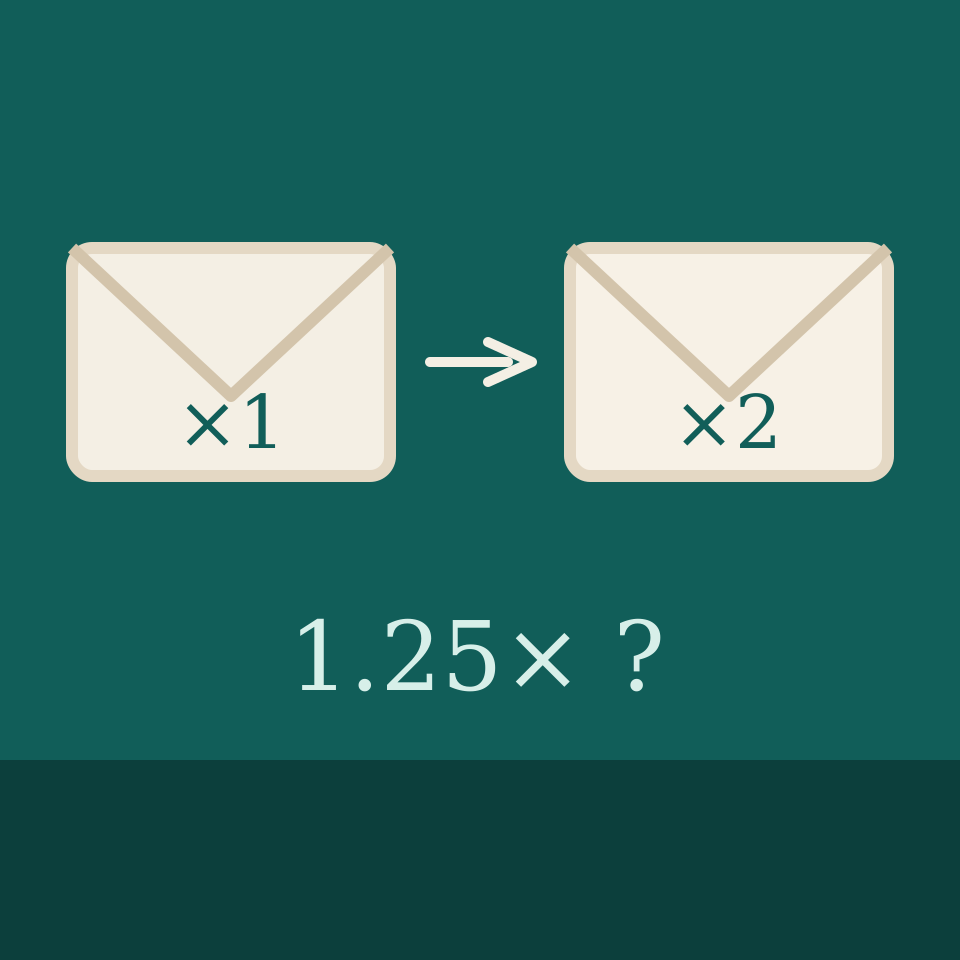
Zwei Umschläge, einer mit doppelt so viel wie der andere. Sie nehmen einen. Ein kurzes Argument sagt, der andere sei das 1,25-Fache wert, also sollten Sie wechseln. Das Argument ist falsch, und der Grund ist fein.
The puzzle
You are given two envelopes. One contains twice as much money as the other. You pick one at random. You may keep it, or switch to the other. Should you switch?
The tempting argument
Call the amount in your envelope X. The other envelope holds either half of X or double X. If each were equally likely, the expected amount in the other envelope would be 0.5 × (X/2) + 0.5 × (2X) = 1.25X. That is more than X, so switching looks strictly better. The reasoning never used the value of X, so it seems to say: always switch, whatever you find.
Where it goes wrong
The two possibilities are not equally likely just because you can name them. "The other has double" means your envelope holds the smaller amount. "The other has half" means it holds the larger amount. Once the amount is fixed at a particular X, those are claims about how the pair was chosen, and they need not have the same probability. Without a rule for that choice, the expected value of switching is not defined, and 1.25 is not a result.
A fixed pair
Suppose the envelopes always contain 10 and 20, and you are given one at random. If you do not open yours, each envelope has expected amount 15. Switching changes nothing. If you open it and see 10, the other holds 20 and you should switch. If you see 20, the other holds 10 and you should stay. Following that rule, you always end with 20. The 1.25 argument would have told you to switch even when you were holding 20.
A range, and an infinite average
Suppose the smaller amount is a whole number drawn from 1 to 100, and the other envelope holds double. For many amounts you might open, half and double are equally likely and the other envelope really does average 1.25 times yours. For an odd amount, or any amount that can only be the smaller one, the other envelope has double. For the largest amounts you can only be holding the larger one, and switching loses. Over all pairs, blind switching still averages the same as staying. Switching only when the opened amount favors it does better.
There is also a rule on the powers of two, where the smaller amount is 2ⁿ with probability (1/3)·(2/3)ⁿ. Under that rule every finite amount you can open makes switching look better: 1.1 times yours, or double for the smallest amount. The average amount is infinite. Conditional expectations can all point one way while there is still no finite expected gain. A long simulation does not settle, because one rare huge pair moves the average by a lot.
Explore it
Open the app and the envelopes are closed: the verdict is that either choice is fine. Open yours and the chart marks where that amount sits. Above the line at 1, switching has the higher expectation. Below it, staying does. The dashed line at 1.25 is what the tempting argument claims for every amount. Run 10,000 pairs to see blind switching match staying, and a selective switch come out ahead, except for the powers of two, where the average does not settle.
Häufig gestellte Fragen
Ist das Umschläge-Paradoxon ein echter Widerspruch?
Nein. Der Widerspruch erscheint nur, wenn man einen Schritt zugibt, der nicht stimmt: dass halb und doppelt gleich wahrscheinlich bleiben, nachdem der Betrag feststeht. Mit einer vollständig angegebenen Art, die Beträge zu wählen, sind die Erwartungswerte wohldefiniert, und es gibt keinen Widerspruch.
Ist Wechseln jemals richtig?
Ja. Wenn Sie den Umschlag öffnen und die Art, wie die Beträge gewählt wurden, den anderen im Mittel mehr wert macht, wechseln Sie. Haben Sie ihn nicht geöffnet, ändert Wechseln den Erwartungswert nicht.
Wer hat das Umschläge-Paradoxon formuliert?
Das Rätsel ist seit der Mitte des 20. Jahrhunderts im Umlauf. Maurice Kraitchik besprach 1953 ein verwandtes Tauschparadox, und die Form mit zwei Umschlägen wurde ein Standardbeispiel der Wahrscheinlichkeits- und Entscheidungstheorie. Die Schwierigkeit ist, die Verteilung der Beträge anzugeben.
Warum kann jeder Betrag fürs Wechseln sprechen?
Weil „besser, egal was man sieht“ bei unendlichem Mittelwert nicht „insgesamt besser“ bedeutet. Das Gesetz der totalen Erwartung braucht einen endlichen Mittelwert, bevor man die bedingten Teile addieren kann. Bei den Zweierpotenzen ist dieser Mittelwert unendlich, die Teile werden also nie zu einem endlichen Gewinn.
Verwandte Tools
Umschläge-Paradoxon
Sehen Sie, warum Wechseln nicht immer besser ist. Öffnen Sie einen Betrag, vergleichen Sie das verlockende 1,25-Fache mit dem richtigen Erwartungswert und spielen Sie 10.000 Paare.

Das Ziegenproblem
Das Ziegenproblem zum Ausprobieren: Wählen Sie eine von drei Türen, sehen Sie zu, wie Monty eine Tür mit einer Ziege öffnet, und bleiben oder wechseln Sie dann. Spielen Sie selbst oder lassen Sie den Computer 1.000 Spiele spielen: Wechseln gewinnt in zwei von drei Fällen.

Das Geburtstagsparadoxon
In einer Gruppe von 23 Personen liegt die Wahrscheinlichkeit, dass zwei am selben Tag Geburtstag haben, bei 50,7 %, bei 57 Personen sind es 99 %. Sehen Sie alle 253 Paare, den Kalender und die Kurve, und testen Sie Tausende zufälliger Gruppen in Ihrem Browser.

Simpson-Paradoxon
Entdecken Sie das Simpson-Paradoxon: Sehen Sie, wie eine Option in jeder Gruppe besser und insgesamt doch schlechter abschneiden kann, mit echten Daten zu Nierensteinbehandlungen, Zulassungen in Berkeley und Schlagdurchschnitten oder mit Ihren eigenen Zahlen.

Spielerfehlschluss
Werfen Sie eine faire Münze 100-mal pro Sekunde und sehen Sie, was nach jeder Serie von 5 oder 8 Mal Kopf in Folge kommt. Es bleibt 50/50: Die Münze hat kein Gedächtnis.
Bereit, es auszuprobieren?
Öffnen Sie PictorX in Ihrem Browser – keine Installation, zum Starten ist keine Kreditkarte erforderlich.
Die zwei Umschläge ausprobieren