
Paradoxen med två kuvert
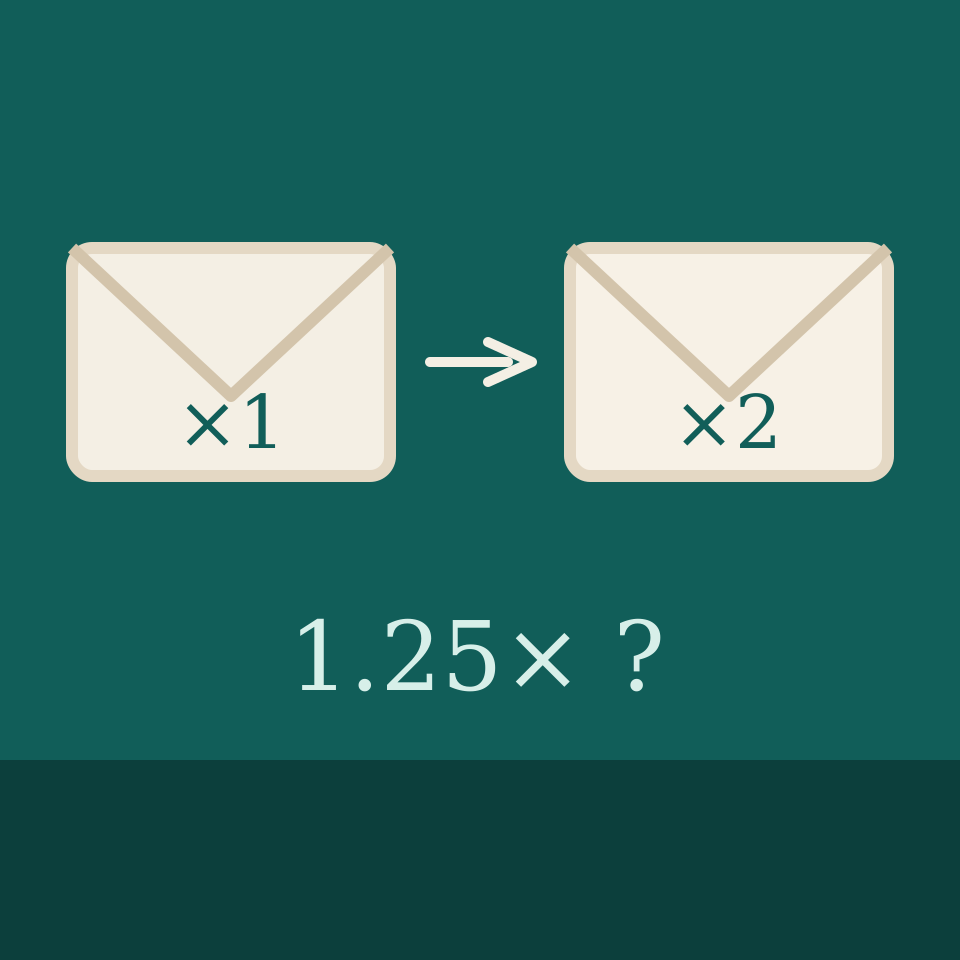
Två kuvert, det ena med dubbelt så mycket som det andra. Du tar ett. Ett kort argument säger att det andra är värt 1,25 gånger så mycket, så du ska byta. Argumentet är fel, och skälet är finurligt.
The puzzle
You are given two envelopes. One contains twice as much money as the other. You pick one at random. You may keep it, or switch to the other. Should you switch?
The tempting argument
Call the amount in your envelope X. The other envelope holds either half of X or double X. If each were equally likely, the expected amount in the other envelope would be 0.5 × (X/2) + 0.5 × (2X) = 1.25X. That is more than X, so switching looks strictly better. The reasoning never used the value of X, so it seems to say: always switch, whatever you find.
Where it goes wrong
The two possibilities are not equally likely just because you can name them. "The other has double" means your envelope holds the smaller amount. "The other has half" means it holds the larger amount. Once the amount is fixed at a particular X, those are claims about how the pair was chosen, and they need not have the same probability. Without a rule for that choice, the expected value of switching is not defined, and 1.25 is not a result.
A fixed pair
Suppose the envelopes always contain 10 and 20, and you are given one at random. If you do not open yours, each envelope has expected amount 15. Switching changes nothing. If you open it and see 10, the other holds 20 and you should switch. If you see 20, the other holds 10 and you should stay. Following that rule, you always end with 20. The 1.25 argument would have told you to switch even when you were holding 20.
A range, and an infinite average
Suppose the smaller amount is a whole number drawn from 1 to 100, and the other envelope holds double. For many amounts you might open, half and double are equally likely and the other envelope really does average 1.25 times yours. For an odd amount, or any amount that can only be the smaller one, the other envelope has double. For the largest amounts you can only be holding the larger one, and switching loses. Over all pairs, blind switching still averages the same as staying. Switching only when the opened amount favors it does better.
There is also a rule on the powers of two, where the smaller amount is 2ⁿ with probability (1/3)·(2/3)ⁿ. Under that rule every finite amount you can open makes switching look better: 1.1 times yours, or double for the smallest amount. The average amount is infinite. Conditional expectations can all point one way while there is still no finite expected gain. A long simulation does not settle, because one rare huge pair moves the average by a lot.
Explore it
Open the app and the envelopes are closed: the verdict is that either choice is fine. Open yours and the chart marks where that amount sits. Above the line at 1, switching has the higher expectation. Below it, staying does. The dashed line at 1.25 is what the tempting argument claims for every amount. Run 10,000 pairs to see blind switching match staying, and a selective switch come out ahead, except for the powers of two, where the average does not settle.
Ofta ställda frågor
Är paradoxen med två kuvert en verklig motsägelse?
Nej. Motsägelsen uppstår bara om man medger ett steg som inte är sant: att hälften och det dubbla förblir lika sannolika när beloppet i ditt kuvert är fast. Med ett fullt angivet sätt att välja beloppen är väntevärdena väldefinierade och det finns ingen motsägelse.
Är det någonsin rätt att byta?
Ja. Om du öppnar kuvertet och sättet beloppen valdes på gör det andra mer värt i snitt, byt. Har du inte öppnat det, ändrar ett byte inte väntevärdet.
Vem formulerade paradoxen med två kuvert?
Gåtan har cirkulerat sedan mitten av 1900-talet. Maurice Kraitchik diskuterade 1953 en besläktad utbytesparadox, och formen med två kuvert blev ett standardexempel i sannolikhet och beslutsteori. Svårigheten är att ange fördelningen av beloppen.
Varför kan varje belopp tala för ett byte?
Därför att „bättre vad du än ser“ inte betyder „bättre totalt“ när medelvärdet är oändligt. Lagen om det totala väntevärdet behöver ett ändligt medel innan de betingade bitarna kan läggas ihop. För potenser av två är det medelvärdet oändligt, så bitarna blir aldrig en ändlig vinst.
Relaterade verktyg
Paradoxen med två kuvert
Se varför det inte alltid är bättre att byta. Öppna ett belopp, jämför det frestande snittet på 1,25 gånger med det riktiga väntevärdet och kör 10 000 par.

Monty Hall-problemet
Monty Hall-problemet att prova själv: välj en av tre dörrar, se Monty öppna en med en get, och behåll eller byt. Spela själv eller låt datorn spela 1 000 spel och se att det vinner två gånger av tre att byta.

Födelsedagsparadoxen
I en grupp på 23 personer är sannolikheten att två fyller år samma dag 50,7 %, och med 57 personer är den 99 %. Se alla 253 par, kalendern och kurvan, och testa tusentals slumpmässiga grupper i webbläsaren.

Simpsons paradox
Utforska Simpsons paradox: se hur ett alternativ kan vara bättre i varje grupp men sämre sammantaget, med verkliga data om njurstensbehandlingar, antagningen vid Berkeley och slaggenomsnitt i baseboll, eller med dina egna siffror.

Spelarens felslut
Kasta ett rättvist mynt 100 gånger i sekunden och se vad som kommer efter varje svit på 5 eller 8 krona i rad. Det är fortfarande 50/50: myntet har inget minne.
Redo att prova det?
Öppna PictorX i din webbläsare - ingen installation, inget kreditkort krävs för att starta.
Prova de två kuverten