
De to kuverters paradoks
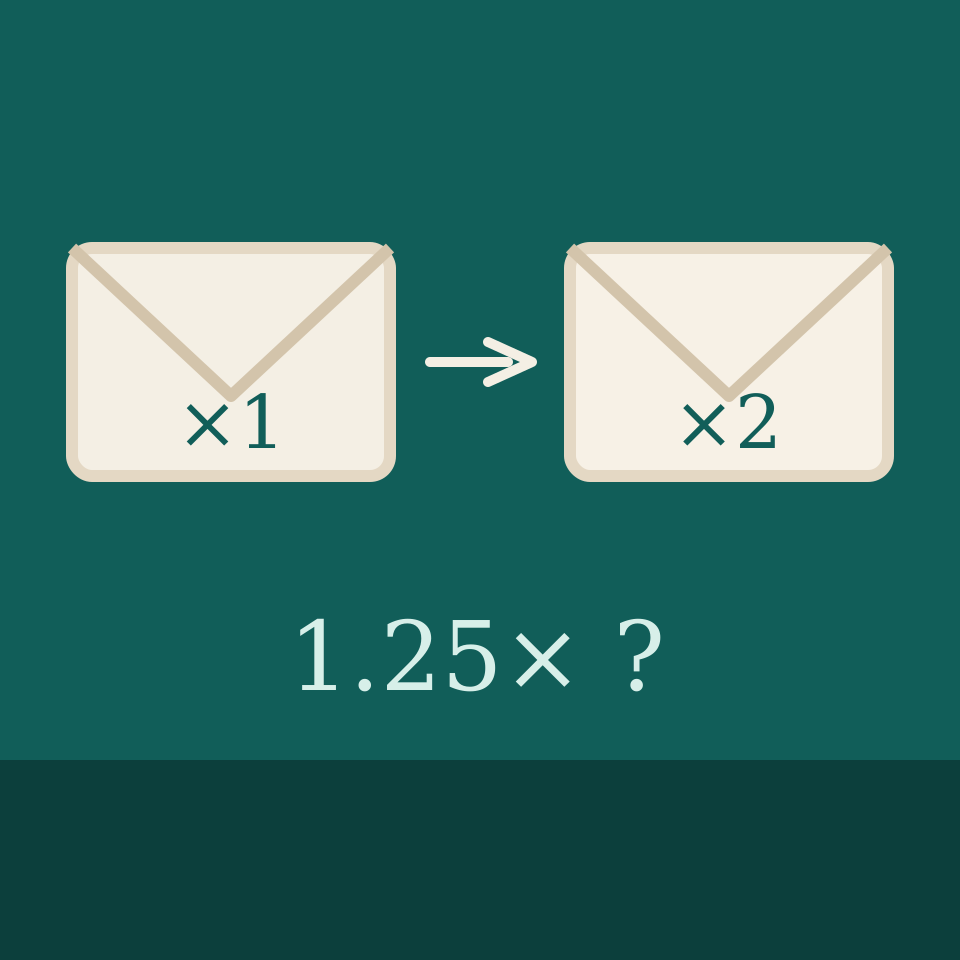
To kuverter, den ene med det dobbelte af den anden. Du tager en. Et kort argument siger, at den anden er 1,25 gange så meget værd, så du bør skifte. Argumentet er forkert, og grunden er spidsfindig.
The puzzle
You are given two envelopes. One contains twice as much money as the other. You pick one at random. You may keep it, or switch to the other. Should you switch?
The tempting argument
Call the amount in your envelope X. The other envelope holds either half of X or double X. If each were equally likely, the expected amount in the other envelope would be 0.5 × (X/2) + 0.5 × (2X) = 1.25X. That is more than X, so switching looks strictly better. The reasoning never used the value of X, so it seems to say: always switch, whatever you find.
Where it goes wrong
The two possibilities are not equally likely just because you can name them. "The other has double" means your envelope holds the smaller amount. "The other has half" means it holds the larger amount. Once the amount is fixed at a particular X, those are claims about how the pair was chosen, and they need not have the same probability. Without a rule for that choice, the expected value of switching is not defined, and 1.25 is not a result.
A fixed pair
Suppose the envelopes always contain 10 and 20, and you are given one at random. If you do not open yours, each envelope has expected amount 15. Switching changes nothing. If you open it and see 10, the other holds 20 and you should switch. If you see 20, the other holds 10 and you should stay. Following that rule, you always end with 20. The 1.25 argument would have told you to switch even when you were holding 20.
A range, and an infinite average
Suppose the smaller amount is a whole number drawn from 1 to 100, and the other envelope holds double. For many amounts you might open, half and double are equally likely and the other envelope really does average 1.25 times yours. For an odd amount, or any amount that can only be the smaller one, the other envelope has double. For the largest amounts you can only be holding the larger one, and switching loses. Over all pairs, blind switching still averages the same as staying. Switching only when the opened amount favors it does better.
There is also a rule on the powers of two, where the smaller amount is 2ⁿ with probability (1/3)·(2/3)ⁿ. Under that rule every finite amount you can open makes switching look better: 1.1 times yours, or double for the smallest amount. The average amount is infinite. Conditional expectations can all point one way while there is still no finite expected gain. A long simulation does not settle, because one rare huge pair moves the average by a lot.
Explore it
Open the app and the envelopes are closed: the verdict is that either choice is fine. Open yours and the chart marks where that amount sits. Above the line at 1, switching has the higher expectation. Below it, staying does. The dashed line at 1.25 is what the tempting argument claims for every amount. Run 10,000 pairs to see blind switching match staying, and a selective switch come out ahead, except for the powers of two, where the average does not settle.
Ofte stillede spørgsmål
Er de to kuverters paradoks en ægte modsigelse?
Nej. Modsigelsen opstår kun, hvis man indrømmer et trin, der ikke er sandt: at halvdelen og det dobbelte bliver ved med at være lige sandsynlige, når beløbet i din kuvert er fast. Med en fuldt angivet måde at vælge beløbene på er forventningerne veldefinerede, og der er ingen modsigelse.
Er det nogensinde rigtigt at skifte?
Ja. Hvis du åbner kuverten, og måden beløbene blev valgt på gør den anden mere værd i gennemsnit, så skift. Har du ikke åbnet den, ændrer et skift ikke den forventede værdi.
Hvem formulerede de to kuverters paradoks?
Gåden har cirkuleret siden midten af det 20. århundrede. Maurice Kraitchik drøftede i 1953 et beslægtet udvekslingsparadoks, og formen med to kuverter blev et standardeksempel i sandsynlighed og beslutningsteori. Vanskeligheden er at angive fordelingen af beløbene.
Hvorfor kan hvert beløb tale for et skift?
Fordi „bedre uanset hvad du ser“ ikke betyder „bedre i alt“, når gennemsnittet er uendeligt. Loven om den totale forventning kræver et endeligt gennemsnit, før de betingede dele kan lægges sammen. For potenser af to er det gennemsnit uendeligt, så delene bliver aldrig en endelig gevinst.
Relaterede værktøjer
De to kuverters paradoks
Se, hvorfor det ikke altid er bedre at skifte. Åbn et beløb, sammenlign det fristende gennemsnit på 1,25 gange med den rigtige forventning, og kør 10.000 par.

Monty Hall-problemet
Monty Hall-problemet til at prøve selv: Vælg en af tre døre, se Monty åbne en med en ged, og behold eller skift. Spil selv, eller lad computeren spille 1.000 spil, og se, at det vinder to gange ud af tre at skifte.

Fødselsdagsparadokset
I en gruppe på 23 personer er sandsynligheden for, at to har fødselsdag samme dag, 50,7 %, og med 57 personer er den 99 %. Se alle 253 par, kalenderen og kurven, og test tusindvis af tilfældige grupper i din browser.

Simpsons paradoks
Udforsk Simpsons paradoks: se, hvordan én mulighed kan klare sig bedre i hver gruppe, men dårligere samlet, med rigtige data om behandling af nyresten, optagelse på Berkeley og slaggennemsnit i baseball eller med dine egne tal.

Spillerens fejlslutning
Kast en fair mønt 100 gange i sekundet, og se, hvad der kommer efter hver stime på 5 eller 8 gange krone i træk. Det er stadig 50/50: mønten har ingen hukommelse.
Er du klar til at prøve?
Åbn PictorX i din browser – ingen installation og intet kreditkort for at komme i gang.
Prøv de to kuverter