
De paradox van twee enveloppen
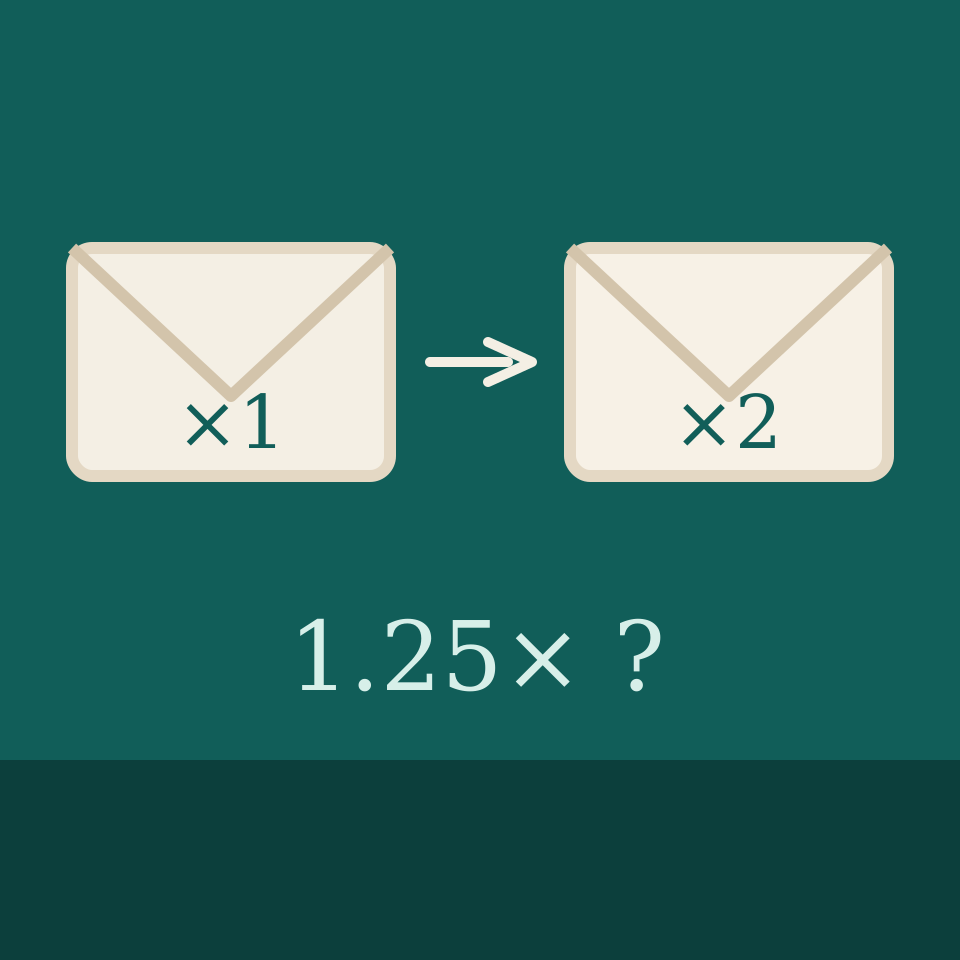
Twee enveloppen, de ene met het dubbele van de andere. Je pakt er een. Een kort argument zegt dat de andere 1,25 keer zoveel waard is, dus dat je moet wisselen. Het argument klopt niet, en de reden is subtiel.
The puzzle
You are given two envelopes. One contains twice as much money as the other. You pick one at random. You may keep it, or switch to the other. Should you switch?
The tempting argument
Call the amount in your envelope X. The other envelope holds either half of X or double X. If each were equally likely, the expected amount in the other envelope would be 0.5 × (X/2) + 0.5 × (2X) = 1.25X. That is more than X, so switching looks strictly better. The reasoning never used the value of X, so it seems to say: always switch, whatever you find.
Where it goes wrong
The two possibilities are not equally likely just because you can name them. "The other has double" means your envelope holds the smaller amount. "The other has half" means it holds the larger amount. Once the amount is fixed at a particular X, those are claims about how the pair was chosen, and they need not have the same probability. Without a rule for that choice, the expected value of switching is not defined, and 1.25 is not a result.
A fixed pair
Suppose the envelopes always contain 10 and 20, and you are given one at random. If you do not open yours, each envelope has expected amount 15. Switching changes nothing. If you open it and see 10, the other holds 20 and you should switch. If you see 20, the other holds 10 and you should stay. Following that rule, you always end with 20. The 1.25 argument would have told you to switch even when you were holding 20.
A range, and an infinite average
Suppose the smaller amount is a whole number drawn from 1 to 100, and the other envelope holds double. For many amounts you might open, half and double are equally likely and the other envelope really does average 1.25 times yours. For an odd amount, or any amount that can only be the smaller one, the other envelope has double. For the largest amounts you can only be holding the larger one, and switching loses. Over all pairs, blind switching still averages the same as staying. Switching only when the opened amount favors it does better.
There is also a rule on the powers of two, where the smaller amount is 2ⁿ with probability (1/3)·(2/3)ⁿ. Under that rule every finite amount you can open makes switching look better: 1.1 times yours, or double for the smallest amount. The average amount is infinite. Conditional expectations can all point one way while there is still no finite expected gain. A long simulation does not settle, because one rare huge pair moves the average by a lot.
Explore it
Open the app and the envelopes are closed: the verdict is that either choice is fine. Open yours and the chart marks where that amount sits. Above the line at 1, switching has the higher expectation. Below it, staying does. The dashed line at 1.25 is what the tempting argument claims for every amount. Run 10,000 pairs to see blind switching match staying, and a selective switch come out ahead, except for the powers of two, where the average does not settle.
Veelgestelde vragen
Is de paradox van twee enveloppen een echte tegenspraak?
Nee. De tegenspraak verschijnt alleen als je een stap toestaat die niet klopt: dat half en dubbel even waarschijnlijk blijven nadat het bedrag in jouw envelop vaststaat. Met een volledig omschreven manier om de bedragen te kiezen zijn de verwachtingen goed gedefinieerd en is er geen tegenspraak.
Is wisselen ooit terecht?
Ja. Als je de envelop opent en de manier waarop de bedragen zijn gekozen de andere gemiddeld meer waard maakt, wissel dan. Heb je hem niet geopend, dan verandert wisselen de verwachte waarde niet.
Wie heeft de paradox van twee enveloppen geformuleerd?
De puzzel circuleert sinds het midden van de twintigste eeuw. Maurice Kraitchik besprak in 1953 een verwant uitwisselingsparadox, en de vorm met twee enveloppen werd een standaardvoorbeeld in kansrekening en beslissingstheorie. De moeilijkheid is de verdeling van de bedragen te specificeren.
Waarom kan elk bedrag voor wisselen pleiten?
Omdat „beter wat je ook ziet“ bij een oneindig gemiddelde niet „in totaal beter“ betekent. De wet van de totale verwachting heeft een eindig gemiddelde nodig voordat de voorwaardelijke stukken kunnen worden opgeteld. Bij de machten van twee is dat gemiddelde oneindig, dus de stukken worden nooit een eindige winst.
Gerelateerde gereedschappen
Paradox van twee enveloppen
Zie waarom wisselen niet altijd beter is. Open een bedrag, vergelijk het verleidelijke gemiddelde van 1,25 keer met de juiste verwachting en speel 10.000 paren.

Het Monty Hall-probleem
Het Monty Hall-probleem om zelf te proberen: kies een van drie deuren, zie Monty er een met een geit openen, en blijf of wissel. Speel zelf of laat de computer 1.000 spellen spelen en zie dat wisselen twee van de drie keer wint.

De verjaardagenparadox
In een groep van 23 mensen is de kans dat er twee op dezelfde dag jarig zijn 50,7%, en bij 57 mensen 99%. Zie alle 253 koppels, de kalender en de curve, en test duizenden willekeurige groepen in je browser.

Simpsons paradox
Ontdek Simpsons paradox: zie hoe een optie in elke groep beter kan scoren en toch slechter in totaal, met echte gegevens over de behandeling van nierstenen, toelatingen in Berkeley en slaggemiddelden, of met je eigen cijfers.

Gokkersdenkfout
Gooi een eerlijke munt 100 keer per seconde op en zie wat er komt na elke reeks van 5 of 8 keer kop op rij. Het blijft 50/50: de munt heeft geen geheugen.
Klaar om het te proberen?
Open PictorX in je browser - geen installatie, geen creditcard nodig om te starten.
Probeer de twee enveloppen