
The puzzle
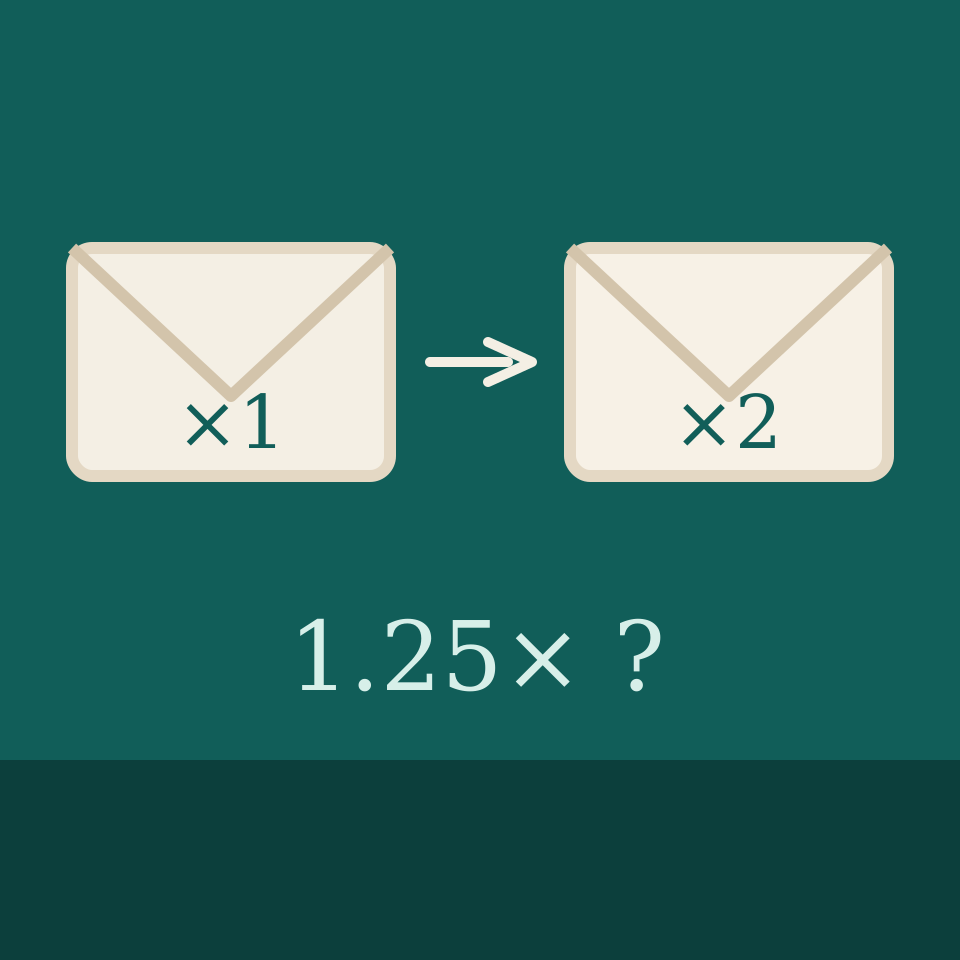
You are given two envelopes. One contains twice as much money as the other. You pick one at random. You may keep it, or switch to the other. Should you switch?
The tempting argument
Call the amount in your envelope X. The other envelope holds either half of X or double X. If each were equally likely, the expected amount in the other envelope would be 0.5 × (X/2) + 0.5 × (2X) = 1.25X. That is more than X, so switching looks strictly better. The reasoning never used the value of X, so it seems to say: always switch, whatever you find.
Where it goes wrong
The two possibilities are not equally likely just because you can name them. "The other has double" means your envelope holds the smaller amount. "The other has half" means it holds the larger amount. Once the amount is fixed at a particular X, those are claims about how the pair was chosen, and they need not have the same probability. Without a rule for that choice, the expected value of switching is not defined, and 1.25 is not a result.
A fixed pair
Suppose the envelopes always contain 10 and 20, and you are given one at random. If you do not open yours, each envelope has expected amount 15. Switching changes nothing. If you open it and see 10, the other holds 20 and you should switch. If you see 20, the other holds 10 and you should stay. Following that rule, you always end with 20. The 1.25 argument would have told you to switch even when you were holding 20.
A range, and an infinite average
Suppose the smaller amount is a whole number drawn from 1 to 100, and the other envelope holds double. For many amounts you might open, half and double are equally likely and the other envelope really does average 1.25 times yours. For an odd amount, or any amount that can only be the smaller one, the other envelope has double. For the largest amounts you can only be holding the larger one, and switching loses. Over all pairs, blind switching still averages the same as staying. Switching only when the opened amount favors it does better.
There is also a rule on the powers of two, where the smaller amount is 2ⁿ with probability (1/3)·(2/3)ⁿ. Under that rule every finite amount you can open makes switching look better: 1.1 times yours, or double for the smallest amount. The average amount is infinite. Conditional expectations can all point one way while there is still no finite expected gain. A long simulation does not settle, because one rare huge pair moves the average by a lot.
Explore it
Open the app and the envelopes are closed: the verdict is that either choice is fine. Open yours and the chart marks where that amount sits. Above the line at 1, switching has the higher expectation. Below it, staying does. The dashed line at 1.25 is what the tempting argument claims for every amount. Run 10,000 pairs to see blind switching match staying, and a selective switch come out ahead, except for the powers of two, where the average does not settle.
常见问题
双信封悖论是真正的矛盾吗?
不是。只有在你接受一个不成立的步骤时,矛盾才会出现:金额已经确定之后,一半和两倍仍然同样可能。金额的产生方式一旦完全说清,期望就是明确定义的,并没有矛盾。
交换有时是对的吗?
会。如果你打开信封,而金额的产生方式使另一个的平均价值更高,就该交换。还没打开时,交换不改变期望金额。
双信封悖论是谁提出的?
这个谜题从 20 世纪中叶起流传。Maurice Kraitchik 在 1953 年讨论过一个相关的交换悖论,双信封的形式成了概率论和决策论里的标准例子。难点在于要说明金额的分布。
为什么每一个金额都可能偏向交换?
因为平均是无穷大时,“无论你看到什么都更好”并不等于“总体上更好”。全期望公式要先有一个有限的平均,才能把条件部分加起来。对 2 的幂,这个平均是无穷大,所以这些部分永远变不成有限的收益。
相关工具
双信封悖论
看看为什么交换并不总是更好。打开一个金额,把诱人的 1.25 倍平均值和正确的期望比较,并运行 10,000 对。

蒙提霍尔问题
亲手试试蒙提霍尔问题:从三扇门中选一扇,看蒙提打开一扇后面是山羊的门,然后决定换还是不换。你可以自己玩,也可以让电脑玩 1,000 局,看换门每三次赢两次。

生日悖论
在 23 人的群体中,两人同一天生日的概率是 50.7%,57 人时则是 99%。看看全部 253 对、日历和曲线,并在浏览器中测试数千个随机群体。

辛普森悖论
探索辛普森悖论:看看一个选项为什么能在每一组中都表现更好,总体上却更差。可以使用肾结石治疗、伯克利录取和棒球打击率的真实数据,也可以输入你自己的数字。

赌徒谬误
每秒抛 100 次公平的硬币,看看每次连续 5 次或 8 次正面之后会出现什么。仍然是 50/50:硬币没有记忆。
准备好尝试了吗?
在浏览器中打开 PictorX — 无需安装,无需信用卡即可启动。
试试两个信封