
İki zarf paradoksu
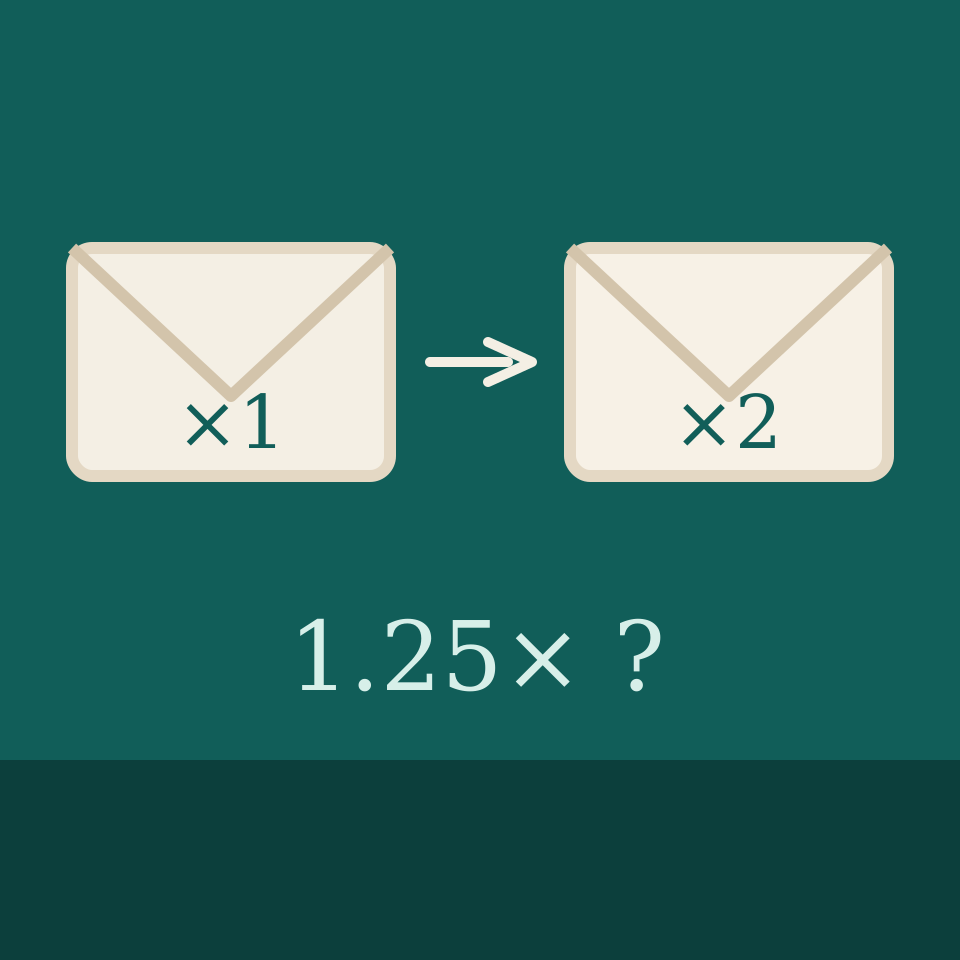
İki zarf, biri diğerinin iki katı. Birini seçersiniz. Kısa bir sav, diğerinin 1,25 kat değerinde olduğunu, bu yüzden değiştirmeniz gerektiğini söyler. Sav yanlıştır ve nedeni incedir.
The puzzle
You are given two envelopes. One contains twice as much money as the other. You pick one at random. You may keep it, or switch to the other. Should you switch?
The tempting argument
Call the amount in your envelope X. The other envelope holds either half of X or double X. If each were equally likely, the expected amount in the other envelope would be 0.5 × (X/2) + 0.5 × (2X) = 1.25X. That is more than X, so switching looks strictly better. The reasoning never used the value of X, so it seems to say: always switch, whatever you find.
Where it goes wrong
The two possibilities are not equally likely just because you can name them. "The other has double" means your envelope holds the smaller amount. "The other has half" means it holds the larger amount. Once the amount is fixed at a particular X, those are claims about how the pair was chosen, and they need not have the same probability. Without a rule for that choice, the expected value of switching is not defined, and 1.25 is not a result.
A fixed pair
Suppose the envelopes always contain 10 and 20, and you are given one at random. If you do not open yours, each envelope has expected amount 15. Switching changes nothing. If you open it and see 10, the other holds 20 and you should switch. If you see 20, the other holds 10 and you should stay. Following that rule, you always end with 20. The 1.25 argument would have told you to switch even when you were holding 20.
A range, and an infinite average
Suppose the smaller amount is a whole number drawn from 1 to 100, and the other envelope holds double. For many amounts you might open, half and double are equally likely and the other envelope really does average 1.25 times yours. For an odd amount, or any amount that can only be the smaller one, the other envelope has double. For the largest amounts you can only be holding the larger one, and switching loses. Over all pairs, blind switching still averages the same as staying. Switching only when the opened amount favors it does better.
There is also a rule on the powers of two, where the smaller amount is 2ⁿ with probability (1/3)·(2/3)ⁿ. Under that rule every finite amount you can open makes switching look better: 1.1 times yours, or double for the smallest amount. The average amount is infinite. Conditional expectations can all point one way while there is still no finite expected gain. A long simulation does not settle, because one rare huge pair moves the average by a lot.
Explore it
Open the app and the envelopes are closed: the verdict is that either choice is fine. Open yours and the chart marks where that amount sits. Above the line at 1, switching has the higher expectation. Below it, staying does. The dashed line at 1.25 is what the tempting argument claims for every amount. Run 10,000 pairs to see blind switching match staying, and a selective switch come out ahead, except for the powers of two, where the average does not settle.
Sık sorulan sorular
İki zarf paradoksu gerçek bir çelişki midir?
Hayır. Çelişki ancak doğru olmayan bir adımı kabul ederseniz ortaya çıkar: tutarınız sabitlendikten sonra yarım ile iki katının eşit olasılıklı kalması. Tutarları seçmenin tam belirtilmiş bir yolu varsa, beklentiler iyi tanımlıdır ve çelişki yoktur.
Değiştirmek hiç doğru olur mu?
Evet. Zarfı açarsanız ve tutarların seçiliş biçimi diğerini ortalamada daha değerli kılıyorsa, değiştirin. Açmadıysanız, değiştirmek beklenen tutarı değiştirmez.
İki zarf paradoksunu kim ortaya koydu?
Bilmece 20. yüzyılın ortasından beri dolaşır. Maurice Kraitchik 1953'te ilgili bir değiş tokuş paradoksunu ele aldı ve iki zarflı biçim olasılık ile karar kuramında standart bir örnek oldu. Zorluk, tutarların dağılımını belirtmektir.
Her tutar neden değiştirmeyi destekleyebilir?
Çünkü ortalama sonsuzken „ne görürseniz görün daha iyi“ „toplamda daha iyi“ anlamına gelmez. Toplam beklenti yasası, koşullu parçalar toplanabilsin diye sonlu bir ortalama ister. İkinin kuvvetlerinde bu ortalama sonsuzdur, bu yüzden parçalar hiçbir zaman sonlu bir kazanca dönüşmez.
İlgili araçlar
İki zarf paradoksu
Değiştirmenin neden her zaman daha iyi olmadığını görün. Bir tutar açın, cezbedici 1,25 kat ortalamayı doğru beklentiyle karşılaştırın ve 10.000 çift çalıştırın.

Monty Hall problemi
Monty Hall problemini deneyin: üç kapıdan birini seçin, Monty’nin arkasında keçi olan bir kapıyı açmasını izleyin, sonra kalın ya da değiştirin. Kendiniz oynayın ya da bilgisayara 1.000 oyun oynatın ve değiştirmenin üç oyunun ikisinde kazandığını görün.

Doğum günü paradoksu
23 kişilik bir grupta ikisinin doğum gününün aynı olma olasılığı %50,7’dir; 57 kişide bu olasılık %99’a çıkar. 253 çiftin hepsini, takvimi ve eğriyi görün ve tarayıcınızda binlerce rastgele grubu test edin.

Simpson paradoksu
Simpson paradoksunu keşfedin: bir seçeneğin nasıl her grupta daha iyi ama toplamda daha kötü olabileceğini böbrek taşı tedavileri, Berkeley kabulleri ve beyzbol vuruş ortalamalarına ait gerçek verilerle ya da kendi sayılarınızla görün.

Kumarbaz yanılgısı
Hilesiz bir parayı saniyede 100 kez atın ve üst üste 5 ya da 8 turalık her serinin ardından ne geldiğini görün. Yine 50/50: paranın hafızası yoktur.
Denemeye hazır mısınız?
PictorX'i tarayıcınızda açın — kurulum gerekmez, başlamak için kredi kartı gerekmez.
İki zarfı dene