
La paradoja de los dos sobres
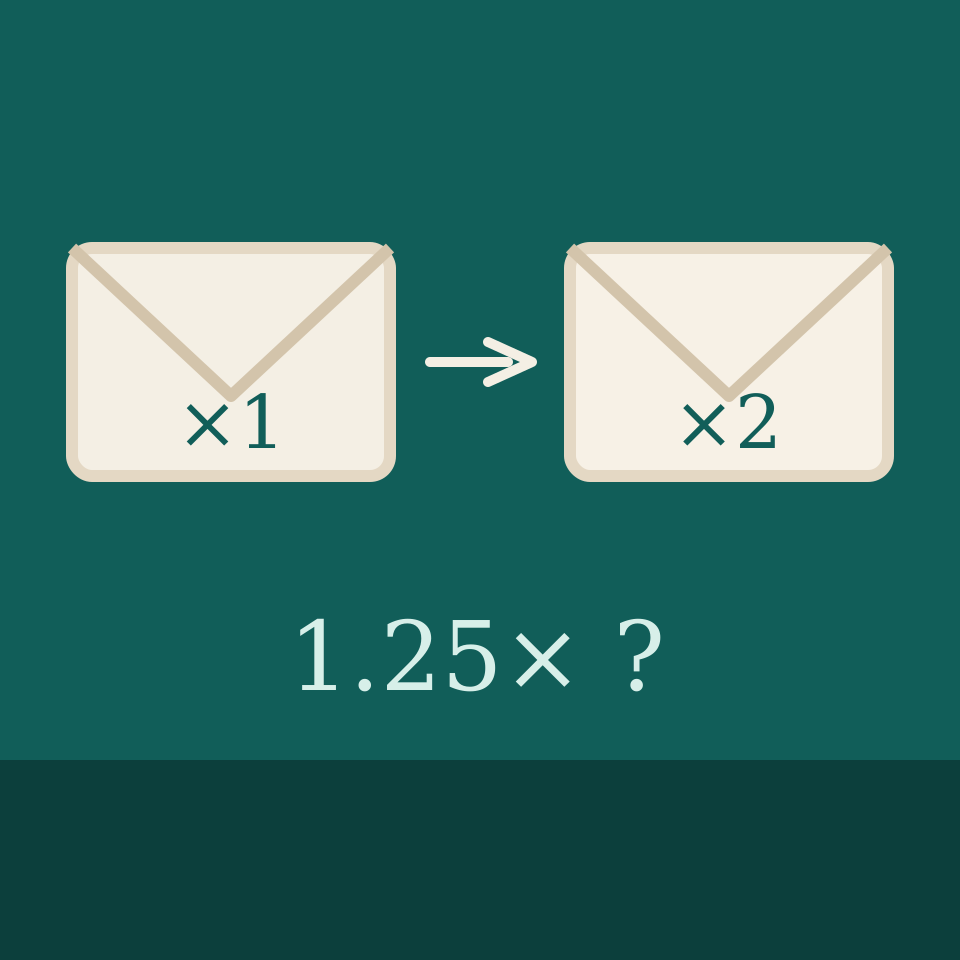
Dos sobres, uno con el doble que el otro. Tomas uno. Un argumento breve dice que el otro vale 1,25 veces más, así que debes cambiar. El argumento es falso, y la razón es sutil.
The puzzle
You are given two envelopes. One contains twice as much money as the other. You pick one at random. You may keep it, or switch to the other. Should you switch?
The tempting argument
Call the amount in your envelope X. The other envelope holds either half of X or double X. If each were equally likely, the expected amount in the other envelope would be 0.5 × (X/2) + 0.5 × (2X) = 1.25X. That is more than X, so switching looks strictly better. The reasoning never used the value of X, so it seems to say: always switch, whatever you find.
Where it goes wrong
The two possibilities are not equally likely just because you can name them. "The other has double" means your envelope holds the smaller amount. "The other has half" means it holds the larger amount. Once the amount is fixed at a particular X, those are claims about how the pair was chosen, and they need not have the same probability. Without a rule for that choice, the expected value of switching is not defined, and 1.25 is not a result.
A fixed pair
Suppose the envelopes always contain 10 and 20, and you are given one at random. If you do not open yours, each envelope has expected amount 15. Switching changes nothing. If you open it and see 10, the other holds 20 and you should switch. If you see 20, the other holds 10 and you should stay. Following that rule, you always end with 20. The 1.25 argument would have told you to switch even when you were holding 20.
A range, and an infinite average
Suppose the smaller amount is a whole number drawn from 1 to 100, and the other envelope holds double. For many amounts you might open, half and double are equally likely and the other envelope really does average 1.25 times yours. For an odd amount, or any amount that can only be the smaller one, the other envelope has double. For the largest amounts you can only be holding the larger one, and switching loses. Over all pairs, blind switching still averages the same as staying. Switching only when the opened amount favors it does better.
There is also a rule on the powers of two, where the smaller amount is 2ⁿ with probability (1/3)·(2/3)ⁿ. Under that rule every finite amount you can open makes switching look better: 1.1 times yours, or double for the smallest amount. The average amount is infinite. Conditional expectations can all point one way while there is still no finite expected gain. A long simulation does not settle, because one rare huge pair moves the average by a lot.
Explore it
Open the app and the envelopes are closed: the verdict is that either choice is fine. Open yours and the chart marks where that amount sits. Above the line at 1, switching has the higher expectation. Below it, staying does. The dashed line at 1.25 is what the tempting argument claims for every amount. Run 10,000 pairs to see blind switching match staying, and a selective switch come out ahead, except for the powers of two, where the average does not settle.
Preguntas frecuentes
¿La paradoja de los dos sobres es una contradicción real?
No. La contradicción aparece solo si se concede un paso que no es cierto: que la mitad y el doble siguen siendo igual de probables después de fijar el importe de tu sobre. Con una forma completamente especificada de elegir los importes, las expectativas están bien definidas y no hay contradicción.
¿Alguna vez es correcto cambiar?
Sí. Si abres el sobre y la forma en que se eligieron los importes hace que el otro valga más de media, cambia. Si no lo has abierto, cambiar no modifica el valor esperado.
¿Quién planteó la paradoja de los dos sobres?
El enigma circula desde mediados del siglo XX. Maurice Kraitchik trató en 1953 una paradoja de intercambio afín, y la forma de los dos sobres se volvió un ejemplo habitual en probabilidad y teoría de la decisión. La dificultad es especificar la distribución de los importes.
¿Por qué cada importe puede favorecer el cambio?
Porque «mejor sea lo que sea lo que veas» no implica «mejor en conjunto» cuando el promedio es infinito. La ley de la esperanza total necesita un promedio finito antes de poder sumar las piezas condicionadas. Para las potencias de dos ese promedio es infinito, así que las piezas nunca se vuelven una ganancia finita.
Herramientas relacionadas
Paradoja de los dos sobres
Mira por qué cambiar no siempre es mejor. Abre un importe, compara el tentador promedio de 1,25 veces con la expectativa correcta y ejecuta 10.000 pares.

El problema de Monty Hall
El problema de Monty Hall para probar: elige una de tres puertas, mira cómo Monty abre una con una cabra y luego mantén o cambia. Juega tú o deja que el ordenador juegue 1000 partidas y comprueba que cambiar gana dos de cada tres veces.

La paradoja del cumpleaños
En un grupo de 23 personas, la probabilidad de que dos cumplan años el mismo día es del 50,7 %, y con 57 personas es del 99 %. Mira las 253 parejas, el calendario y la curva, y prueba miles de grupos aleatorios en tu navegador.

Paradoja de Simpson
Explora la paradoja de Simpson: mira cómo una opción puede ser mejor en cada grupo y, aun así, peor en total, con datos reales del tratamiento de cálculos renales, las admisiones en Berkeley y los promedios de bateo, o con tus propios números.

Falacia del jugador
Lanza una moneda justa 100 veces por segundo y mira qué sale después de cada racha de 5 u 8 caras seguidas. Sigue siendo 50/50: la moneda no tiene memoria.
¿Listo para probarlo?
Abre PictorX en tu navegador: sin instalación ni tarjeta de crédito para empezar.
Probar los dos sobres