
Paradoks dua amplop
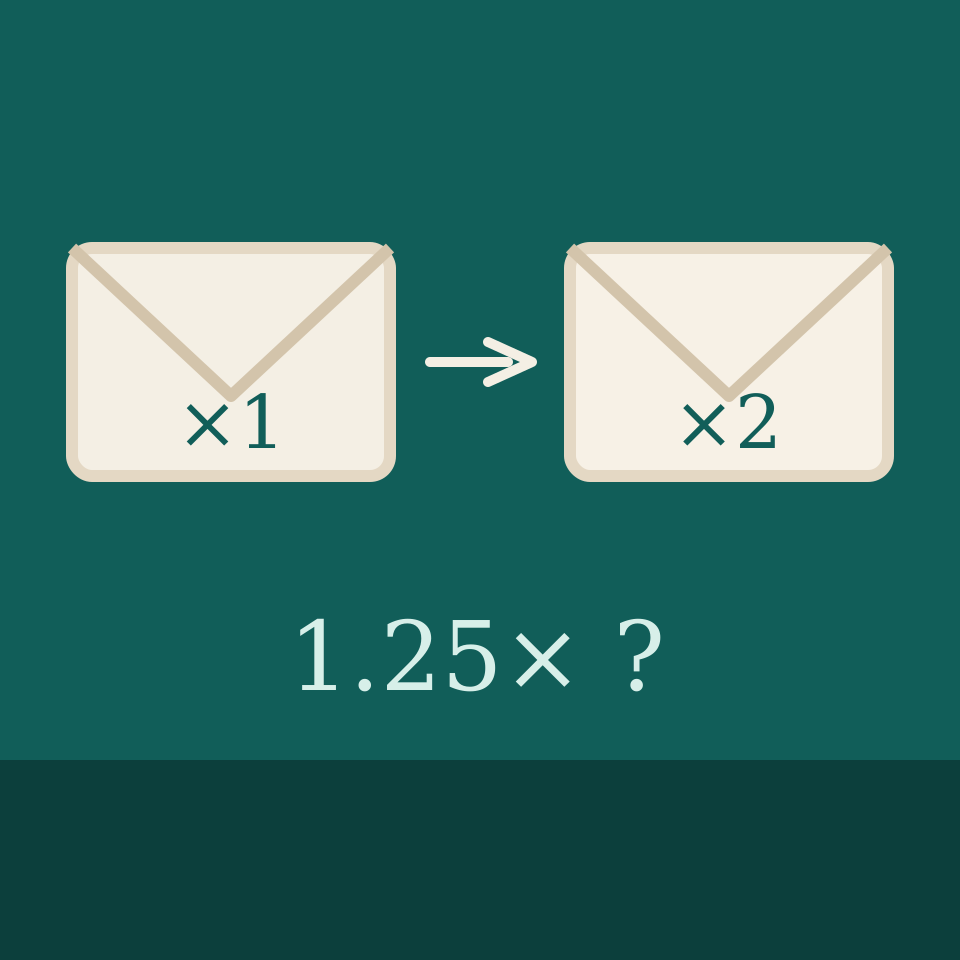
Dua amplop, satu berisi dua kali yang lain. Anda mengambil satu. Argumen singkat berkata amplop lain bernilai 1,25 kali lebih banyak, jadi Anda harus bertukar. Argumen itu salah, dan alasannya halus.
The puzzle
You are given two envelopes. One contains twice as much money as the other. You pick one at random. You may keep it, or switch to the other. Should you switch?
The tempting argument
Call the amount in your envelope X. The other envelope holds either half of X or double X. If each were equally likely, the expected amount in the other envelope would be 0.5 × (X/2) + 0.5 × (2X) = 1.25X. That is more than X, so switching looks strictly better. The reasoning never used the value of X, so it seems to say: always switch, whatever you find.
Where it goes wrong
The two possibilities are not equally likely just because you can name them. "The other has double" means your envelope holds the smaller amount. "The other has half" means it holds the larger amount. Once the amount is fixed at a particular X, those are claims about how the pair was chosen, and they need not have the same probability. Without a rule for that choice, the expected value of switching is not defined, and 1.25 is not a result.
A fixed pair
Suppose the envelopes always contain 10 and 20, and you are given one at random. If you do not open yours, each envelope has expected amount 15. Switching changes nothing. If you open it and see 10, the other holds 20 and you should switch. If you see 20, the other holds 10 and you should stay. Following that rule, you always end with 20. The 1.25 argument would have told you to switch even when you were holding 20.
A range, and an infinite average
Suppose the smaller amount is a whole number drawn from 1 to 100, and the other envelope holds double. For many amounts you might open, half and double are equally likely and the other envelope really does average 1.25 times yours. For an odd amount, or any amount that can only be the smaller one, the other envelope has double. For the largest amounts you can only be holding the larger one, and switching loses. Over all pairs, blind switching still averages the same as staying. Switching only when the opened amount favors it does better.
There is also a rule on the powers of two, where the smaller amount is 2ⁿ with probability (1/3)·(2/3)ⁿ. Under that rule every finite amount you can open makes switching look better: 1.1 times yours, or double for the smallest amount. The average amount is infinite. Conditional expectations can all point one way while there is still no finite expected gain. A long simulation does not settle, because one rare huge pair moves the average by a lot.
Explore it
Open the app and the envelopes are closed: the verdict is that either choice is fine. Open yours and the chart marks where that amount sits. Above the line at 1, switching has the higher expectation. Below it, staying does. The dashed line at 1.25 is what the tempting argument claims for every amount. Run 10,000 pairs to see blind switching match staying, and a selective switch come out ahead, except for the powers of two, where the average does not settle.
Pertanyaan yang sering diajukan
Apakah paradoks dua amplop benar-benar kontradiksi?
Tidak. Kontradiksi muncul hanya jika Anda menerima langkah yang tidak benar: bahwa setengah dan dua kali tetap sama mungkin setelah jumlah di amplop Anda ditetapkan. Dengan cara memilih jumlah yang dinyatakan sepenuhnya, nilai harapannya terdefinisi dengan baik dan tidak ada kontradiksi.
Apakah bertukar pernah benar?
Ya. Jika Anda membuka amplop dan cara jumlahnya dipilih membuat yang lain rata-rata lebih bernilai, bertukarlah. Jika Anda belum membukanya, bertukar tidak mengubah nilai harapan.
Siapa yang menyatakan paradoks dua amplop?
Teka-teki ini beredar sejak pertengahan abad ke-20. Maurice Kraitchik membahas paradoks pertukaran yang terkait pada 1953, dan bentuk dua amplop menjadi contoh baku dalam peluang dan teori keputusan. Kesulitannya adalah menentukan distribusi jumlahnya.
Mengapa setiap jumlah dapat memihak bertukar?
Karena „lebih baik apa pun yang Anda lihat“ tidak berarti „lebih baik secara keseluruhan“ ketika rata-ratanya tak terhingga. Hukum nilai harapan total membutuhkan rata-rata terhingga sebelum potongan bersyarat dapat dijumlahkan. Untuk pangkat dua rata-rata itu tak terhingga, jadi potongan-potongan itu tidak pernah menjadi keuntungan terhingga.
Alat terkait
Paradoks dua amplop
Lihat mengapa bertukar tidak selalu lebih baik. Buka suatu jumlah, bandingkan rata-rata menggoda 1,25 kali dengan harapan yang benar, dan jalankan 10.000 pasang.

Masalah Monty Hall
Coba masalah Monty Hall: pilih satu dari tiga pintu, lihat Monty membuka pintu berisi kambing, lalu tetap atau ganti. Main sendiri atau biarkan komputer memainkan 1.000 permainan dan lihat bahwa mengganti menang dua dari tiga kali.

Paradoks ulang tahun
Dalam kelompok 23 orang, peluang dua orang berulang tahun sama adalah 50,7%, dan dengan 57 orang peluangnya 99%. Lihat semua 253 pasangan, kalender, dan kurvanya, lalu uji ribuan kelompok acak di browser Anda.

Paradoks Simpson
Jelajahi paradoks Simpson: lihat bagaimana satu opsi bisa lebih baik di setiap kelompok tetapi lebih buruk secara keseluruhan, dengan data nyata tentang pengobatan batu ginjal, penerimaan mahasiswa Berkeley, dan rata-rata pukulan bisbol, atau dengan angka Anda sendiri.

Kekeliruan penjudi
Lempar koin seimbang 100 kali per detik dan lihat apa yang muncul setelah setiap rentetan 5 atau 8 gambar berturut-turut. Tetap 50/50: koin tidak punya ingatan.
Siap mencobanya?
Buka PictorX di browser Anda — tanpa instalasi, tanpa kartu kredit untuk memulai.
Coba dua amplop