
Il paradosso delle due buste
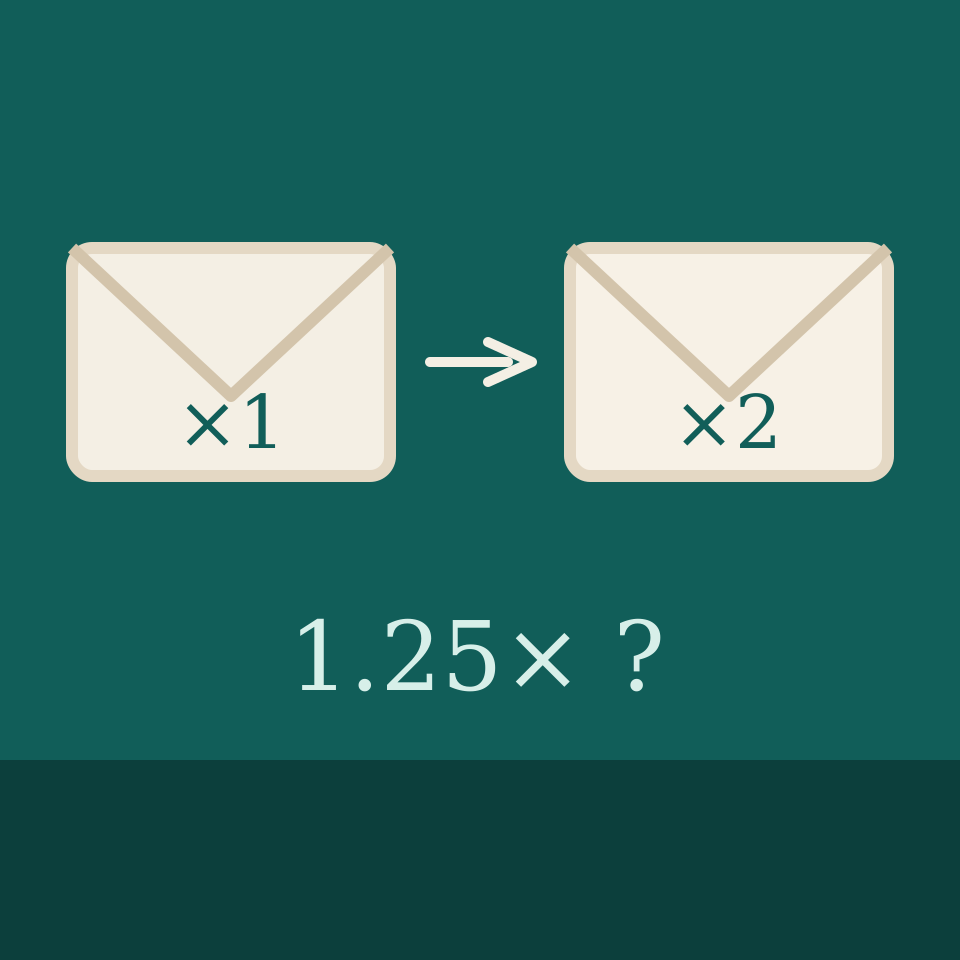
Due buste, una con il doppio dell'altra. Ne prendi una. Un breve argomento dice che l'altra vale 1,25 volte tanto, quindi conviene cambiare. L'argomento è sbagliato, e la ragione è sottile.
The puzzle
You are given two envelopes. One contains twice as much money as the other. You pick one at random. You may keep it, or switch to the other. Should you switch?
The tempting argument
Call the amount in your envelope X. The other envelope holds either half of X or double X. If each were equally likely, the expected amount in the other envelope would be 0.5 × (X/2) + 0.5 × (2X) = 1.25X. That is more than X, so switching looks strictly better. The reasoning never used the value of X, so it seems to say: always switch, whatever you find.
Where it goes wrong
The two possibilities are not equally likely just because you can name them. "The other has double" means your envelope holds the smaller amount. "The other has half" means it holds the larger amount. Once the amount is fixed at a particular X, those are claims about how the pair was chosen, and they need not have the same probability. Without a rule for that choice, the expected value of switching is not defined, and 1.25 is not a result.
A fixed pair
Suppose the envelopes always contain 10 and 20, and you are given one at random. If you do not open yours, each envelope has expected amount 15. Switching changes nothing. If you open it and see 10, the other holds 20 and you should switch. If you see 20, the other holds 10 and you should stay. Following that rule, you always end with 20. The 1.25 argument would have told you to switch even when you were holding 20.
A range, and an infinite average
Suppose the smaller amount is a whole number drawn from 1 to 100, and the other envelope holds double. For many amounts you might open, half and double are equally likely and the other envelope really does average 1.25 times yours. For an odd amount, or any amount that can only be the smaller one, the other envelope has double. For the largest amounts you can only be holding the larger one, and switching loses. Over all pairs, blind switching still averages the same as staying. Switching only when the opened amount favors it does better.
There is also a rule on the powers of two, where the smaller amount is 2ⁿ with probability (1/3)·(2/3)ⁿ. Under that rule every finite amount you can open makes switching look better: 1.1 times yours, or double for the smallest amount. The average amount is infinite. Conditional expectations can all point one way while there is still no finite expected gain. A long simulation does not settle, because one rare huge pair moves the average by a lot.
Explore it
Open the app and the envelopes are closed: the verdict is that either choice is fine. Open yours and the chart marks where that amount sits. Above the line at 1, switching has the higher expectation. Below it, staying does. The dashed line at 1.25 is what the tempting argument claims for every amount. Run 10,000 pairs to see blind switching match staying, and a selective switch come out ahead, except for the powers of two, where the average does not settle.
Domande frequenti
Il paradosso delle due buste è una vera contraddizione?
No. La contraddizione compare solo se si concede un passo falso: che metà e doppio restino ugualmente probabili dopo che l'importo nella tua busta è fissato. Con un modo completamente specificato di scegliere gli importi, i valori attesi sono ben definiti e non c'è contraddizione.
È mai giusto cambiare?
Sì. Se apri la busta e il modo in cui sono stati scelti gli importi rende l'altra più preziosa in media, cambia. Se non l'hai aperta, cambiare non modifica il valore atteso.
Chi ha formulato il paradosso delle due buste?
L'enigma circola dalla metà del XX secolo. Maurice Kraitchik discusse nel 1953 un paradosso di scambio affine, e la forma con due buste divenne un esempio standard in probabilità e teoria delle decisioni. La difficoltà è specificare la distribuzione degli importi.
Perché ogni importo può favorire il cambiare?
Perché «meglio qualunque cosa tu veda» non implica «meglio nel complesso» quando la media è infinita. La legge dell'attesa totale ha bisogno di una media finita prima che i pezzi condizionati si possano sommare. Per le potenze di due quella media è infinita, quindi i pezzi non diventano mai un guadagno finito.
Strumenti correlati
Paradosso delle due buste
Guarda perché cambiare non è sempre meglio. Apri un importo, confronta la media allettante di 1,25 volte con il valore atteso corretto ed esegui 10.000 coppie.

Il problema di Monty Hall
Il problema di Monty Hall da provare: scegli una di tre porte, guarda Monty aprirne una con una capra, poi tieni o cambia. Gioca tu o lascia che il computer giochi 1.000 partite e vedi che cambiare vince due volte su tre.

Il paradosso del compleanno
In un gruppo di 23 persone la probabilità che due compiano gli anni lo stesso giorno è del 50,7%, e con 57 persone è del 99%. Guarda tutte le 253 coppie, il calendario e la curva, e testa migliaia di gruppi casuali nel tuo browser.

Paradosso di Simpson
Esplora il paradosso di Simpson: guarda come un’opzione può fare meglio in ogni gruppo eppure peggio nel complesso, con dati reali sul trattamento dei calcoli renali, sulle ammissioni a Berkeley e sulle medie battuta, oppure con i tuoi numeri.

Fallacia dello scommettitore
Lancia una moneta equa 100 volte al secondo e guarda cosa arriva dopo ogni serie di 5 o 8 teste di fila. È sempre 50/50: la moneta non ha memoria.
Pronto a provarlo?
Apri PictorX nel tuo browser: nessuna installazione, nessuna carta di credito richiesta per iniziare.
Prova le due buste