
Парадокс двух конвертов
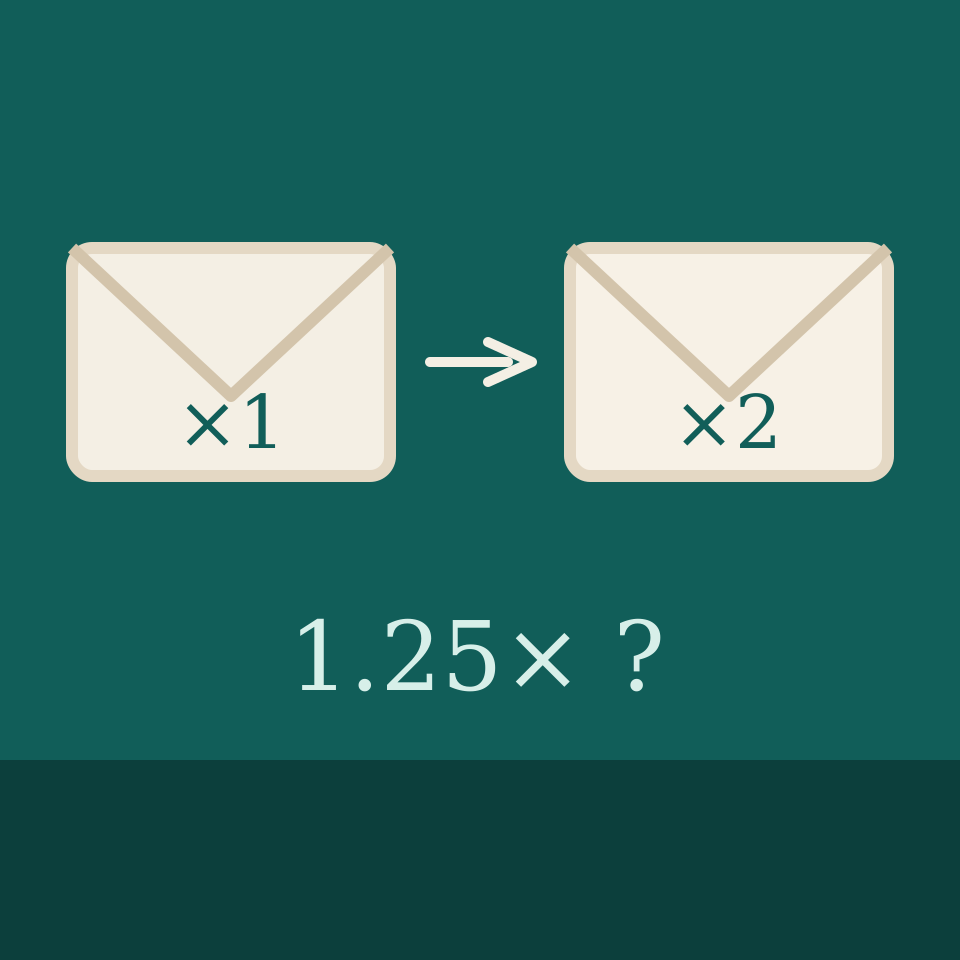
Два конверта, в одном вдвое больше, чем в другом. Вы берёте один. Короткий довод говорит, что другой стоит в 1,25 раза больше, значит, надо менять. Довод неверен, и причина тонка.
The puzzle
You are given two envelopes. One contains twice as much money as the other. You pick one at random. You may keep it, or switch to the other. Should you switch?
The tempting argument
Call the amount in your envelope X. The other envelope holds either half of X or double X. If each were equally likely, the expected amount in the other envelope would be 0.5 × (X/2) + 0.5 × (2X) = 1.25X. That is more than X, so switching looks strictly better. The reasoning never used the value of X, so it seems to say: always switch, whatever you find.
Where it goes wrong
The two possibilities are not equally likely just because you can name them. "The other has double" means your envelope holds the smaller amount. "The other has half" means it holds the larger amount. Once the amount is fixed at a particular X, those are claims about how the pair was chosen, and they need not have the same probability. Without a rule for that choice, the expected value of switching is not defined, and 1.25 is not a result.
A fixed pair
Suppose the envelopes always contain 10 and 20, and you are given one at random. If you do not open yours, each envelope has expected amount 15. Switching changes nothing. If you open it and see 10, the other holds 20 and you should switch. If you see 20, the other holds 10 and you should stay. Following that rule, you always end with 20. The 1.25 argument would have told you to switch even when you were holding 20.
A range, and an infinite average
Suppose the smaller amount is a whole number drawn from 1 to 100, and the other envelope holds double. For many amounts you might open, half and double are equally likely and the other envelope really does average 1.25 times yours. For an odd amount, or any amount that can only be the smaller one, the other envelope has double. For the largest amounts you can only be holding the larger one, and switching loses. Over all pairs, blind switching still averages the same as staying. Switching only when the opened amount favors it does better.
There is also a rule on the powers of two, where the smaller amount is 2ⁿ with probability (1/3)·(2/3)ⁿ. Under that rule every finite amount you can open makes switching look better: 1.1 times yours, or double for the smallest amount. The average amount is infinite. Conditional expectations can all point one way while there is still no finite expected gain. A long simulation does not settle, because one rare huge pair moves the average by a lot.
Explore it
Open the app and the envelopes are closed: the verdict is that either choice is fine. Open yours and the chart marks where that amount sits. Above the line at 1, switching has the higher expectation. Below it, staying does. The dashed line at 1.25 is what the tempting argument claims for every amount. Run 10,000 pairs to see blind switching match staying, and a selective switch come out ahead, except for the powers of two, where the average does not settle.
Часто задаваемые вопросы
Парадокс двух конвертов — это настоящее противоречие?
Нет. Противоречие появляется, только если принять неверный шаг: что половина и удвоение остаются равновероятными после того, как сумма в вашем конверте фиксирована. При полностью заданном способе выбирать суммы ожидания определены, и противоречия нет.
Бывает ли обмен правильным?
Да. Если вы открыли конверт и способ выбора сумм делает другой в среднем ценнее, меняйте. Если вы его не открывали, обмен не меняет ожидаемую сумму.
Кто сформулировал парадокс двух конвертов?
Загадка ходит с середины XX века. Морис Крайчик в 1953 году разобрал родственный парадокс обмена, а форма с двумя конвертами стала стандартным примером в теории вероятностей и теории решений. Трудность в том, чтобы задать распределение сумм.
Почему любая сумма может говорить в пользу обмена?
Потому что «лучше, что бы вы ни увидели» не значит «лучше в целом», когда среднее бесконечно. Закон полного ожидания требует конечного среднего, прежде чем условные части можно сложить. Для степеней двойки это среднее бесконечно, так что части никогда не складываются в конечный выигрыш.
Сопутствующие инструменты
Парадокс двух конвертов
Посмотрите, почему обмен не всегда лучше. Откройте сумму, сравните соблазнительное среднее в 1,25 раза с верным ожиданием и прогоните 10 000 пар.

Парадокс Монти Холла
Парадокс Монти Холла на практике: выберите одну из трёх дверей, посмотрите, как Монти открывает другую, с козой, и решите, остаться или сменить. Играйте сами или дайте компьютеру сыграть 1000 игр и убедитесь, что смена выигрывает в двух случаях из трёх.

Парадокс дней рождения
В группе из 23 человек вероятность того, что у двоих совпадут дни рождения, равна 50,7 %, а в группе из 57 человек — 99 %. Посмотрите на все 253 пары, календарь и кривую и проверьте тысячи случайных групп прямо в браузере.

Парадокс Симпсона
Исследуйте парадокс Симпсона: посмотрите, как один вариант может быть лучше в каждой группе, но хуже в целом, на реальных данных о лечении камней в почках, приёме в Беркли и показателях отбивания в бейсболе или на своих числах.

Ошибка игрока
Подбрасывайте честную монету 100 раз в секунду и смотрите, что выпадает после каждой серии из 5 или 8 орлов подряд. По-прежнему 50/50: у монеты нет памяти.
Готовы попробовать?
Откройте PictorX в своем браузере — установка не требуется, для запуска не требуется кредитная карта.
Попробовать два конверта