
Multiplication Circles
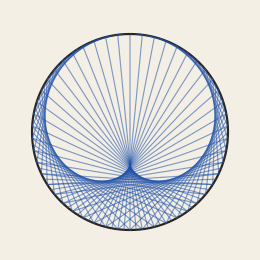
A multiplication circle puts numbers around a rim and draws the pattern of multiplying by one factor. The same figure is made with a pencil, a stick of chalk, or string on a board of nails.
Numbers around a rim
Place n points on a circle. Point 0 is at the top, and the numbers run clockwise: 0, 1, 2, up to n − 1. Choose a factor m. In the products drawing, a straight line runs from each point k to the point (k × m) mod n. The remainder after division by n is the point where the line ends. On a circle of 10, 7 × 2 = 14, and 14 divided by 10 leaves remainder 4, so the line runs from 7 to 4. Adding n to the factor does not change a line. 12× on 10 points is the same drawing as 2×, because 12 and 2 leave the same remainder.
The times table
The classroom drawing walks the multiples in order instead of joining every product. Start at 0 and keep adding m, then join those points. On 10 points the 2× walk is 0–2–4–6–8–0, a pentagon. The 4× walk is 0–4–8–2–6–0, a five-pointed star. The 3× walk visits every point. The 1× walk goes once around the rim, and the 0× walk stays at 0. All cycles draws the loops that do not pass through 0. On 10 points the 2× table has a second pentagon, through the odd numbers. This is the circle used in Waldorf lessons and other hands-on arithmetic, on paper, on a chalkboard, or with yarn.
The cardioid
Keep the products rule and add points. At a couple of hundred, the 2× lines crowd against a cardioid, a curve with one cusp, the heart at the top of the circle. The 3× lines crowd against a nephroid, which has two cusps. An integer factor m hugs a curve with m − 1 cusps. The 5× lines have four. Every line is straight. The curve is only the edge the lines will not cross. Slide the factor and the cusp count changes in plain sight. The 1× factor draws nothing, because every point lands on itself. The 0× factor sends every line to point 0.
Paper, chalk, and nails
The figure is the one people draw by hand. Paper is a colored pencil on a warm sheet. Chalk is a green board and a dusty line. Wood is a ring of nails with yarn pulled from nail to nail, the round geoboard. Ten or twelve points are for reading a table, and the numbers can sit just outside the rim. A hundred points or more are for the curve. The nails disappear once they would sit on top of one another, and the lines carry the picture.
Explore it in PictorX
Open Multiplication Circles and the cardioid is already drawn: 200 points, times 2, on paper. 2× table, 4× star, and 3× table are the ten-point drawings, with the numbers on. 12 points, ×5 is the star on a clock face. Nephroid is the 3× curve. Wood string uses 60 nails and yarn. Chalk sweep plays the factor forward on a green board. Press play and the factor walks. Previous and next step one whole table at a time. Click a point and the readout gives the product and the remainder. Save a PNG, or open the canvas in the PictorX editor. The Ulam spiral and Buffon's needle are two more pieces of mathematics you can watch.
Frequently asked questions
What is a multiplication circle?
Points numbered around a circle, and a drawing of multiplication by one factor. Products joins each point k to (k × m) mod n. Times table joins the multiples in order: 0, m, 2m, 3m, and so on.
Why does times 2 look like a heart?
With a few hundred points, the straight lines of the 2× products sit against a cardioid, a curve with one cusp. Times 3 sits against a nephroid, which has two cusps. An integer factor m gives m − 1 cusps.
Why is the 4× table a star?
In times table mode on 10 points, adding 4 each step visits 0, 4, 8, 2, 6, and back to 0. Those five chords are a pentagram. The 2× table on the same circle is the pentagon 0–2–4–6–8.
What does mod n mean?
The remainder after division by n, the number of points. On 10 points, 7 × 2 = 14 and 14 mod 10 is 4, so the line ends at point 4.
Where are multiplication circles used?
Waldorf and other hands-on lessons draw the times tables this way, on paper, on a chalkboard, or with string on a board of nails. The many-point figure is a picture of modular multiplication.
Related tools
Multiplication Circles
Join each number on a circle to its multiple. Draw a times table, a cardioid, or a string figure on paper, chalk, or wood.
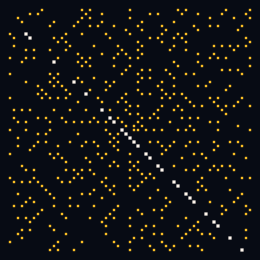
Ulam spiral
Draw the Ulam spiral in your browser. Mark the primes, read the quadratic on each diagonal, and open Euler's unbroken run of 40 primes.
The Ulam spiral
How Stanisław Ulam's 1963 spiral lays the integers on a square grid, why primes gather on quadratic diagonals, and where Euler's forty primes sit when the spiral starts at 41.
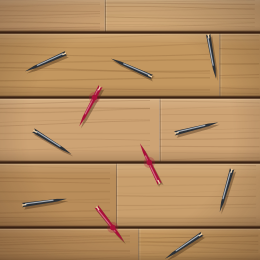
Buffon's Needle
Drop needles on a lined floor in your browser. Count the crossings and watch Buffon's 1777 experiment estimate π.
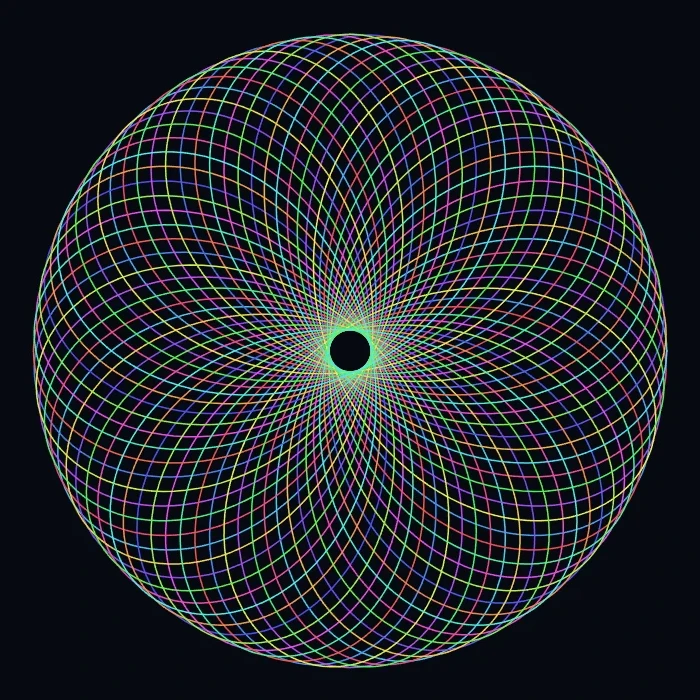
Spirograph
Draw hypotrochoids and epitrochoids in your browser. Tune R, r, and pen offset, animate the curve, randomize styles, and save a PNG.
Ready to try it?
Open PictorX in your browser — no install, no credit card required to start.
Try multiplication circles