
How body mass index works
Body mass index puts height and weight into one number that doctors use as a first, quick check of weight in adults. It is simple to work out and easy to compare, but it says nothing about where weight sits or what it is made of. Here is how it is calculated, how to read it and when to look further.
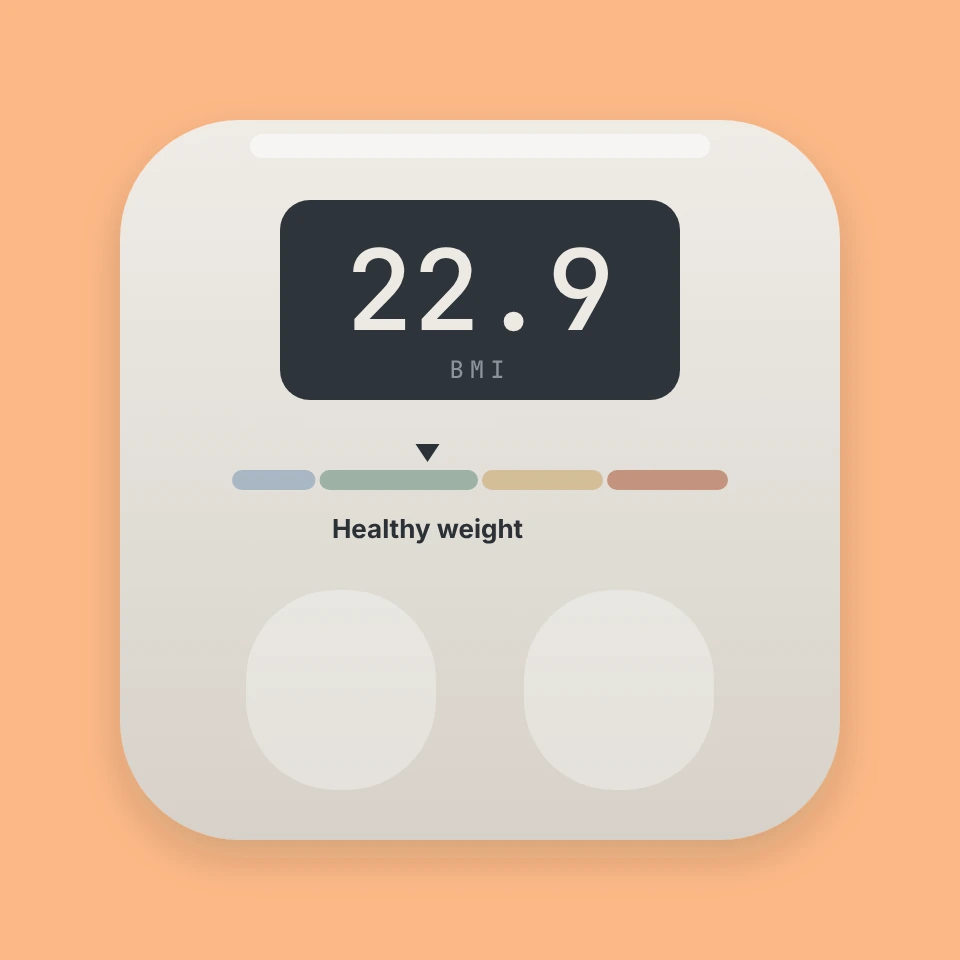
The formula
BMI is weight in kilograms divided by height in metres squared. Someone who weighs 82 kg and is 1.80 m tall has a BMI of 82 ÷ 3.24 = 25.3. With pounds and inches the same result comes from 703 × weight in pounds ÷ height in inches squared: 181 lb at 70.9 inches also gives 25.3. The number itself is only compared with the ranges below.
What the categories mean
The World Health Organization's adult ranges are: under 18.5 underweight, 18.5 to 24.9 healthy weight, 25 to 29.9 overweight, 30 to 34.9 obesity class I, 35 to 39.9 class II, and 40 or more class III. Large studies link a BMI outside the healthy range with higher risks of conditions such as type 2 diabetes and heart disease and, at the low end, weaker bones and a weaker immune system. The risk rises gradually: the borders are conventions, not cliffs.
Your healthy weight range
Because BMI only depends on height and weight, the healthy range turns into a weight range for your height: 18.5 × height² to 24.9 × height². At 1.75 m that is about 56.7 to 76.3 kg (125 to 168 lb). The calculator shows this range and how many kilograms or pounds you are above or below it, which is often easier to act on than the BMI itself.
Where BMI falls short
BMI cannot tell muscle from fat or show where fat is stored. An athlete can count as overweight, and an older person who has lost muscle can look healthy. Fat around the waist carries more risk than fat elsewhere, so a waist measurement helps: a waist under half your height is a common rule of thumb. Some health services use lower BMI thresholds for people of South Asian, Chinese, Middle Eastern, Black African or African-Caribbean origin, because their risks rise at a lower BMI.
Children, pregnancy and older age
For children and teenagers, BMI is compared with growth charts for age and sex, so the adult ranges do not apply. In pregnancy, weight gain is expected, and doctors use the BMI from before the pregnancy. In older age, many studies find no higher risk for a BMI a little above 25. In all these cases, talk to a doctor, nurse or dietitian rather than relying on the adult ranges.
Frequently asked questions
What is BMI Prime?
BMI Prime is your BMI divided by 25, the upper limit of the healthy range. A value of 0.92 means you are 8% below that limit, and 1.10 means 10% above it, so you can see at a glance how far you are from the limit.
Why does my BMI say overweight when I am fit?
Muscle is denser than fat, so people with a lot of muscle can have a BMI of 25 or more with little body fat. If you train a lot, a waist measurement or a body fat measurement says more than BMI.
How often should I check my BMI?
There is no need to check it often. Weight goes up and down by a kilogram or two from day to day. To follow a trend, weigh yourself at the same time of day once a week or once a month and look at the change over several weeks.
Related tools
BMI calculator
A free BMI calculator for adults: body mass index from height and weight in metric or imperial units, with the WHO category, your healthy weight range and a clear scale.
Unit converter
A free online unit converter for length, weight, temperature, speed, area, volume, time, pressure, energy and computer data - bytes to gigabytes and GB to GiB.
Habit tracker
A free online habit tracker: add daily or weekly habits, tick off days in a week or month grid, and watch streaks, completion and a heatmap. Saved in your browser.
Calculator
A free online calculator with a basic and a scientific mode: trigonometry, logarithms, powers, roots, factorials, memory and history, with the correct order of operations.
Ready to try it?
Open PictorX in your browser — no install, no credit card required to start.
Open the BMI calculator