
Hi-Lo card counting
Card counting is a blackjack strategy in which a player keeps track of the cards that have been played, to judge whether the cards that are left favour the player or the dealer. By betting more when they favour the player, a counter can beat the casino in the long run.

The Hi-Lo values
The best known and most used method is the Hi-Lo system. Every card that comes out of the shoe gets a value of +1, 0 or −1.
+1, the low cards: 2, 3, 4, 5 and 6. When they fall, fewer low cards are left. That is good for the player. 0, the neutral cards: 7, 8 and 9. They have no influence on the edge and do not change the count. −1, the high cards: 10, jack, queen, king and ace. When they fall, the chance of a blackjack or a high starting hand for the player goes down.
A deck has 20 low cards and 20 high cards, so its 52 cards add up to exactly 0. That makes Hi-Lo a balanced count: after the last card of the shoe the count is back at 0.
Step by step
1. Start the count: begin at 0 as soon as the dealer has shuffled and starts to deal. 2. Keep the running count: add up the values of all the cards that are turned face up on the table, all the time. 3. Work out the true count: casinos play with several decks, so divide the running count by the estimated number of decks still in the shoe. True count = running count ÷ decks left. 4. Adjust your bet: the higher the true count, the bigger your edge. Bet more when the count is positive, and bet the minimum, or sit out, when it is negative.
Why the true count
A running count of +6 means something different at the start of a six-deck shoe than near its end. With five decks left, six extra high cards are spread over 260 cards and hardly matter: the true count is +1.2. With one deck left the same six cards make a true count of +6, a big edge. Counters estimate the decks left by looking at the discard tray, usually to the nearest half deck. The app shows the tray and the shoe with a tick for every deck, and the division under the true count.
Why tens and aces help the player
A blackjack, an ace with a ten, pays the player 3 to 2, but when the dealer has one the player only loses the bet. More tens and aces also make the dealer bust more often, because the dealer must keep drawing until 17, while the player may stand on 12. Doubling down on 10 or 11 wins more often too. Low cards do the opposite: they help the dealer reach 17 to 21 without busting.
How big the edge is
With six decks, the dealer standing on all 17s, doubling after a split and blackjack paying 3 to 2, a player using basic strategy and betting the same every round loses about 0.4% of the money bet. Each point of true count adds roughly 0.5%, so the player has the edge from a true count of about +1. That is not often: with six decks the true count is +2 or more in only about one round in seven. Betting 1 unit at low counts and up to 12 at high counts, and sitting out below −1, turns this into a profit of about 1% of the money bet in the app's simulation. The swings are much larger than the edge, so a counter needs a big bankroll and many hours of play.
Penetration, live casinos and online games
The deeper the dealer deals into the shoe before shuffling, the higher the true counts can climb. This is called penetration. In regular online blackjack counting is impossible, because the software shuffles the cards digitally after every hand: the count is 0 before every bet. At live casino tables, with a real dealer on a video stream, it is sometimes possible, but they often shuffle as soon as half the shoe has been dealt. That poor penetration keeps the edge small: in the app's simulation, a six-deck shoe shuffled halfway leaves the counter less than a third of the edge of a shoe dealt to 75%.
Is it legal?
Yes. Counting cards with your own head is not illegal. Casinos are private property, though, and have the right to refuse players or to ask them to stop if they suspect that they are counting cards. Using a device or software to help you count at a real table is illegal in many places.
A short history
In 1962 the mathematician Edward Thorp published Beat the Dealer, which showed with computer calculations that blackjack can be beaten by keeping track of the cards. His first method counted tens. In 1963 Harvey Dubner proposed the simpler high-low count, and in 1975 Stanford Wong described it in detail in Professional Blackjack. Hi-Lo is still the count most players learn first: it is easy to keep, and more complex counts gain only a little.
Explore it in PictorX
Open Hi-Lo card counting and a blackjack table deals by itself, a card at a time. Every card shows its value, the running count is on the left under the discard tray, and the true count is on the right under the shoe. The chart follows the count through the shoe up to the cut card. In Practice the values and counts are hidden and after every round you pick the running count. Count down a deck turns 52 cards one by one; with one card left the count tells you what it is. Deal a million rounds to see the edge at each true count, compare a flat bet with betting by the count, and try a live casino that shuffles halfway or an online game that shuffles after every round.
Frequently asked questions
Who invented the Hi-Lo count?
Harvey Dubner proposed it in 1963, building on Edward Thorp's work in Beat the Dealer (1962). Stanford Wong made it popular with his book Professional Blackjack in 1975.
What is the difference between the running count and the true count?
The running count is the sum of the values of all the cards seen since the shuffle. The true count is the running count divided by the decks still in the shoe, so it measures how rich the remaining cards are in tens and aces.
Why does a full deck add up to 0?
A deck has five low ranks (2 to 6) and five high ranks (10, jack, queen, king and ace), each four times: 20 cards count +1 and 20 count −1. The twelve 7s, 8s and 9s count 0.
Do card counters win every round?
No. Even at a high true count the edge is only a few percent, so many rounds are still lost. The edge shows only over thousands of rounds, and losing streaks of hundreds of units are normal along the way.
How fast should I be able to count?
A common exercise is to count down a deck: turn the cards one by one and check that you end at 0. Practised counters do it in under 30 seconds. With one card held back, the final count tells you whether it is low, neutral or high.
Related tools
Hi-Lo card counting
Learn Hi-Lo card counting at a blackjack table in your browser: +1, 0 or −1 for every card, the running count, the true count and the bet. Practise the count, count down a deck, or play a million rounds.

Gambler's fallacy
Flip a fair coin 100 times a second and see what comes after every streak of 5 or 8 heads in a row. It is still 50/50: the coin has no memory.
The gambler's fallacy
Why a coin has no memory: independent events, the chance of a streak versus the chance of the next flip, the 1913 Monte Carlo roulette streak, how often long runs appear, and why the law of large numbers needs no correction.
The Monty Hall problem
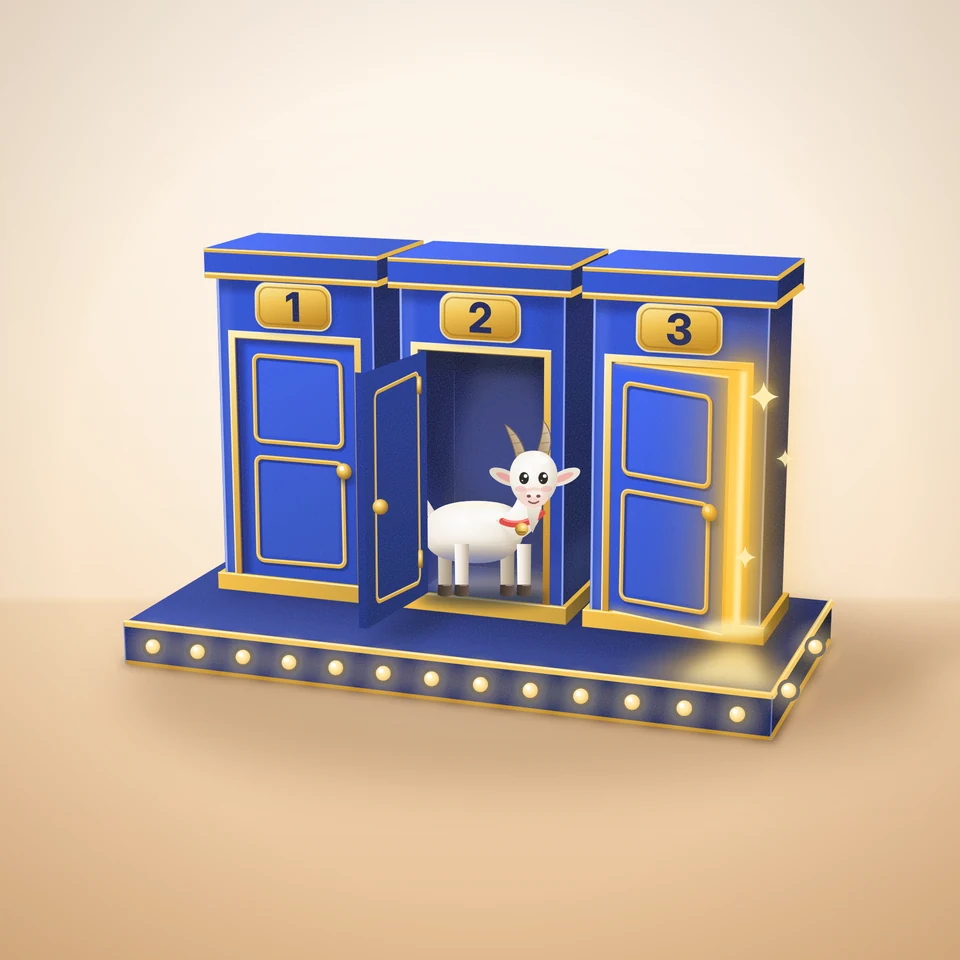
Pick one of three doors, watch Monty open one with a goat, then stay or switch. Play yourself or let the computer play 1,000 games and see switching win two times out of three.
The Monty Hall problem
The Monty Hall problem explained: why switching wins 2/3 of the time, a table of all cases, Bayes' theorem, the many-doors version, the host who does not know, and the 1990 controversy.
Rolling dice
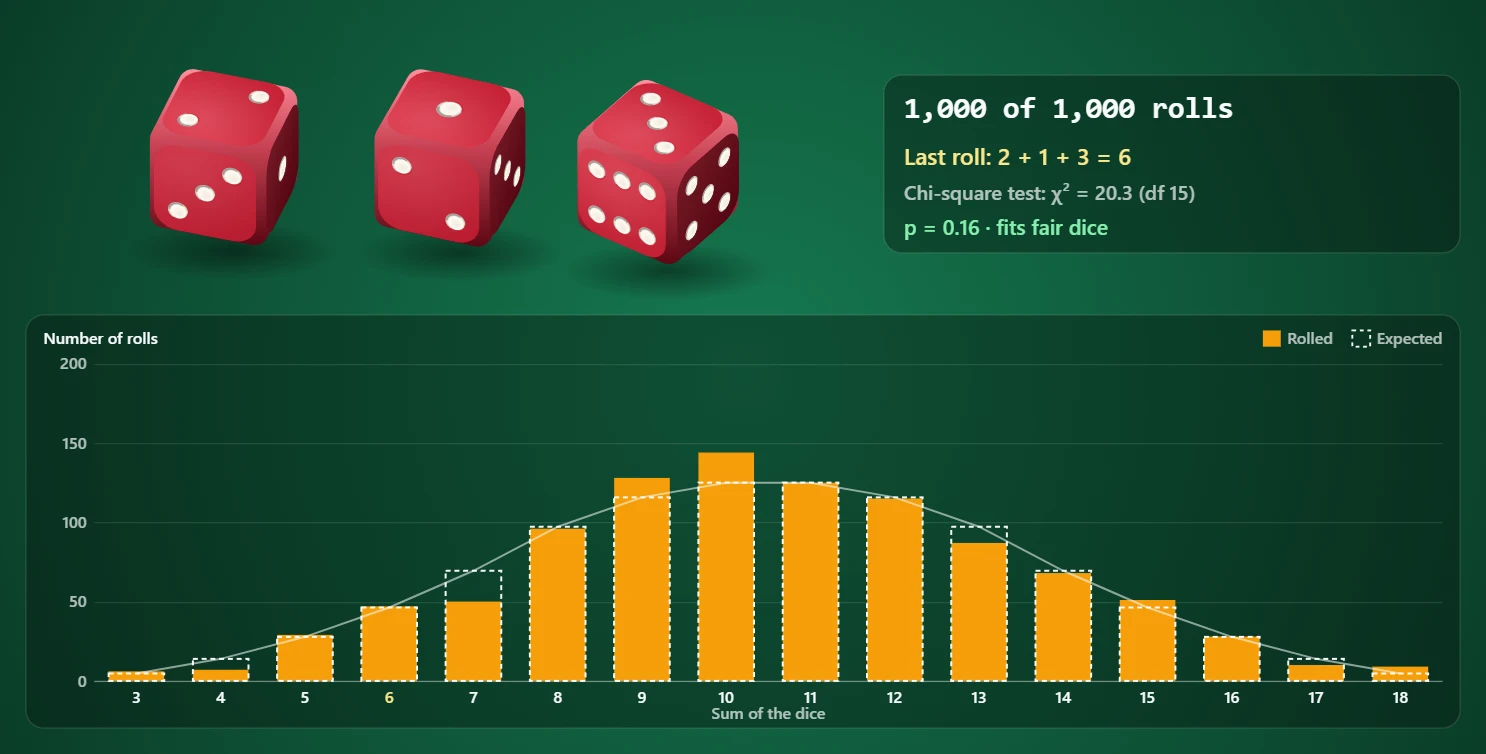
Roll one, two or three dice a thousand times and compare the bar chart of how often each result came up with the expected frequencies. See why 7 is the most common sum.
Ready to try it?
Open PictorX in your browser — no install, no credit card required to start.
Try Hi-Lo card counting