
The story of Kanban
Kanban is Japanese for signboard or visual card. What began as paper cards on a Toyota factory floor became one of the most popular ways to organise any kind of work: make it visible, limit how much is going on at once, and let tasks flow from start to finish.
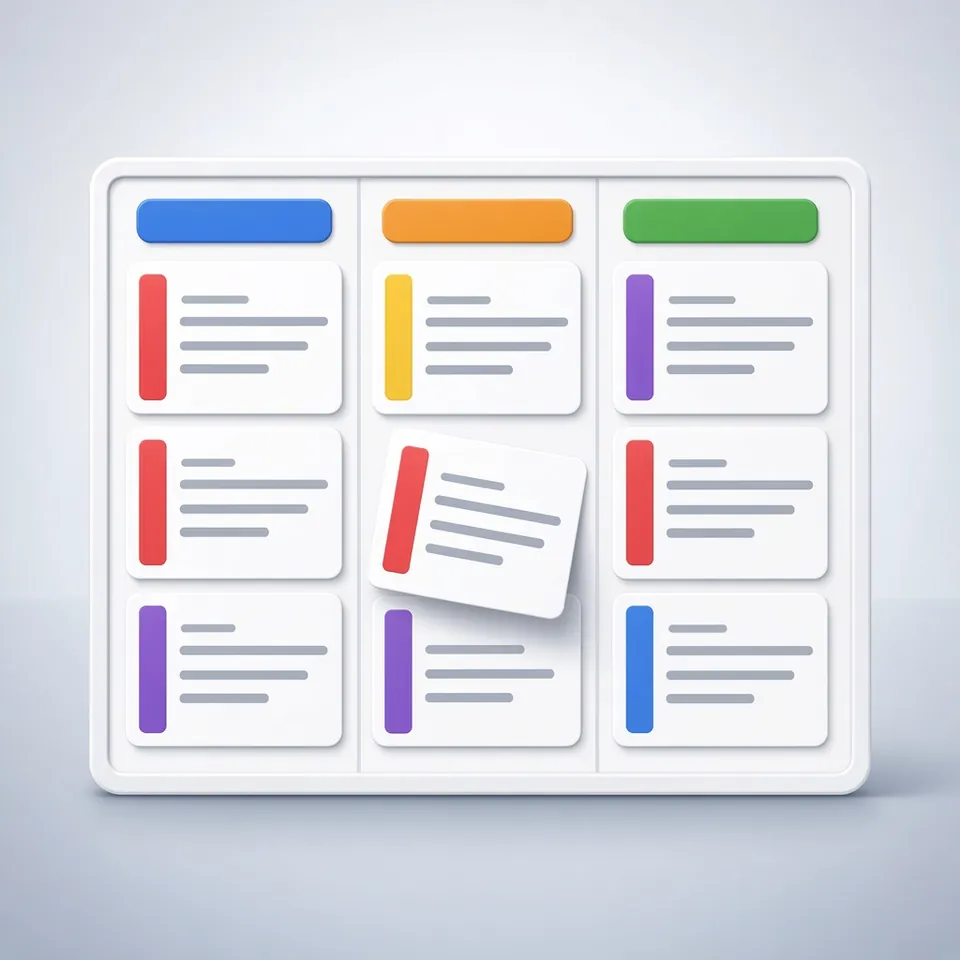
Cards on a factory floor
In the late 1940s and 1950s Taiichi Ohno, an engineer at Toyota, looked for a way to make only what was needed, when it was needed. Each container of parts carried a card, the kanban. When a station used up its parts, the card went back and told the previous station to make more. Production was pulled by real demand instead of pushed by a forecast, which cut stock, waste and waiting.
The supermarket idea
Ohno was inspired by American supermarkets, where shelves are refilled only when customers take products away. The empty space on the shelf is the order for more. Kanban cards worked the same way in the factory and became a core part of the Toyota Production System and, later, of lean manufacturing worldwide.
From factories to knowledge work
From the mid 2000s David J. Anderson applied the same ideas to software teams, and his 2010 book Kanban made the method popular far beyond factories. Work items became cards, the steps of the process became columns, and the team pulled the next card only when there was room. Today teams in software, marketing, healthcare and households use Kanban boards on walls and screens.
Why limiting work in progress helps
Starting a task feels productive, but every half finished task costs attention. A WIP limit caps how many cards may sit in a column. When a column is full, people help to finish work instead of starting more, bottlenecks become visible and tasks move through the board faster. Little's law explains why: at the same throughput, less work in progress means a shorter wait for each task.
Frequently asked questions
What does Kanban mean?
Kanban is Japanese and roughly means signboard or visual card. At Toyota it was the card that signalled when to make more parts. Today it usually means a board with cards that move through columns.
Who invented Kanban?
Taiichi Ohno developed the Kanban system at Toyota in the late 1940s and 1950s as part of the Toyota Production System. David J. Anderson later shaped the Kanban method for software and other knowledge work.
What is the difference between Kanban and Scrum?
Scrum plans work in fixed sprints with set roles. Kanban has no sprints: work flows continuously and WIP limits control how much is in progress. Many teams combine the two.
Related tools
Kanban board
A free online Kanban board: drag cards between To do, In progress and Done, add your own columns, WIP limits, colour labels, due dates and priorities. Saved in your browser.

To-do list
A free, minimalist to-do list: add tasks with Enter, tick them off, filter by status, tag and priority, sort by due date and keep several lists, all stored in your browser.
Pomodoro timer
A free Pomodoro timer: 25 minutes of focus, 5-minute breaks and a long break after four sessions, with a progress ring, sound signals, notifications and daily stats.
Countdown timer
A free online countdown timer: count down live to an event, product launch or the New Year in any time zone, with flip or clean digits, share links, embed code and confetti.
Ready to try it?
Open PictorX in your browser — no install, no credit card required to start.
Open the Kanban board