
Exchange rates, from the gold standard to floating currencies
An exchange rate is simply the price of one currency in another. Here is how those prices are set, why some currencies float and others are pinned to the dollar or the euro, how to read codes such as EUR and JPY, and how today's system grew out of gold.
What is an exchange rate?
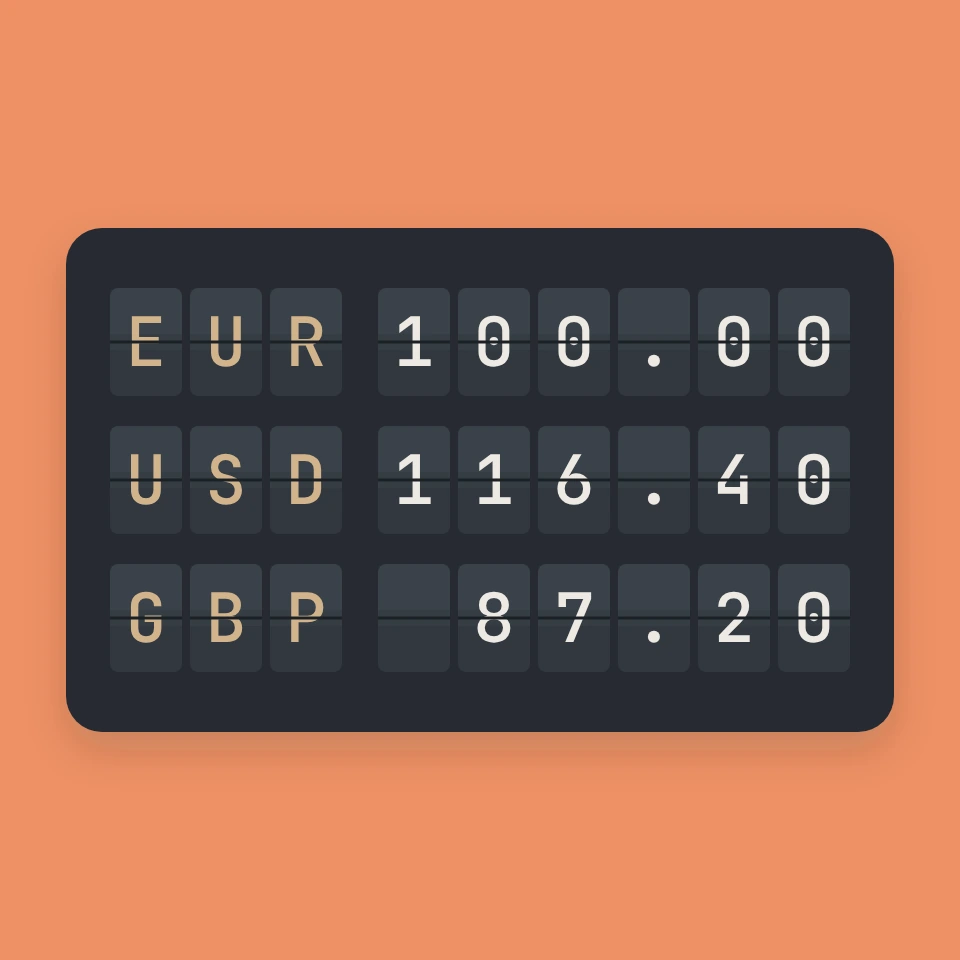
An exchange rate tells you how much of one currency you get for one unit of another. If EUR/USD is 1.08, one euro buys 1.08 US dollars and one dollar buys about 0.93 euros. Banks and exchange offices quote two prices: a lower bid at which they buy and a higher ask at which they sell. The mid-market rate sits halfway between and is the fairest reference. Reference rates, such as those of the European Central Bank, are published once a working day, while traders see prices change every second.
Floating and fixed exchange rates
Most large currencies, including the US dollar, the euro, the pound and the yen, float: their price is set by supply and demand, and central banks steer it only indirectly through interest rates. Other countries fix or peg their currency. The Danish krone is held at a central rate of 7.46038 kroner per euro within the ERM II band of 2.25 percent, the Hong Kong dollar has stayed between 7.75 and 7.85 per US dollar since 1983, and the Saudi riyal has been fixed at 3.75 per dollar since 1986. Many systems sit in between as a managed float, where the central bank allows movement but intervenes to smooth it.
ISO 4217 currency codes
The three-letter codes in this converter come from the international standard ISO 4217, first published in 1978. The first two letters are usually the ISO country code and the third is the initial of the currency, so USD is the United States dollar and JPY the Japanese yen. The euro, which belongs to no single country, is EUR. Codes starting with X are not tied to a country: XAU is an ounce of gold and XDR the IMF special drawing right. Each currency also has a numeric code, such as 978 for the euro and 840 for the dollar, and a number of minor units: the yen has none, the Kuwaiti dinar has three.
History - from the gold standard to Bretton Woods
Britain drifted onto gold in 1717, when Isaac Newton as Master of the Mint set the price of the guinea, and made it law in 1821. By the 1870s most trading nations tied their money to a fixed weight of gold, so exchange rates barely moved until the First World War broke the system in 1914. In July 1944 delegates from 44 countries met at Bretton Woods in New Hampshire: currencies were pegged to the US dollar, the dollar was convertible into gold at 35 dollars an ounce, and the IMF and the World Bank were founded. On 15 August 1971 President Nixon stopped converting dollars into gold, and from March 1973 the major currencies floated. The euro followed on 1 January 1999, with notes and coins in 2002.
Frequently asked questions
Which currency is worth the most?
Per unit, the Kuwaiti dinar is usually the most expensive currency, at more than three US dollars. That says little about the strength of an economy: the value of one unit mostly reflects where a currency started and how often it was redenominated, not how rich a country is.
Is a fixed exchange rate better than a floating one?
Neither is better in every case. A peg gives traders and travellers certainty and can import the credibility of a stronger currency, but the central bank then has to follow the anchor's interest rates and needs reserves to defend the rate. A floating currency absorbs shocks on its own and leaves monetary policy free, at the cost of day-to-day swings.
Why did the gold standard end?
Gold tied the amount of money to the amount of metal in the vaults, which made it hard to pay for wars or to fight a depression. Countries suspended it in 1914, tried to return in the 1920s and dropped it again in the Great Depression, Britain in 1931. Bretton Woods kept a link to gold only through the dollar, and that link ended in 1971 when US gold reserves could no longer cover the dollars held abroad.
Related tools
Currency converter
A free online currency converter with live exchange rates: convert euros, pounds, dollars, yen and more than 150 other currencies, with favourites and an offline fallback.
VAT calculator
A free online VAT calculator: add or remove VAT with rates for the Netherlands, Belgium, Germany, France, the UK and more, and print a simple invoice overview.
Calculator
A free online calculator with a basic and a scientific mode: trigonometry, logarithms, powers, roots, factorials, memory and history, with the correct order of operations.
Ready to try it?
Open PictorX in your browser — no install, no credit card required to start.
Open the Currency converter