
Bertrand's paradox explained
In 1889 the French mathematician Joseph Bertrand asked a question that sounds as if it has one answer: draw a chord of a circle at random, and how likely is it to be longer than a side of the equilateral triangle inscribed in the circle? He then gave three careful solutions with three different results. The puzzle is not a trick. It shows that "at random" means nothing until you say how the random choice is made.
The question
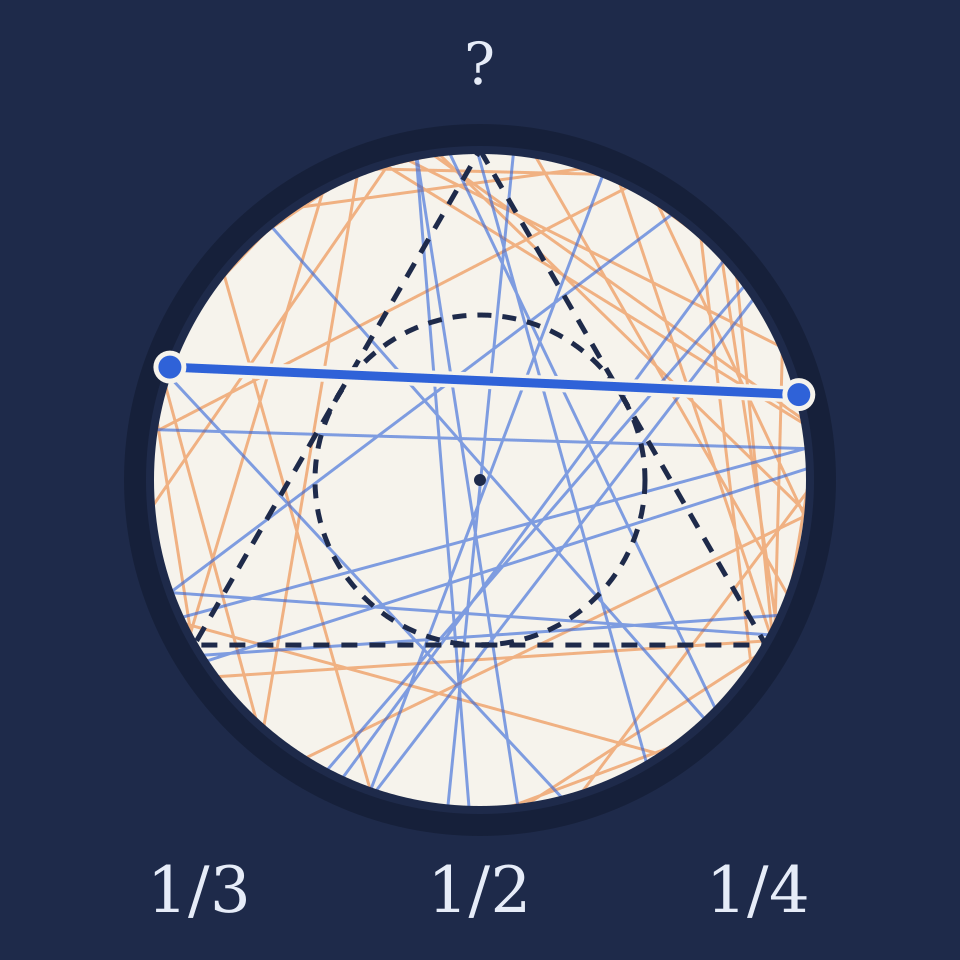
Take a circle of radius r and the equilateral triangle that fits inside it; each of its sides is √3 r long, about 1.73 r. Now choose a chord, a straight line from one point of the circle to another, at random. What is the probability that the chord is longer than a side of the triangle? Bertrand put the question in his Calcul des probabilités to warn against problems on infinite sets of possibilities that do not say how a choice is made, and he answered it three times.
Random endpoints: 1/3
Choose two points on the circle independently and join them. Because the circle looks the same from every point, you may turn the triangle so that one corner sits on the first point. The chord is then longer than a side exactly when the second point falls on the arc between the other two corners, which is one third of the circle. So the probability is 1/3.
Random radius: 1/2
Choose a radius, then a point on it uniformly, and draw the chord through that point at right angles to the radius. Turn the triangle so that one side is also at right angles to that radius. That side crosses the radius at its midpoint, at r/2 from the centre. The chord is longer than the side when its point is closer to the centre than r/2, which happens for half of the radius. So the probability is 1/2.
Random midpoint: 1/4
Every chord except a diameter has exactly one midpoint, so you can choose a chord by choosing its midpoint uniformly anywhere inside the circle. A chord is longer than the side exactly when its midpoint lies within r/2 of the centre. That inner circle has half the radius and so a quarter of the area. So the probability is 1/4.
What really differs: the midpoints
Half a chord at distance d from the centre is √(r² − d²) long, so every chord is longer than the triangle's side exactly when d < r/2. The three methods agree on that, and disagree only on how often each distance d comes up. With random endpoints the midpoints crowd towards the edge, with density 2 / (π√(r² − d²)). With a random radius every distance is equally likely. With a random midpoint the density grows with d, as 2d / r², because there is more room far from the centre. The share of each distribution below r/2 is 1/3, 1/2 and 1/4. A histogram of the midpoint distances shows the three shapes at once, and it is the clearest way to see that the methods are simply different experiments.
The principle of indifference
Bertrand's target was the principle of indifference: when you know nothing that favours one possibility, give them all the same probability. With finitely many cases, such as the faces of a die, it works. With infinitely many it does not say what "the same" should mean: equal probability for equal lengths of arc, equal lengths of radius, or equal areas of the disc. Each choice is uniform in one description and uneven in the others, and each leads to a different answer. Modern probability avoids the problem by requiring every question to name its probability distribution.
Jaynes and the thrown straws
In his 1973 paper The Well-Posed Problem, the physicist Edwin Jaynes asked what happens when the problem is made physical: straws are thrown onto a circle drawn on the floor by someone too far away to aim. The answer should not change if the circle is shifted a little or drawn slightly larger, because the thrower cannot tell. Jaynes showed that only one distribution of lines has both properties, the one with evenly spread distances from the centre, so the answer is 1/2, and he reported that real straws agreed. Not everyone accepts that this settles the question for every reading of "at random", but it shows how a vague question can become a well-posed one.
Explore it
Open Bertrand's paradox to draw chords by random endpoints, a random radius, a random midpoint or thrown straws. The triangle turns the way each argument needs it, the inner circle shows which midpoints make long chords, and switching from chords to midpoints shows where each method puts them. A histogram compares the distances of the midpoints with the theory curve, and Compare all draws 10,000 chords by every method so the four answers sit side by side in one table.
Frequently asked questions
Who was Joseph Bertrand?
A French mathematician, 1822 to 1900, who worked on number theory, differential geometry, probability and economics. Bertrand's postulate, that there is always a prime between n and 2n, and Bertrand competition in economics are also named after him. The chord problem appears in his book Calcul des probabilités of 1889.
Is one of the three answers wrong?
No. Each is the exact answer for its own method of choosing a chord. The paradox is that the question, as Bertrand stated it, does not say which method to use, and the methods give different probabilities to the same set of chords.
Why does 1/2 come up twice?
A random point on a random radius and a random straw that crosses the circle both give a midpoint whose distance from the centre is spread evenly from 0 to r. Different procedures can give the same distribution, and then they give the same answers to every question.
Is it related to Buffon's needle?
Both belong to geometric probability, where chances are measured by lengths, areas and angles. Buffon's needle of 1777 is well posed, because the needle's position and angle are taken as evenly spread, and it leads to π. Bertrand's paradox shows what happens when a question leaves that choice open.
Related tools
Bertrand's paradox
Draw random chords of a circle four ways and watch the share longer than the triangle's side settle at 1/3, 1/2 or 1/4. See the midpoints, the theory curve, and Jaynes's straws.

Buffon's Needle
Drop needles on a lined floor in your browser. Count the crossings and watch Buffon's 1777 experiment estimate π.
Monte Carlo π
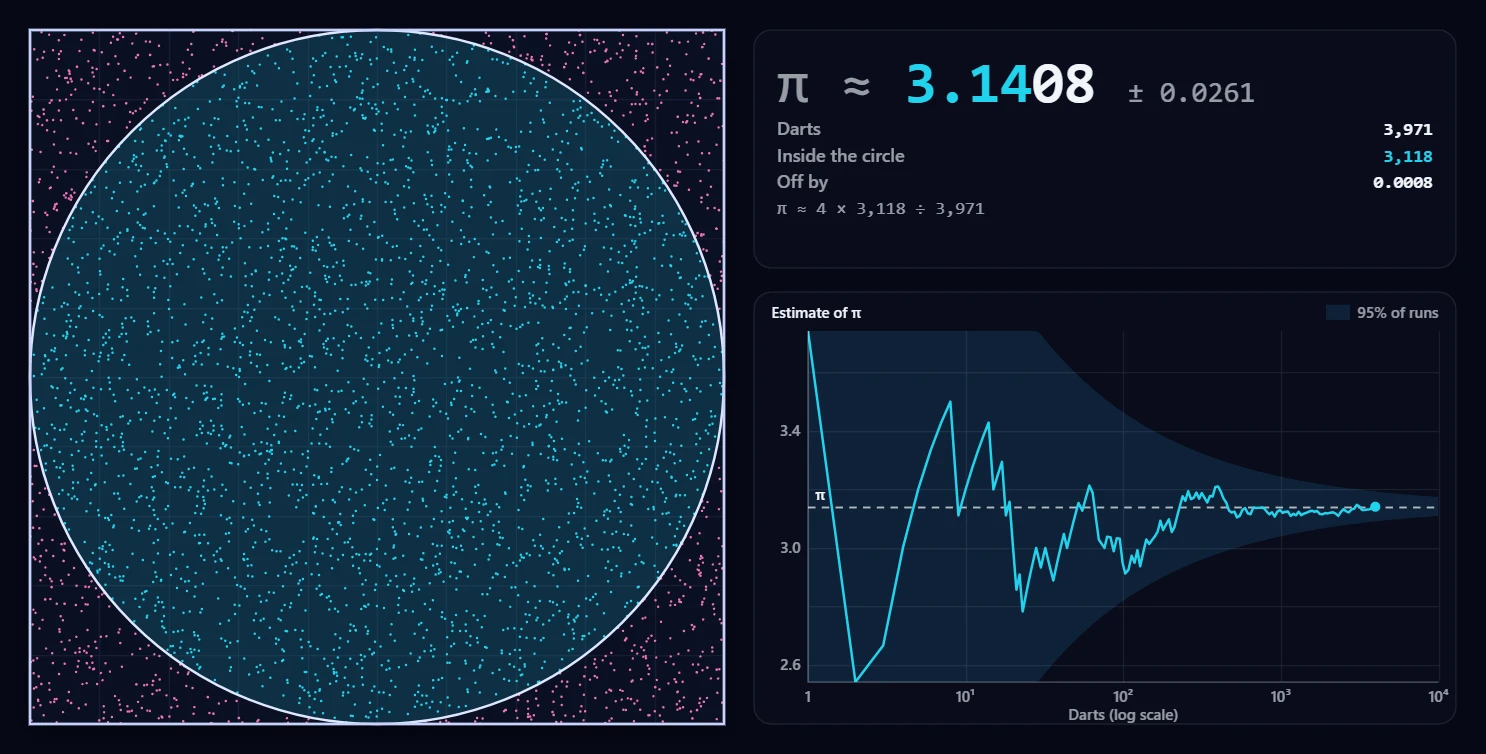
Throw thousands of random darts at a square with a circle in it and watch the share that lands inside turn into π. Start, stop, and follow the estimate as it converges.
Two envelopes paradox
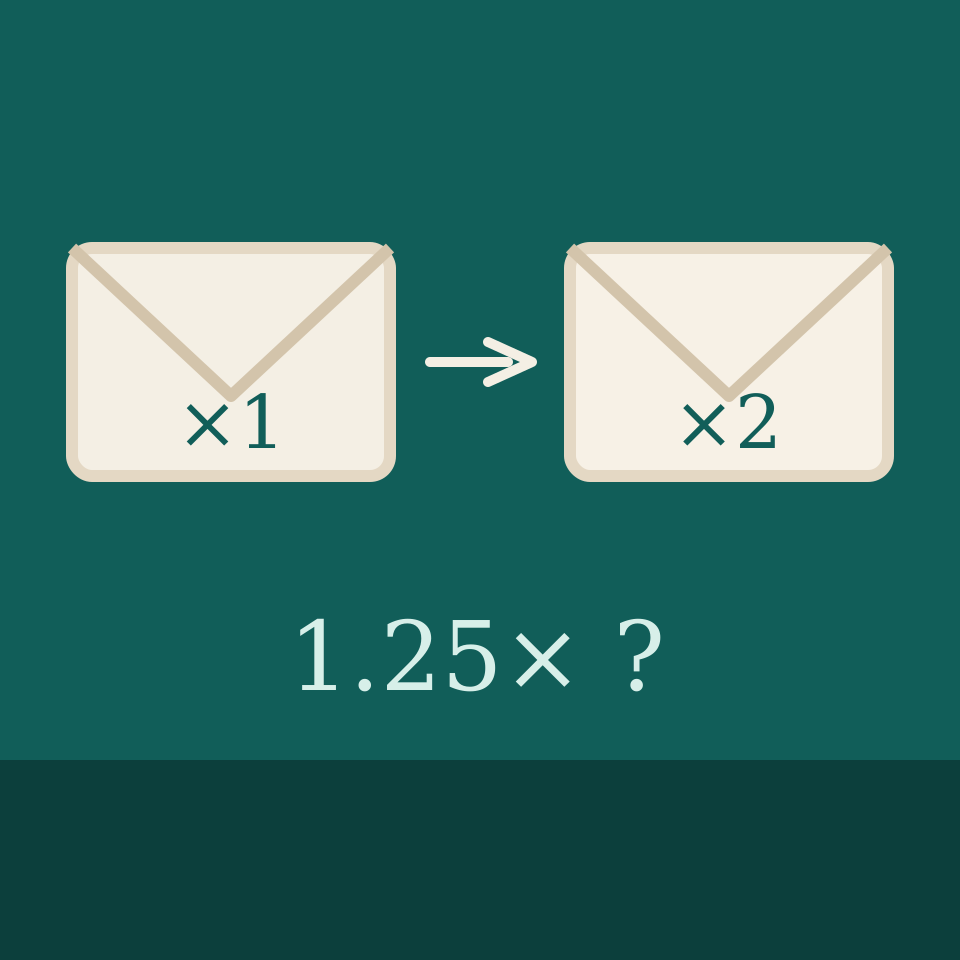
See why switching envelopes is not always better. Open one amount, compare the tempting 1.25 times average with the correct expectation, and run 10,000 pairs.

The birthday paradox
In a group of 23 people the chance that two share a birthday is 50.7%, and with 57 people it is 99%. See all 253 pairs, the calendar and the curve, and test thousands of random groups in your browser.
Ready to try it?
Open PictorX in your browser — no install, no credit card required to start.
Open Bertrand's paradox