
- Longer than the side
- Shorter than the side
- Triangle and inner circle
- Longer than the side
- Shorter than the side
- Theory curve
Distance of the chord's midpoint from the centre
| Method | Theory | Observed | Chords drawn |
|---|---|---|---|
| 1/3 | - | 0 | |
| 1/2 | - | 0 | |
| 1/4 | - | 0 | |
| 1/2 | - | 0 |
Bertrand's paradox
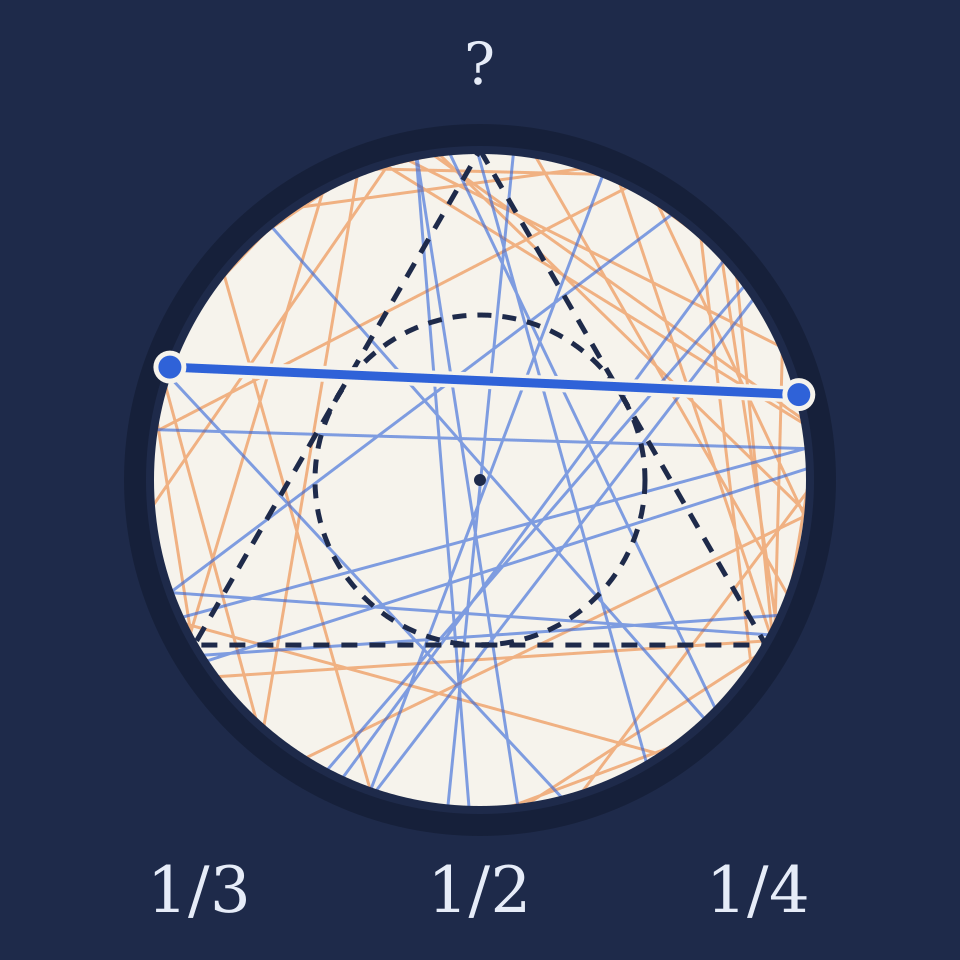
Draw a chord of a circle at random. How likely is it to be longer than a side of the equilateral triangle that fits inside the circle? Joseph Bertrand showed in 1889 that three sensible ways of choosing the chord give three different answers: 1/3, 1/2 and 1/4. Draw thousands of chords by each method, watch the shares settle on their own answers, and see where each method puts the midpoints, which is the whole reason they disagree. Choose how a chord is drawn at random, then press Play, or Step for one chord at a time. The legend shows which colour marks the chords that are longer than a side of the triangle. Show the midpoints instead of the chords to see where each method puts them. Compare all draws 10,000 chords with every method at once; click a method in the table to switch to it.
How it works
- Choose a method: two random endpoints, a random point on a random radius, a random midpoint, or straws thrown onto the circle.
- Press Play or Step and watch each chord drawn long or short, with the triangle turned the way the method's argument needs it.
- Show the midpoints, read the spread of their distance against the theory curve, and press Compare all to put the four methods side by side.
Three answers to one question
Pick two random points on the circle and join them: fix the first, and the chord is longer than the triangle's side when the second lands on the third of the circle opposite it, so the chance is 1/3. Pick a random radius and a random point on it, and draw the chord at right angles through that point: the chord is long when the point is on the inner half of the radius, so the chance is 1/2. Pick a random point in the circle as the chord's midpoint: the chord is long when the midpoint is within half the radius of the centre, a circle with a quarter of the area, so the chance is 1/4. Each argument is correct for its own method.
Why they disagree
A chord is fixed by its midpoint, and it is longer than the triangle's side exactly when that midpoint lies within half the radius of the centre. The methods only differ in how they spread the midpoints. Random endpoints crowd them near the edge, a random radius spreads their distance from the centre evenly, and a random midpoint spreads them evenly over the area, which puts few near the centre. "At random" is not one rule but many, and the question has no answer until you say which. In 1973 Edwin Jaynes argued that straws thrown onto a circle from far away pick out the even spread, 1/2, the only answer that stays the same when the circle is moved or resized.
Frequently asked questions
So what is the right answer to Bertrand's paradox?
There is none until you say how the chord is chosen. Random endpoints give 1/3, a random point on a random radius gives 1/2 and a random midpoint gives 1/4, and every one of these is exact for its own method. The simulation shows each method settling on its own answer. Many people take 1/2 as the natural one, following Edwin Jaynes, because it is the only answer that does not depend on where the circle is or how big it is.
Why is a chord longer than the triangle's side exactly when its midpoint is near the centre?
Half of a chord at distance d from the centre is √(r² − d²) long, by Pythagoras. The triangle's side is √3 r, so the chord is longer when r² − d² > 3r²/4, which means d < r/2. That is the dashed inner circle: every chord whose midpoint lies inside it is longer than the side, and every other chord is shorter.
What are the thrown straws?
Edwin Jaynes's version: straws fall on the floor anywhere and pointing any way, and the ones that cross the circle make the chords. Their distance from the centre is spread evenly from 0 to r, the same as a random point on a random radius, so they give 1/2. The app throws straws over a square larger than the circle and keeps the hits; the tile shows how many straws it took.
Do the methods also give different average chord lengths?
Yes. With radius r, random endpoints give an average length of 4r/π, about 1.27r; a random midpoint 4r/3, about 1.33r; and a random radius πr/2, about 1.57r. The disagreement is not about one cut-off, the methods describe genuinely different distributions of chords.
Are the chords really random?
They use your browser's random number generator, so every run is different. After a few hundred chords the share of long ones is usually within a few percentage points of the theory, and after 10,000 within about one. Nothing is sent anywhere, and your settings stay in this browser's local storage.
Related tools
Bertrand's paradox explained
How three reasonable ways of drawing a random chord give 1/3, 1/2 and 1/4, why the midpoint decides everything, what the principle of indifference gets wrong, and how Jaynes picked 1/2.

Buffon's Needle
Drop needles on a lined floor in your browser. Count the crossings and watch Buffon's 1777 experiment estimate π.
Monte Carlo π
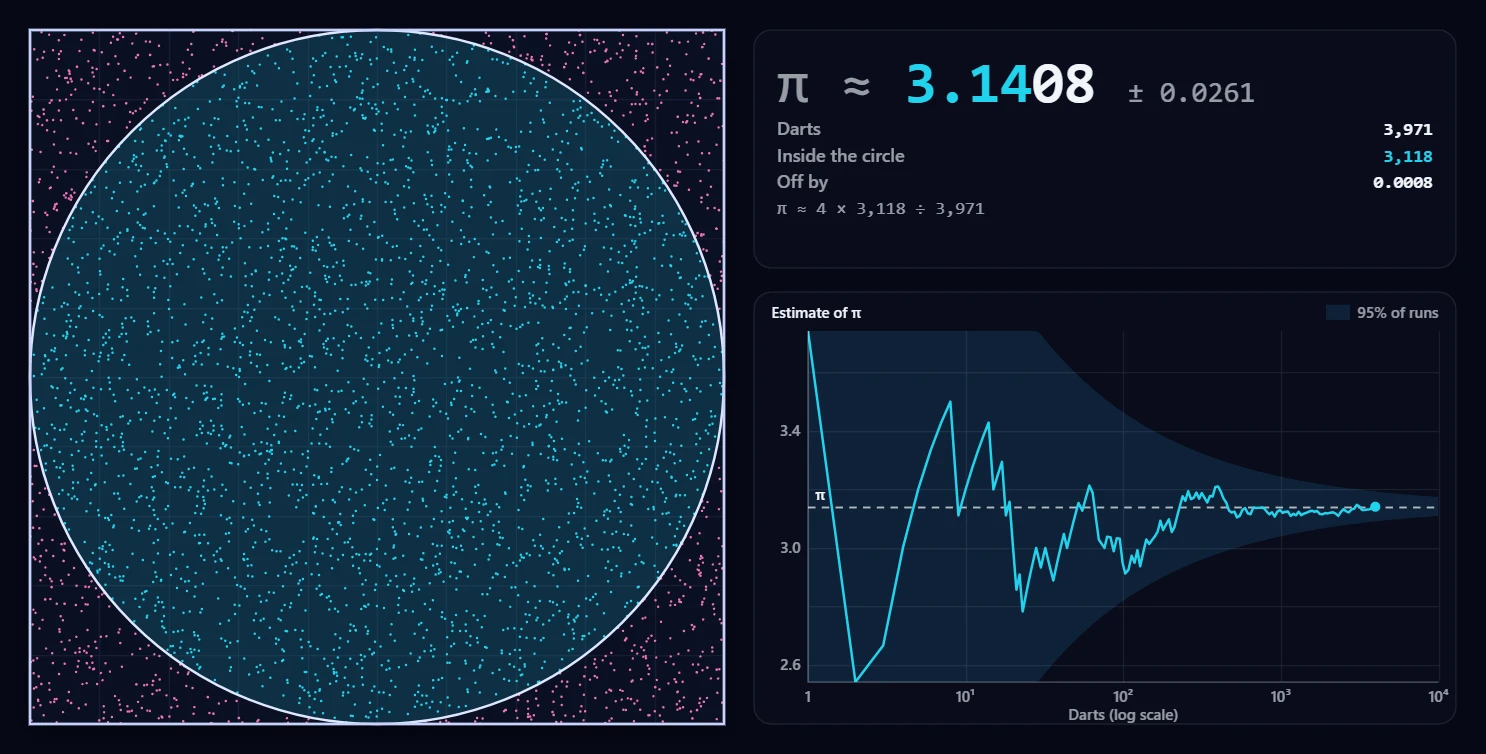
Throw thousands of random darts at a square with a circle in it and watch the share that lands inside turn into π. Start, stop, and follow the estimate as it converges.
Two envelopes paradox
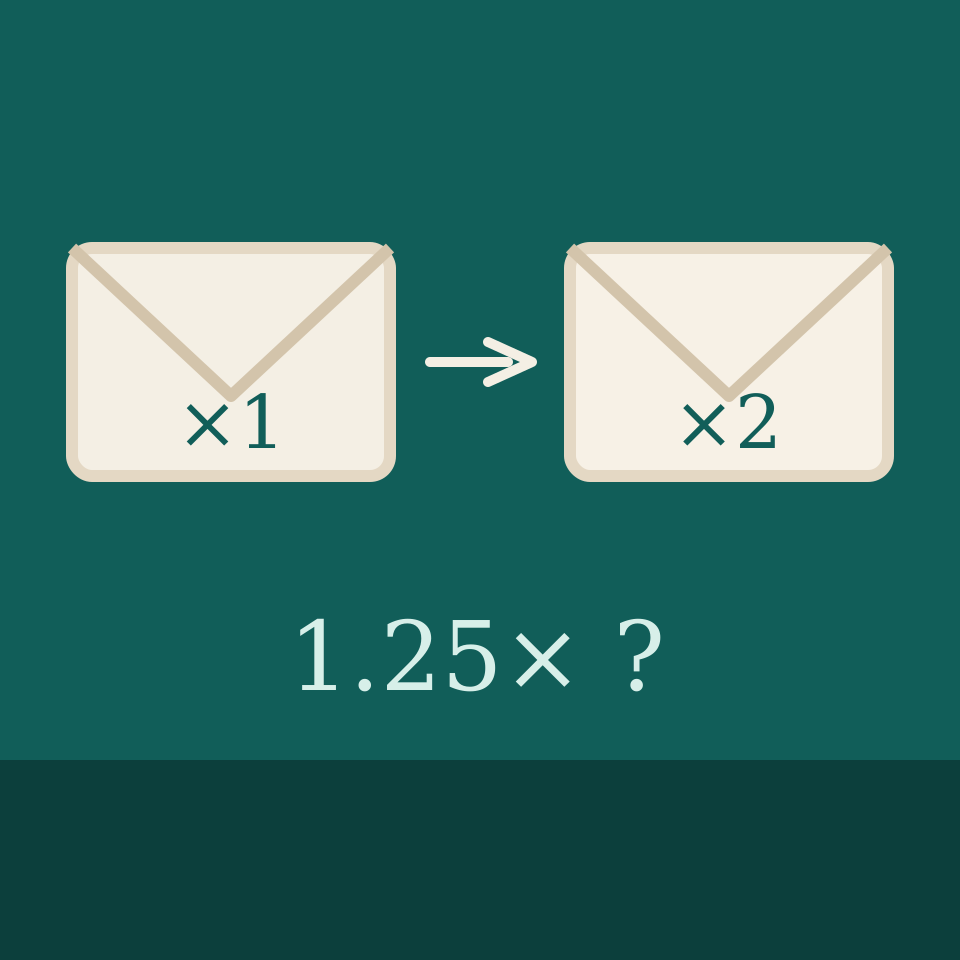
See why switching envelopes is not always better. Open one amount, compare the tempting 1.25 times average with the correct expectation, and run 10,000 pairs.

Simpson's paradox
Explore Simpson's paradox: see how one option can do better in every group yet worse overall, with real data on kidney stone treatments, Berkeley admissions and batting averages, or your own numbers.

The birthday paradox
In a group of 23 people the chance that two share a birthday is 50.7%, and with 57 people it is 99%. See all 253 pairs, the calendar and the curve, and test thousands of random groups in your browser.
Ready to try it?
Open PictorX in your browser — no install, no credit card required to start.
Go to Editor