
The story behind the aspect ratio calculator
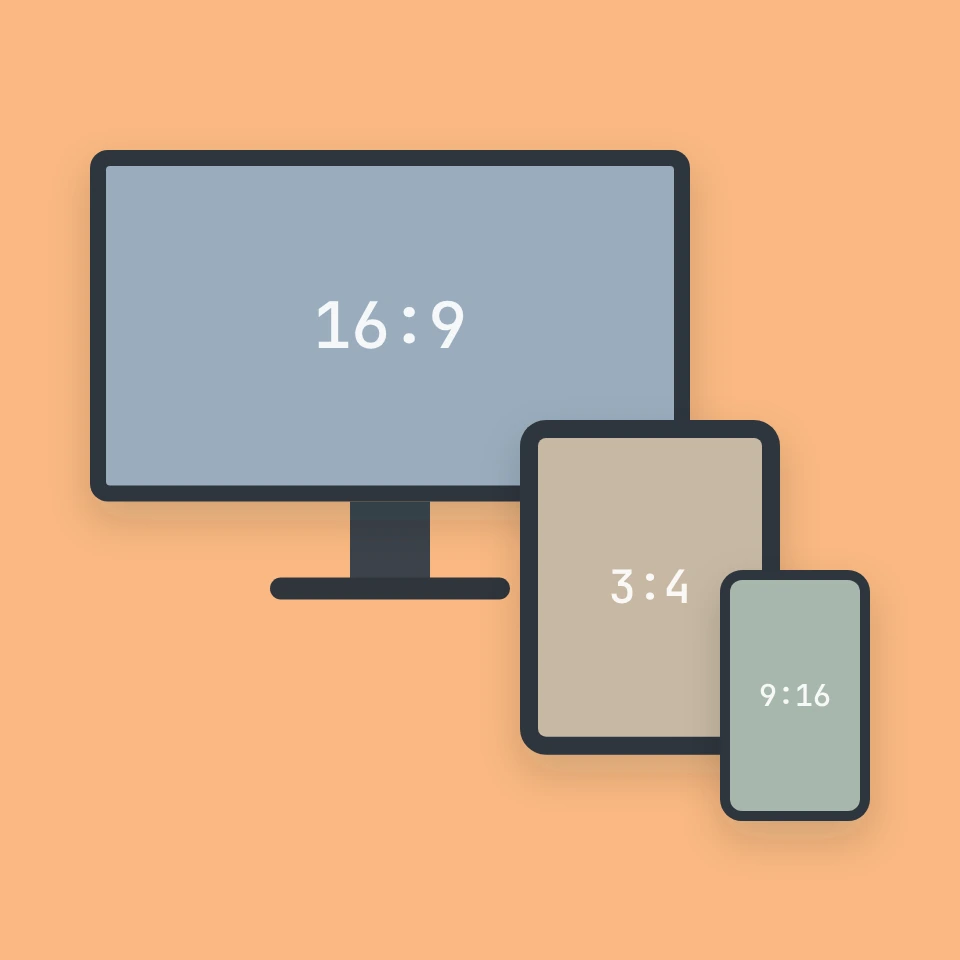
Every picture has a shape, written as width to height. The shapes we use today were not chosen by chance: they come from film stock, cinema rivalry, a clever compromise for television, a paper standard from 1922 and the way we hold our phones.
Four by three
Around 1890 the laboratory of Thomas Edison used 35 mm film with frames four perforations high, giving a picture about 1.33 times as wide as it was tall. That 4:3 shape became the standard for silent film. When sound arrived, the soundtrack took space on the film, and in 1932 the Academy ratio of about 1.37:1 restored the familiar proportions. Television copied the shape, so 4:3 ruled screens for decades.
Cinema goes wide
In the 1950s television kept people at home, and studios answered with wider pictures. Cinerama joined three projectors, and CinemaScope squeezed a wide image onto normal film with an anamorphic lens, projecting it at about 2.35:1. Later adjustments brought the modern scope ratio of 2.39:1, still used for many blockbusters, while 1.85:1 became the common flat widescreen format.
Why 16:9
In the 1980s engineers planning high definition television needed one shape that could show both old 4:3 programmes and wide films without wasting too much screen. Kerns Powers drew the common ratios as rectangles of equal area and found that 16:9, about 1.78:1, sits close to their geometric mean. Every format then fits with modest bars. Computer screens followed, and later ultrawide monitors marketed as 21:9 often use 2560 x 1080, an exact ratio of 64:27.
Paper and phones
A4 paper has a ratio of 1 to the square root of two, about 1:1.414. The idea goes back to Georg Christoph Lichtenberg in 1786: fold such a sheet in half and the halves keep the same shape. Germany standardised it in 1922 as DIN 476, and it became ISO 216. More recently phones made portrait video normal, so 9:16 stories and reels now sit next to 16:9 and the square 1:1 post.
Frequently asked questions
Is 16:9 the same as 1.78:1?
Yes. 16 divided by 9 is 1.777..., usually rounded to 1.78:1. The decimal form makes it easy to compare with film ratios such as 1.85:1 and 2.39:1.
Why is A4 not a simple ratio like 3:2?
The square root of two cannot be written as a fraction of whole numbers. A4 at 210 x 297 mm is rounded to millimetres, so the calculator names it as A-paper, √2, rather than as a small whole ratio.
Is 21:9 really 21:9?
Rarely. Most ultrawide screens are 64:27 or 43:18, both about 2.37 to 2.39:1. The name 21:9 was chosen because it sounds like a wider 16:9.
Related tools
Aspect ratio calculator
A free aspect ratio calculator: simplified ratio and decimal ratio from width and height, the nearest common ratio, resize with a locked ratio and rounding for video, presets for screens, social media and print, and fit or fill with letterbox bars.
Text case converter
A free text case converter: UPPERCASE, lowercase, Title Case with language rules, Sentence case, camelCase, PascalCase, snake_case, kebab-case, CONSTANT_CASE, dot.case and URL slugs, plus cleanup for spaces, line breaks, bullets and emojis.
Color contrast checker
A free WCAG color contrast checker: enter text and background colors as HEX, RGB or HSL, see the contrast ratio with AA and AAA results, get the nearest passing color and simulate color blindness.

JSON formatter
A free JSON formatter and validator: beautify or minify JSON, find the exact line and column of an error, sort keys, browse a collapsible tree, copy paths and convert arrays to CSV, all in your browser.
The story behind the text case converter
Why capitals are called upper case, how Carolingian minuscule shaped lower case, title case versus sentence case, where camelCase and snake_case come from, and why the Turkish dotted İ and the German capital ẞ matter.
Ready to try it?
Open PictorX in your browser — no install, no credit card required to start.
Open the aspect ratio calculator