
The 15 puzzle
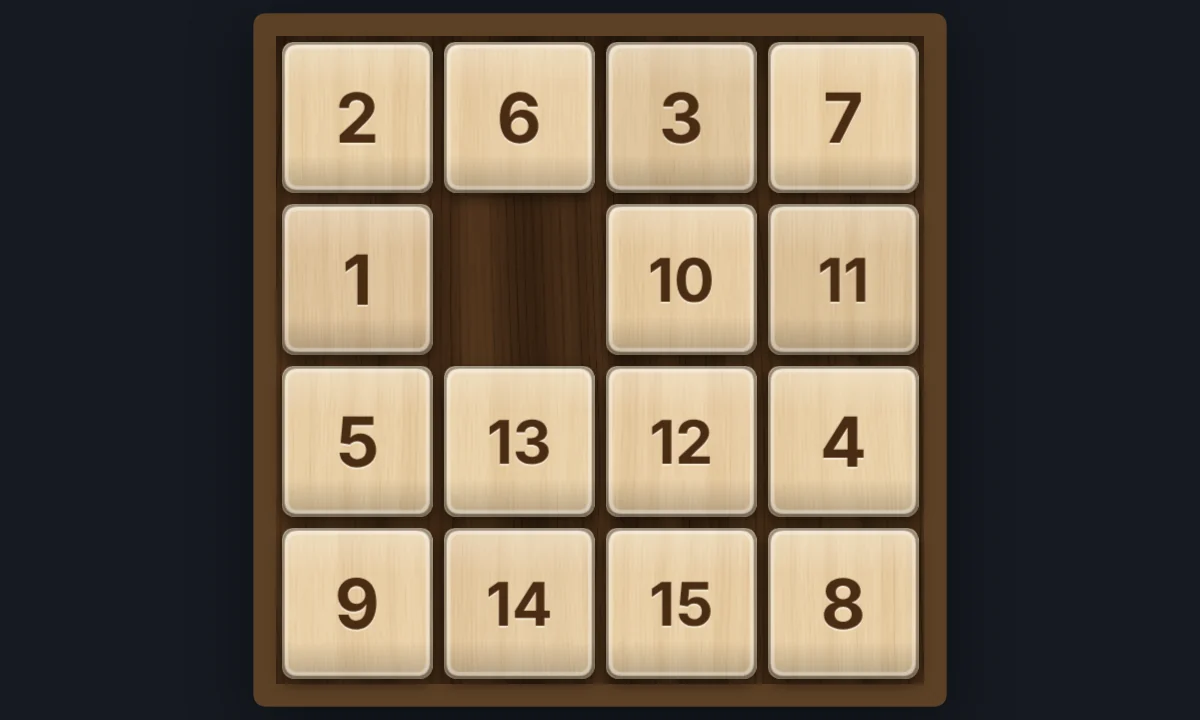
The 15 puzzle is a tray of fifteen numbered tiles and one gap. Slide the tiles back into order and it is solved. It looks simple, but it caused a craze in 1880, and behind it lies one of the neatest proofs in recreational mathematics: half of all positions can never be solved.
The 1880 craze
The puzzle comes from New York State in the 1870s; Noyes Chapman, a postmaster in Canastota, is usually named as its inventor. Early in 1880 it became a craze, first across the United States and then in Europe.
Sam Loyd's 14-15
The American puzzle maker Sam Loyd later claimed that he had invented the puzzle, and told of a $1,000 prize for anyone who could solve it with only 14 and 15 swapped. Nobody won the prize, and nobody could: that position cannot be solved. His claim to the invention was not true either.
Why half the positions are impossible
Treat the gap as a sixteenth tile. Every slide swaps the gap with one tile. To get back to its corner the gap must move as often left as right and as often up as down, so a position with the gap in its corner is always an even number of swaps away from the solved order. Swapping 14 and 15 is one swap, which is odd, so no slides can reach it. In 1879 William Johnson and William Story proved that exactly half of all arrangements can be reached.
A test for any position
Count the pairs of tiles that stand in the wrong order when you read the tray row by row. On a 3×3 or 5×5 board a position can be solved when that count is even. On a 4×4 board, add the row of the gap counted from the bottom: the position can be solved when the sum is odd.
Solving by computer
A computer can search for a way back with A*, which always looks at the most promising position first. It estimates the moves still needed from how far each tile is from home, plus two moves for each pair of tiles that block each other in their own row or column. Finding the shortest solution gets very hard on large boards. The hardest 15 puzzle positions need 80 moves, and the 8 puzzle never needs more than 31.
Try it in PictorX
Open the 15 Puzzle and click a tile to slide it. Shuffle mixes the tiles into a new position that can be solved, Solve plays a solution move by move, and Show correct tiles colors the numbers of the tiles already in place. Pick Loyd's 14-15 to see the impossible position, and use Size to switch between 3×3, 4×4, and 5×5.
Frequently asked questions
Who invented the 15 puzzle?
Noyes Chapman, a postmaster in Canastota, New York, is usually named as the inventor, in the 1870s. Sam Loyd's later claim to it was false.
Can the 14-15 puzzle be solved?
No. It is one swap away from the solved order, and every position the slides can reach is an even number of swaps away.
How many positions does the 15 puzzle have?
The 16 squares can be filled in 20,922,789,888,000 ways. Exactly half of them, 10,461,394,944,000, can be reached by sliding.
Does PictorX upload anything?
No. The puzzle is drawn on a canvas in your browser. Save downloads a PNG, and Edit opens that image in the PictorX editor.
Related tools
15 Puzzle
Play the classic 15 sliding puzzle in your browser on 3×3, 4×4, or 5×5 wooden tiles. Shuffle, slide whole rows at once, try Sam Loyd's impossible 14-15, or watch Solve finish it.
Tower of Hanoi
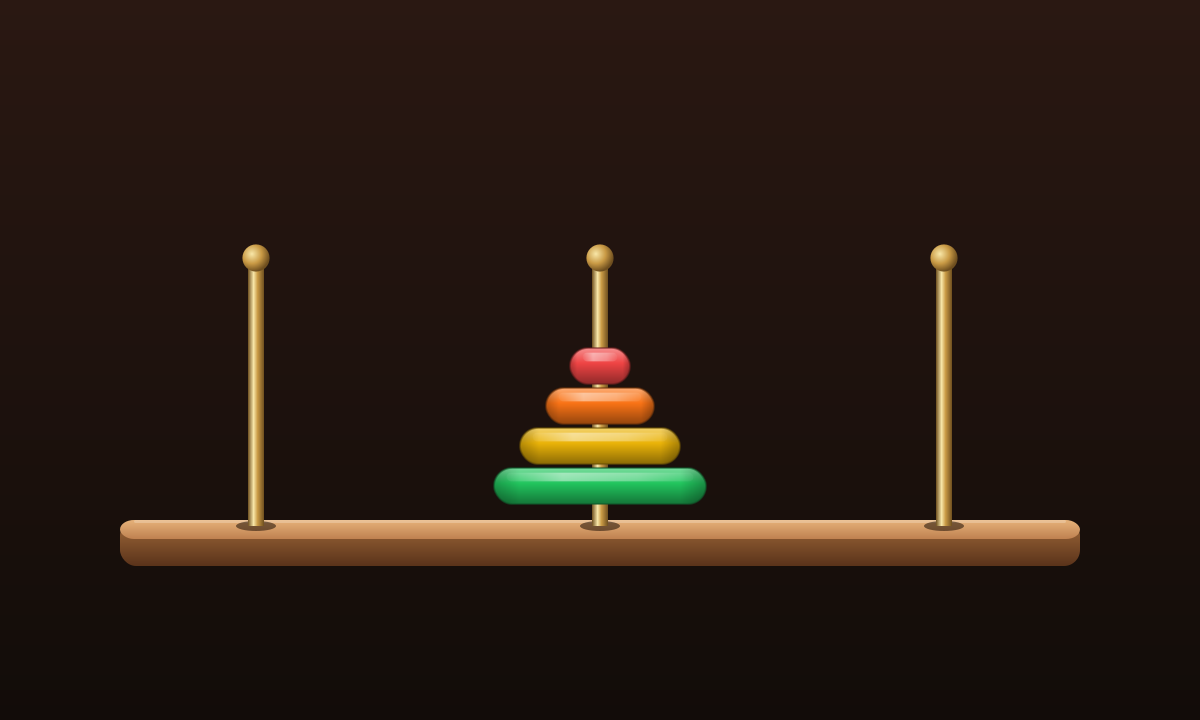
Move a tower of disks across three pegs in your browser. One disk at a time, never a larger disk on a smaller one. The shortest solution is 2ⁿ − 1 moves.
Tower of Hanoi
The Tower of Hanoi: three pegs, one disk at a time, and never a larger disk on a smaller one. The shortest solution is 2ⁿ−1 moves. Édouard Lucas introduced the puzzle in 1883.
Knight's Tour
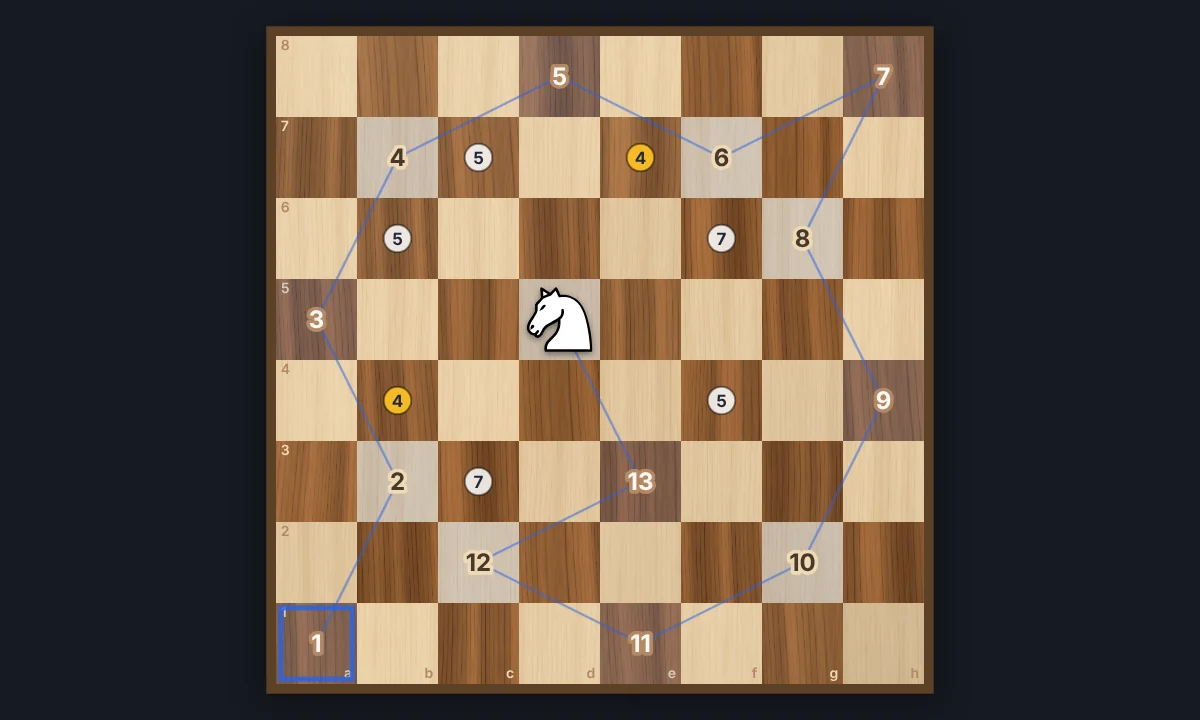
Jump a chess knight to every square of the board exactly once. Play it yourself with Warnsdorff hints, or watch Solve finish an open or closed tour. Save the path as a PNG.
Eight Queens
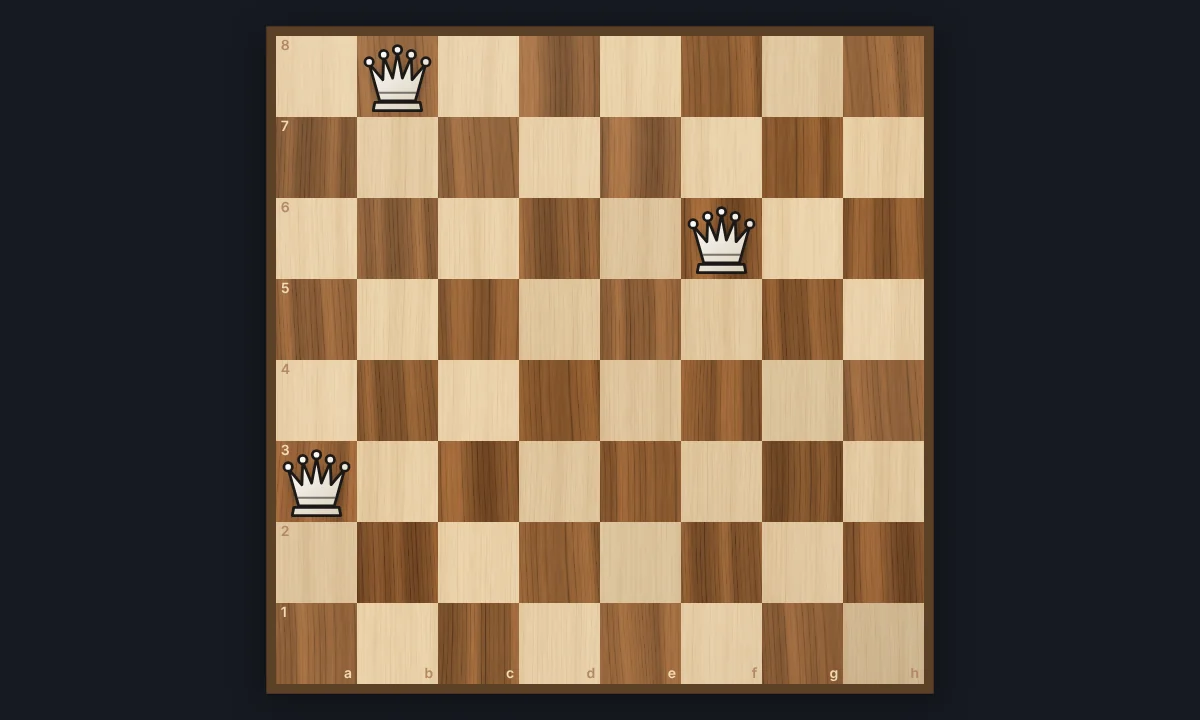
Place eight queens on a chessboard so that none attacks another. Try it yourself, watch the backtracking search find a solution step by step, and go through all 92 solutions.

Langton's Ant
Run Langton's Ant in your browser. Watch symmetry, chaos and the 104-step highway, then try multi-colour rules, several ants, a hex grid and turmites.
Ready to try it?
Open PictorX in your browser — no install, no credit card required to start.
Play the 15 Puzzle