
Torus knots explained
Torus knots are the knots you get by winding a string around a doughnut. They are the best-understood family in knot theory: two whole numbers describe each one completely, and the quantities that are hard to compute for most knots, how many crossings it needs, how many changes untie it, have simple formulas for them. They are also some of the most beautiful shapes in 3D graphics.
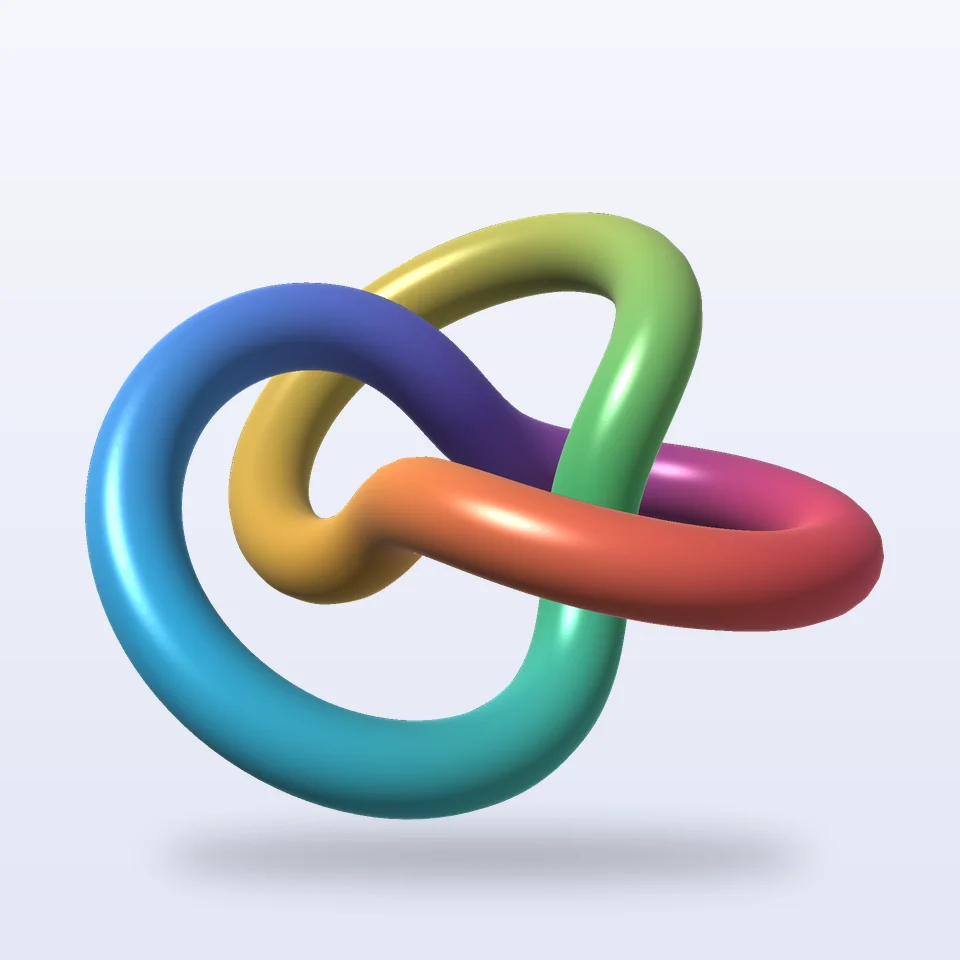
A knot on a doughnut
A torus is the surface of a doughnut. Draw a closed curve on it that goes p times around the doughnut's axis and q times around its tube, evenly spaced and never crossing itself, and you have the (p, q) torus knot. In coordinates it is simple: as an angle φ goes once around, the point turns p·φ around the axis and q·φ around the tube. Seen from above, the knot looks like a flower with q petals, or a star, which is why they are named after leaves: the trefoil has three, the cinquefoil five.
Which knots are there?
If p or q is 1 the curve can be slid off the torus into a plain circle: the unknot. If p and q share a divisor d, the curve closes after a d-th of its windings, and the pattern consists of d loops: a torus link. Otherwise it is a genuine knot, and different pairs give different knots, apart from the swap of p and q and the sign that gives the mirror image. So there are infinitely many torus knots, and each is pinned down by two numbers.
The trefoil and its family
The (2, q) torus knots, with q odd, form the simplest family: the trefoil (2, 3), the cinquefoil or Solomon's seal knot (2, 5), the septafoil (2, 7). Each is a twisted band of two strands with its ends joined, and has q crossings. The (3, 4) torus knot is knot 8₁₉ in the tables, the first knot with eight crossings that is not alternating: its crossings cannot be laid out so that the strand goes over, under, over, under all the way around.
Links: Hopf, Solomon and more
The (2, 2) torus link is the Hopf link, two circles through each other, the simplest link there is; in the Hopf fibration of the 3-sphere every two fibres form one. The (2, 4) link is Solomon's knot, a motif in Roman mosaics and medieval art, which is actually two rings linked twice. In a (p, q) torus link each of the d loops is a (p/d, q/d) torus knot, and every pair is linked (p/d)(q/d) times.
Crossing number
The crossing number of a knot is the fewest crossings any picture of it can have. For most knots it is hard to find, but for torus knots it is min(p(q − 1), q(p − 1)), proved by Kunio Murasugi in 1991. The (2, q) knots need q crossings, T(3, 4) needs 8, T(3, 5) needs 10, and T(5, 8) needs 32. The braid index and the bridge number, two other ways to measure complexity, are both min(p, q).
Milnor's conjecture
How many times must a strand pass through another before the knot comes undone? For the (p, q) torus knot the answer is (p − 1)(q − 1)/2, which is also its genus, the fewest handles a surface needs to have the knot as its edge. John Milnor conjectured this in 1968 while studying singularities of complex curves: the torus knots are exactly the knots that appear around the singular point of a curve like x^p = y^q. Peter Kronheimer and Tomasz Mrowka proved it in 1993 using gauge theory, mathematics that came from particle physics.
Torus knots in nature and science
Closed loops of DNA are often knotted, and many of the knots enzymes tie in them are torus knots, the (2, q) family above all. Chemists have built molecular trefoils and Solomon's links from a few dozen atoms. In physics, vortex rings in fluids and loops of magnetic field in the Sun and in fusion reactors can take the shape of torus knots, and Lord Kelvin once proposed that atoms themselves were knotted vortices in the ether, which started knot theory as a branch of mathematics.
Explore it
Open the torus knot viewer, pick the trefoil and press Trace to watch it being drawn around the torus with Torus ticked. Then raise p and q and see the crossings multiply, try 2 and 4 to watch the curve fall apart into Solomon's link, and colour by loop to tell the loops apart. The pencil opens the picture in the photo editor with every loop on a layer of its own.
Frequently asked questions
Who studied torus knots first?
Torus knots were among the first knots studied in the 19th century, when Peter Guthrie Tait, Thomas Kirkman and Charles Little drew up the first knot tables, inspired by Lord Kelvin's idea that atoms are knotted vortices. Max Dehn and Otto Schreier described their groups in the early 20th century.
Is every knot a torus knot?
No. Most knots cannot be drawn on a torus without crossing themselves. The figure-eight knot, with four crossings, is the simplest knot that is not a torus knot. Torus knots are a small but very well understood family.
Are torus knots left- or right-handed?
Every true torus knot is chiral: it cannot be turned into its mirror image. T(p, q) with positive numbers is one hand; the mirror image is written T(p, −q). The viewer draws one hand; turning the picture never changes it.
What is the genus of a torus knot?
(p − 1)(q − 1)/2, the same as its unknotting number. The genus is the smallest number of handles on an orientable surface whose edge is the knot; for the trefoil it is 1, a punctured torus.
Why are torus knots popular in 3D graphics?
Because they are smooth, closed and symmetric, and a tube along one shows off lighting from every angle: the highlights slide along the curves as it turns. Their formula is short, so they are a classic test shape for renderers and shaders.
Related tools
Torus knot
Turn any (p, q) torus knot in 3D: the trefoil, the cinquefoil, the Hopf link and Solomon's link. Trace how the knot winds around the torus, colour it in flowing gradients or stripes, and read its crossing, unknotting and linking numbers.
Möbius strip and Klein bottle
Turn one-sided surfaces in 3D: the Möbius strip with any number of half twists, the Klein bottle and Boy's surface. Colour the two sides and watch them meet, send a walker once round to come back on the other face, and read the sides, edges and Euler characteristic.
Platonic and Archimedean solids
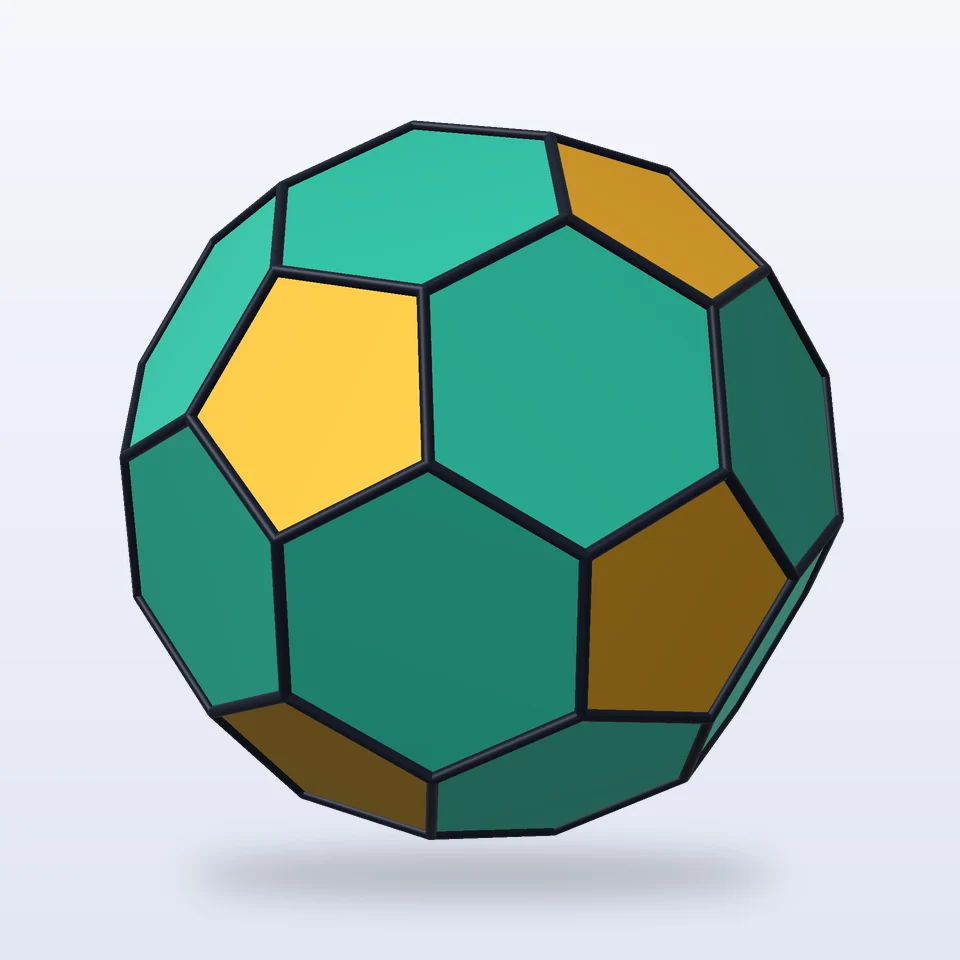
Turn all five Platonic solids and the thirteen Archimedean solids in 3D, from the tetrahedron to the truncated icosahedron soccer ball. Show their duals, colour the faces by kind, and read the faces, edges, vertices, Euler's formula and dihedral angles.
Rubik's Cube Solver
Free online Rubik's cube solver: colour the stickers of your own cube or scramble one, and get a solution of about 20 moves from Kociemba's two-phase algorithm. Play it move by move on a 3D cube, with the moves in standard notation.
Fourier Epicycles
Draw any shape and watch rotating circles trace it: Fourier epicycles online. Pick a heart, star or butterfly, type a word, choose how many circles turn and save a PNG or SVG.
Spirograph
Draw hypotrochoids and epitrochoids in your browser. Tune R, r, and pen offset, animate the curve, randomize styles, and save a PNG.
Menger sponge in 3D
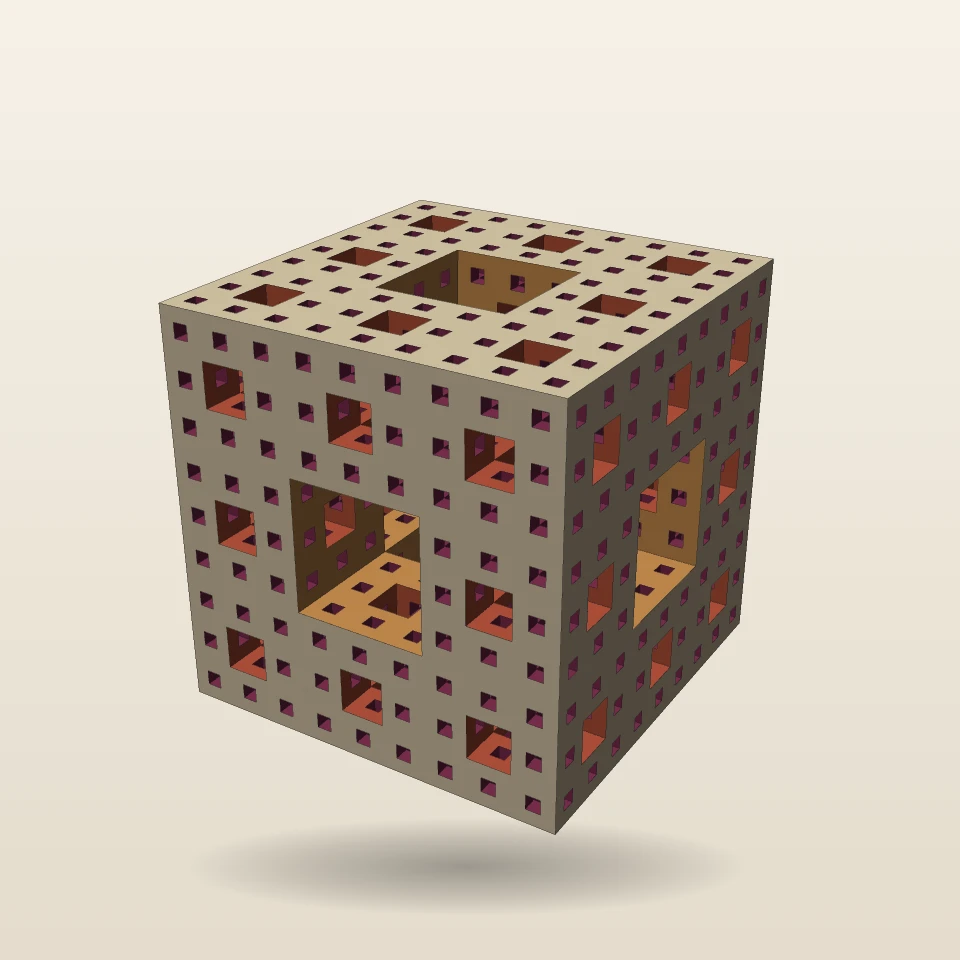
Drill the Menger sponge level by level and turn it in 3D. Compare the Jerusalem cube, the Sierpiński tetrahedron, the Mosely snowflake and Cantor dust, slice through them, and watch the volume vanish while the surface grows.
Ready to try it?
Open PictorX in your browser — no install, no credit card required to start.
Open the torus knot viewer