
Platonic and Archimedean solids
Only five solids can be built from one kind of regular polygon with the same number meeting at every corner: the tetrahedron, the cube, the octahedron, the dodecahedron and the icosahedron. Plato matched them with fire, earth, air, the cosmos and water, and Euclid proved there are no others. Allow two or three kinds of regular faces and you get thirteen more, the Archimedean solids, among them the truncated icosahedron that every soccer ball is sewn from and that sixty carbon atoms form in a buckyball. Turn all eighteen, see each with its dual and count their corners, edges and faces. Pick a solid and drag across the picture to turn it; the wheel or two fingers zoom and a double click puts it back. Turn spins it on its own, Next solid steps through all eighteen, and Reset puts the view back. Show adds the dual, the solid with a corner above every face, as a compound or on its own. Colour by kind of face to tell triangles, squares, pentagons and hexagons apart; Edges and Vertices add the skeleton. The tiles give the faces by kind, the edges with Euler's formula, the vertices with the faces around each, and the angles between faces.
How it works
- Pick one of the five Platonic or thirteen Archimedean solids, or press Next solid to step through them all.
- Drag across the picture to turn the solid, use the wheel or two fingers to zoom, and press Turn to let it spin on its own.
- Show the solid together with its dual, or the dual alone, colour the faces by kind, face by face or in one colour, and add the edges and vertices.
- Read the faces by kind, the edges, the vertices and the angles between faces in the tiles, then save the picture or open it in the editor with every kind of face on a layer of its own.
Why there are only five
At every corner of a solid at least three faces must meet, and the angles of those faces must add up to less than 360°, or the corner lies flat. Equilateral triangles have 60° corners, so three, four or five can meet: the tetrahedron, the octahedron and the icosahedron. Squares have 90°: only three fit, the cube. Regular pentagons have 108°: three fit, the dodecahedron. Hexagons already have 120°, and three of them lie flat. That is the whole list, as Euclid showed at the end of his Elements.
The thirteen Archimedean solids
Let the faces be regular polygons of two or three kinds, but keep every corner exactly alike, and you get thirteen more solids, described by Archimedes in a lost work and found again by Johannes Kepler in 1619. Most come from cutting the corners off a Platonic solid: cut a little off an icosahedron's twelve corners and each becomes a pentagon while the triangles turn into hexagons, the truncated icosahedron, the soccer ball. Two of them, the snub cube and the snub dodecahedron, come in a left- and a right-handed form.
Duals
Put a point above the middle of every face and join the points of faces that share an edge: you get the dual. The cube and the octahedron are duals of each other, as are the dodecahedron and the icosahedron, and the tetrahedron is its own dual. Shown together, the solid and its dual form a compound in which their edges cross at right angles. The duals of the Archimedean solids are the Catalan solids, such as the rhombic dodecahedron, with faces that are all alike but corners that are not.
Counting corners, edges and faces
For every solid without holes, vertices − edges + faces = 2. The cube has 8 − 12 + 6, the soccer ball 60 − 90 + 32. Leonhard Euler noticed it in 1750, and it is one of the first results of topology: it does not depend on the lengths or angles, only on how the faces are joined. The vertex configuration lists the faces around one corner: 5.6.6 for the soccer ball, a pentagon and two hexagons, and 3.4.3.4 for the cuboctahedron.
Frequently asked questions
What are the five Platonic solids?
The tetrahedron (4 triangles), the cube (6 squares), the octahedron (8 triangles), the dodecahedron (12 pentagons) and the icosahedron (20 triangles). Each is made of one kind of regular polygon, with the same number meeting at every corner, and they are the only convex solids that are.
What is the difference between Platonic and Archimedean solids?
A Platonic solid has faces of one kind; an Archimedean solid has regular faces of two or three kinds. In both, every corner looks exactly like every other. There are five Platonic and thirteen Archimedean solids; the prisms and antiprisms also have alike corners but form endless families of their own and are not counted.
Which solid is a soccer ball?
The truncated icosahedron: 12 black pentagons and 20 white hexagons, 60 corners and 90 edges, each corner where one pentagon and two hexagons meet. Its 60 corners are also where the carbon atoms sit in the C60 buckyball molecule, discovered in 1985 and named after Buckminster Fuller's domes. Choose the Soccer ball palette to see it in black and white.
What is a dual polyhedron?
The solid you get by putting a corner above the middle of every face and an edge across every edge. The cube's dual is the octahedron, the dodecahedron's is the icosahedron, and the tetrahedron's is a tetrahedron again. Faces become corners and corners become faces, so the numbers of faces and vertices swap while the number of edges stays the same.
What is the dihedral angle?
The angle between two faces that meet at an edge, measured inside the solid: 90° for the cube, about 116.57° for the dodecahedron and 138.19° for the icosahedron. Solids with two or three kinds of faces can have two or three different dihedral angles, and the tile shows them all.
Can I use the picture in a design?
Yes. Save gives a PNG at the size you choose, and the pencil opens the solid in the PictorX photo editor with the shadow, every kind of face, the dual, the edges and the vertices on layers of their own, so you can recolour the pentagons or hide the edges. In the editor itself it is under Apps ▸ Science ▸ Mathematics ▸ Platonic Solids. Everything is drawn in your browser.
Platonic Solids: how do I record a video?
Press the red Record button in the playback bar: it films what the stage shows. Press it again to stop, and the video is saved to your device. Recording is free; you only need to sign in. Without a subscription the video carries a small PictorX logo in a corner. The button beside Record opens the video options: the shape (as shown, square, story 9:16 or wide 16:9), the length (until you stop, or 5, 10, 15 or 30 seconds for social media) and the file: MP4, WebM or an animated GIF. You can add one of three music tracks: calm, bright or beat.
Related tools
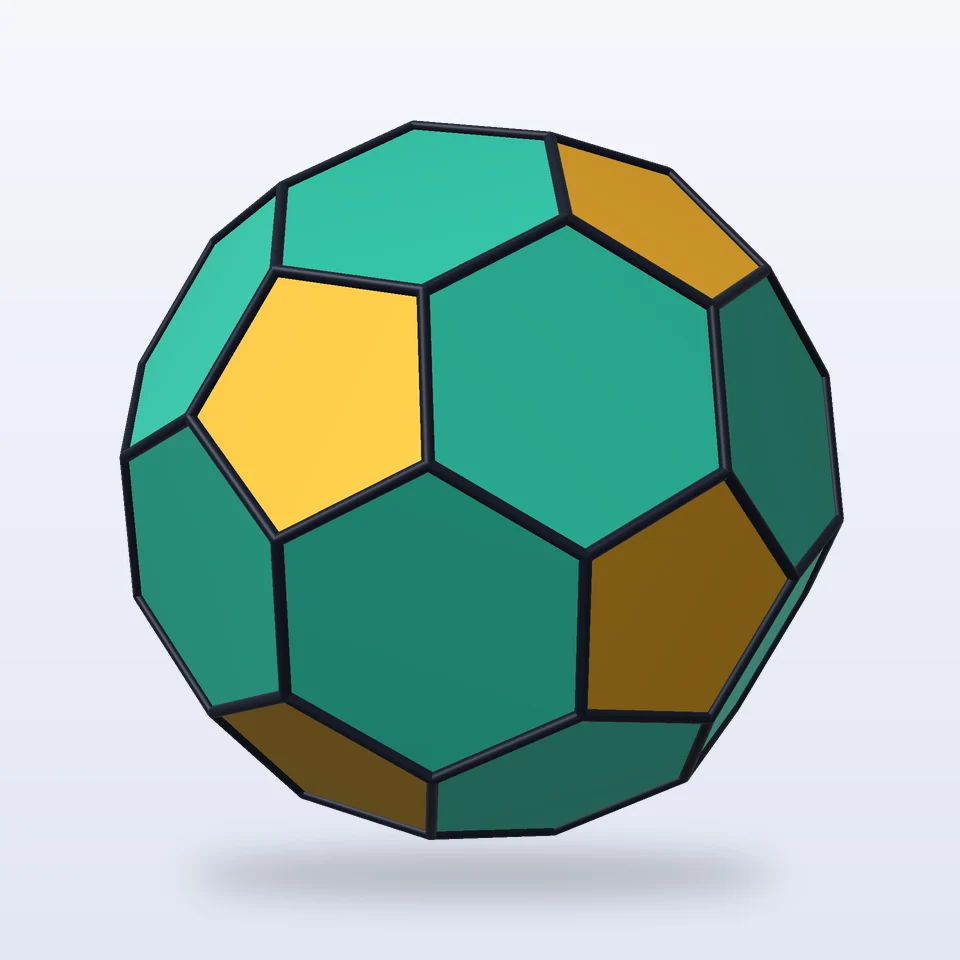
Platonic and Archimedean solids explained
Why there are exactly five Platonic solids, how the thirteen Archimedean solids follow by cutting corners, what duals and Catalan solids are, why vertices − edges + faces = 2, and where these shapes appear in chemistry, viruses and games.
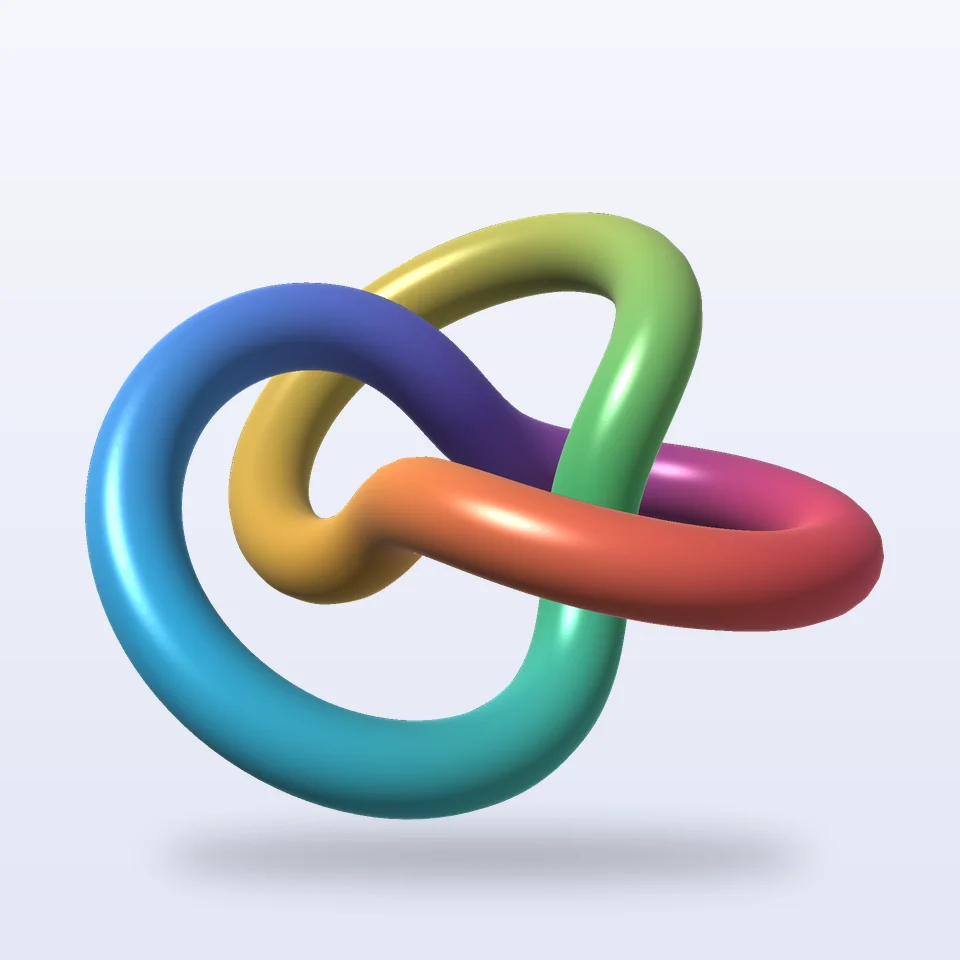
Torus knot
Turn any (p, q) torus knot in 3D: the trefoil, the cinquefoil, the Hopf link and Solomon's link. Trace how the knot winds around the torus, colour it in flowing gradients or stripes, and read its crossing, unknotting and linking numbers.
Möbius strip and Klein bottle
Turn one-sided surfaces in 3D: the Möbius strip with any number of half twists, the Klein bottle and Boy's surface. Colour the two sides and watch them meet, send a walker once round to come back on the other face, and read the sides, edges and Euler characteristic.
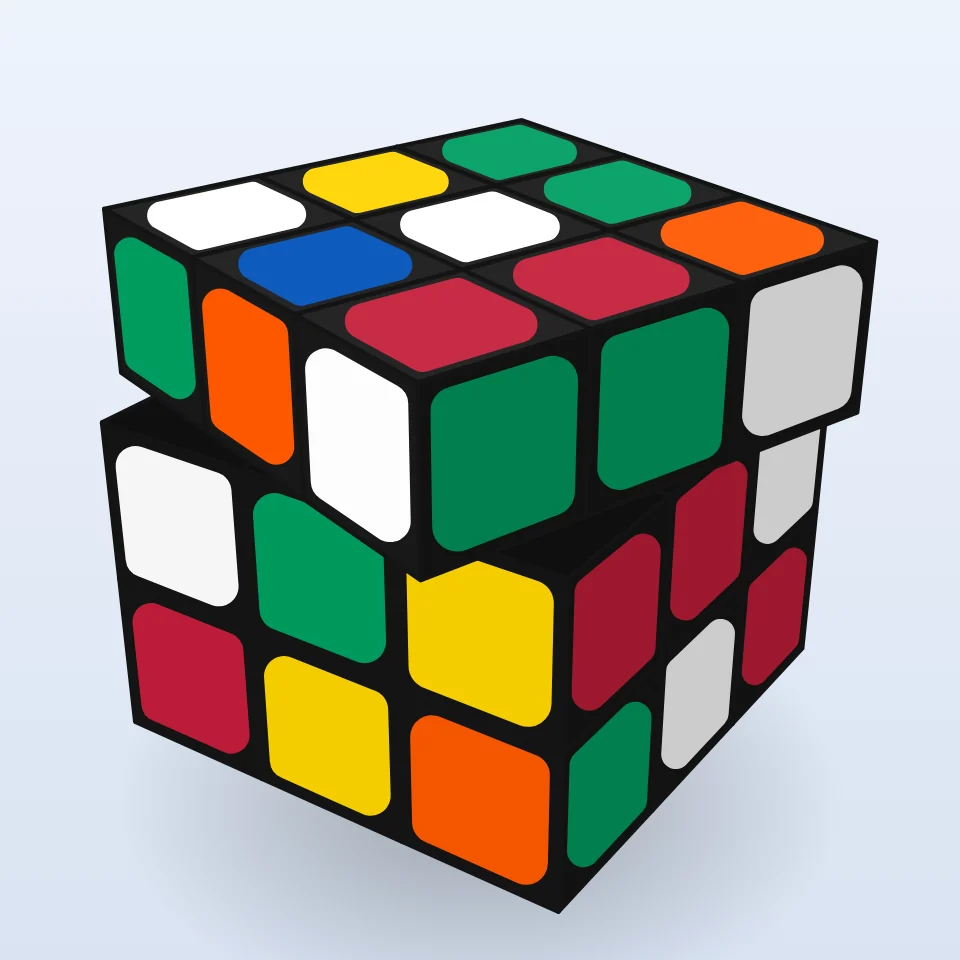
Rubik's Cube Solver
Free online Rubik's cube solver: colour the stickers of your own cube or scramble one, and get a solution of about 20 moves from Kociemba's two-phase algorithm. Play it move by move on a 3D cube, with the moves in standard notation.
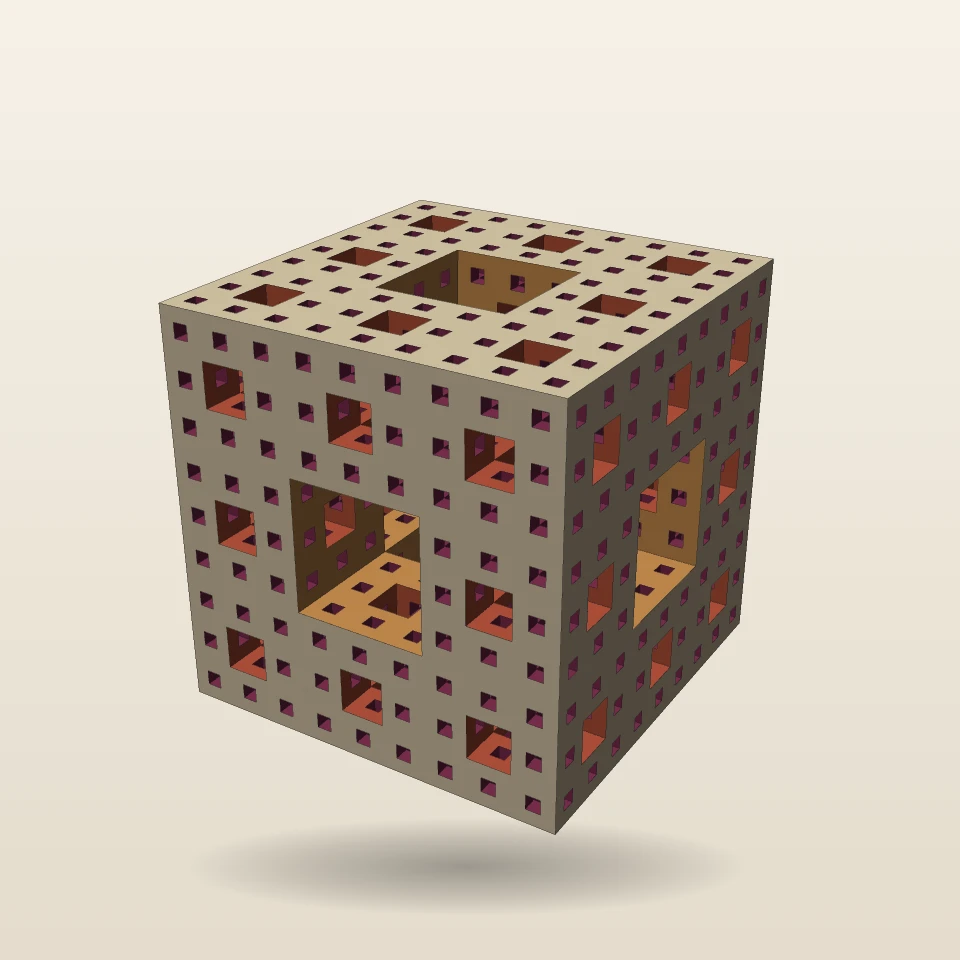
Menger sponge in 3D
Drill the Menger sponge level by level and turn it in 3D. Compare the Jerusalem cube, the Sierpiński tetrahedron, the Mosely snowflake and Cantor dust, slice through them, and watch the volume vanish while the surface grows.
Tessellation maker
Cover the plane with regular and Archimedean tessellations. Tune scale, colours, and warp square edges Escher-style — then save a PNG.
Ready to try it?
Open PictorX in your browser — no install, no credit card required to start.
Go to Editor