
Möbius strip and Klein bottle
Take a strip of paper, give one end half a twist and tape it to the other: you have a surface with only one side. Run a pencil along the middle and you come back to where you started without ever crossing an edge, having drawn on both faces. Glue two Möbius strips along their edges and you get a Klein bottle, a closed bottle with no inside and no outside. Turn these strange surfaces in 3D, colour their two sides and see that the colours have to meet, and send a little walker round to come back upside down. Pick a surface and drag across the picture to turn it; the wheel or two fingers zoom and a double click puts it back. Turn spins it, Walk once round sends a little walker one loop along the surface, and Reset clears the walk and puts the view back. Colour the two sides: on a one-sided surface the colours have to meet somewhere along a seam, and after one loop the walker is upside down on the other face, after two it is back. Half twists changes the Möbius strip: an odd number gives one side and one edge, an even number an ordinary band with two. The tiles give the sides, the edges, the Euler characteristic and how far the walker has gone.
How it works
- Pick the Möbius strip, the Klein bottle as a bottle or a figure 8, or Boy's surface, and for the strip set the number of half twists and its width.
- Drag across the picture to turn the surface, use the wheel or two fingers to zoom, and press Turn to let it spin on its own.
- Colour the two sides in two colours to see where they meet, add grid lines, and press Walk once round to send the walker along the surface.
- Read the sides, the edges, the Euler characteristic and the loops walked in the tiles, then save the picture or open it in the editor with the surface, the grid, the path and the walker on layers of their own.
One side, one edge
An ordinary band, a ring cut from a tube, has two sides, an inside and an outside, and two edges, its top and bottom rims. Give it half a twist before joining the ends and both pairs merge: one side and one edge, a single closed curve twice as long as the band. That is the Möbius strip. Colour its two sides in two colours and you will see a seam where they meet: no colouring of a one-sided surface can avoid it, because there is only one side to colour.
Counting half twists
With an odd number of half twists, 1, 3 or 5, the band is one-sided with one edge. With an even number, 2 or 4, it has two sides and two edges again, like the plain band with none, although its two edges are now linked together. Set Half twists and watch the tiles change. In topology a surface with only one side is called non-orientable: there is no consistent way to say which way is up.
The Klein bottle
Sew two Möbius strips together along their edges, or join the ends of a tube after passing one end through the tube's own wall, and you get a Klein bottle: a closed surface without edges that still has only one side. In our three-dimensional world it cannot be built without passing through itself, so every model, glass bottle or picture, shows it crossing its own wall. In four dimensions the neck could go around instead of through. The figure-8 Klein bottle is another way to draw the same surface.
The walker
Press Walk once round and a little walker sets off along the surface, always on the face it stands on. On a two-sided surface it comes back exactly where it started. On a one-sided one it comes back to the same place upside down, on what looked like the other face; only after a second loop is it back as it began. That is what one-sided means, and why a Möbius strip conveyor belt wears evenly on both faces.
Frequently asked questions
What is a Möbius strip?
A surface with only one side and one edge, made by joining the ends of a strip after giving one end half a twist. It was described independently by August Möbius and Johann Listing in 1858. If you draw a line along its middle, you cover both faces of the paper and come back to the start without lifting the pencil.
What happens if you cut a Möbius strip in half?
Cut along the middle line and it does not fall into two pieces: you get one long band, twice as long, with two full twists, which has two sides. Cut a third of the way from the edge instead and you get two linked bands, a short Möbius strip and a long two-sided band. Try it with paper; the app shows the strip itself.
What is a Klein bottle?
A closed surface with no edge and only one side, described by Felix Klein in 1882. It can be thought of as a tube whose ends are joined after one end has passed through the tube's wall, or as two Möbius strips glued along their edges. In three dimensions it must cross itself; a true Klein bottle without self-intersection needs four dimensions.
What is Boy's surface?
A way to build the real projective plane in three dimensions, found by Werner Boy in 1901. The projective plane is a disc whose opposite edge points are glued together; it is one-sided and closed, like the Klein bottle, but with Euler characteristic 1 instead of 0. Boy's surface shows it with a threefold symmetry and a single triple point where three sheets cross.
What is the Euler characteristic?
The number V − E + F for any net of vertices, edges and faces drawn on the surface. It does not depend on how the net is drawn, only on the surface: 2 for a sphere, 0 for a torus, a Möbius strip and a Klein bottle, 1 for the projective plane. Together with the number of sides and edges it tells surfaces apart.
Can I use the picture in a design?
Yes. Save gives a PNG at the size you choose, and the pencil opens the surface in the PictorX photo editor with the shadow, the surface, the grid lines, the walker's path and the walker on layers of their own. In the editor itself it is under Apps ▸ Science ▸ Mathematics ▸ Möbius Strip & Klein Bottle. Everything is drawn in your browser.
Möbius Strip & Klein Bottle: how do I record a video?
Press the red Record button in the playback bar: it films what the stage shows. Press it again to stop, and the video is saved to your device. Recording is free; you only need to sign in. Without a subscription the video carries a small PictorX logo in a corner. The button beside Record opens the video options: the shape (as shown, square, story 9:16 or wide 16:9), the length (until you stop, or 5, 10, 15 or 30 seconds for social media) and the file: MP4, WebM or an animated GIF. You can add one of three music tracks: calm, bright or beat.
Related tools
The Möbius strip and the Klein bottle explained
What makes the Möbius strip one-sided, what happens when you cut it, how the Klein bottle and Boy's surface are built, why they cross themselves in 3D, and how topologists classify every surface by its sides, edges and Euler characteristic.

Torus knot
Turn any (p, q) torus knot in 3D: the trefoil, the cinquefoil, the Hopf link and Solomon's link. Trace how the knot winds around the torus, colour it in flowing gradients or stripes, and read its crossing, unknotting and linking numbers.
Platonic and Archimedean solids
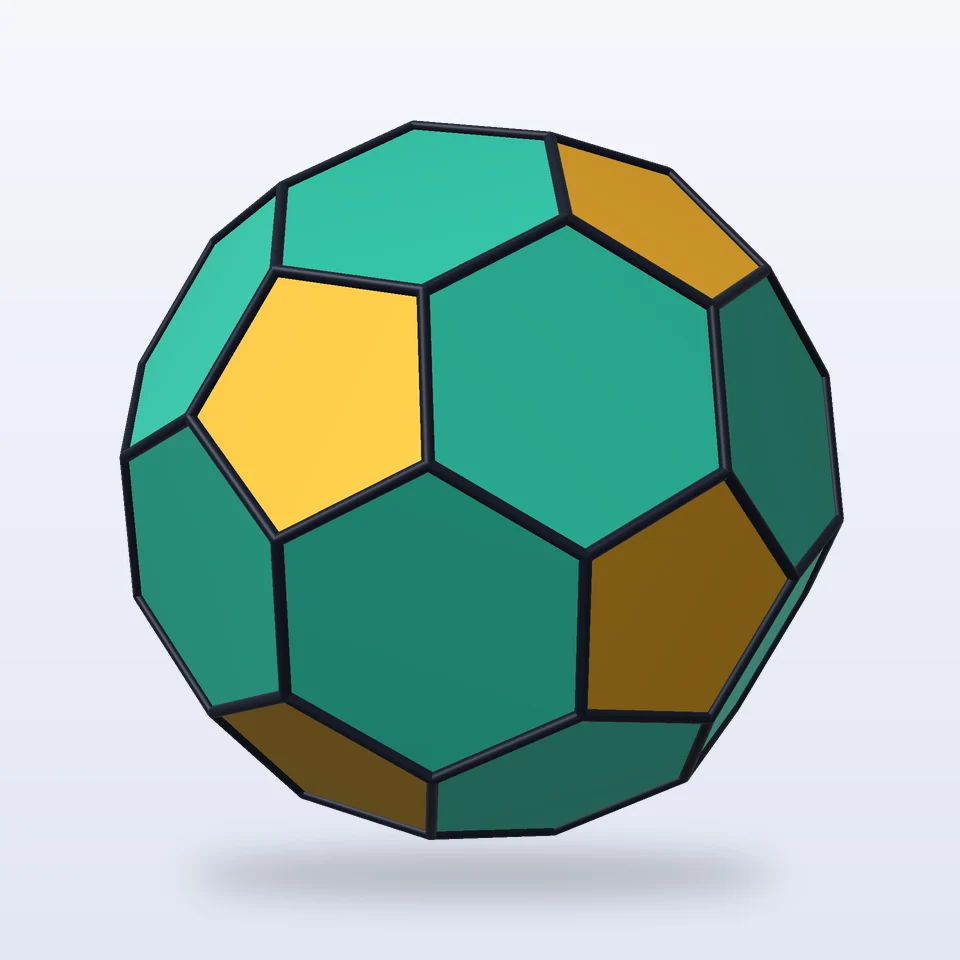
Turn all five Platonic solids and the thirteen Archimedean solids in 3D, from the tetrahedron to the truncated icosahedron soccer ball. Show their duals, colour the faces by kind, and read the faces, edges, vertices, Euler's formula and dihedral angles.
Function plotter
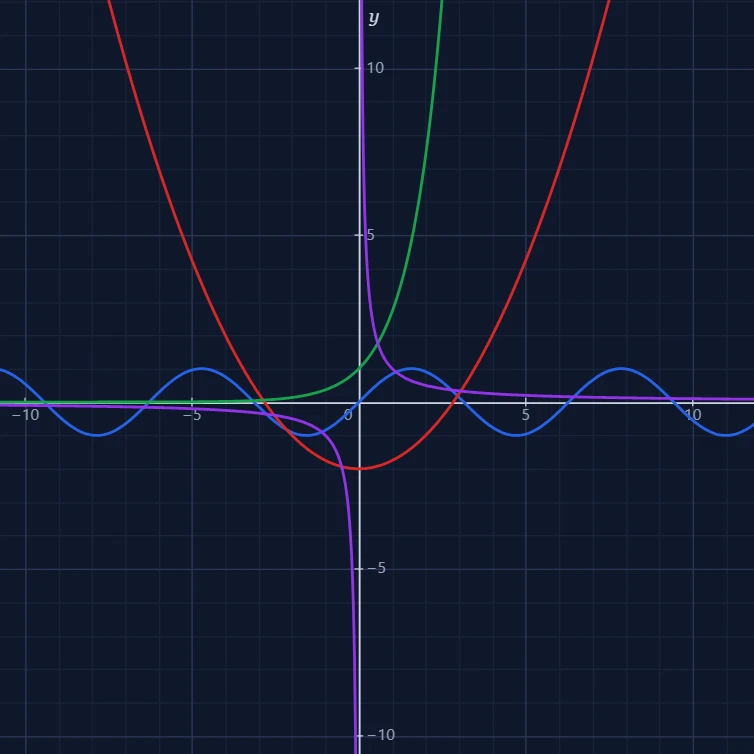
A free online function plotter: draw x², sin x, ln x, 1/x and your own formulas on an interactive grid. Pan, zoom, trace x and y, and save the graph as a PNG.

M.C. Escher tessellation maker
Make M.C. Escher-style tessellations online: interlocking lizards, birds, fish, Pegasus and more. Reshape the motif, recolour it and save PNG or SVG.
Ready to try it?
Open PictorX in your browser — no install, no credit card required to start.
Go to Editor