
Torus knot
Wind a string around a doughnut: p times around its axis, q times through its hole, and join the ends. Unless one of the numbers is 1, the loop you get cannot be untangled without cutting it. Two and three give the trefoil, the simplest knot of all; two and five the cinquefoil; three and four a knot of eight crossings. When p and q share a divisor the string falls apart into several loops that hold on to each other: the Hopf link, Solomon's link, three linked rings. Turn every one of them in 3D and see why. Pick a knot or set p and q: the knot winds p times around the axis of the torus and q times through its hole. Drag across the picture to turn it; the wheel or two fingers zoom and a double click puts it back. Turn spins the knot while its colours flow along it, Trace draws it from start to end so you can follow how it winds, and Reset puts the view back. When p and q share a divisor the curve falls apart into a link of several loops. The tiles give the knot's name, its crossing number, its unknotting number (or the linking number of a link) and how many loops it has.
How it works
- Pick a named knot or set p, the number of times the knot goes around the axis of the torus, and q, the number of times it passes through the hole.
- Drag across the picture to turn the knot, use the wheel or two fingers to zoom, and tick Torus to see the doughnut it lies on.
- Press Trace to watch the tube being drawn from start to end, or Turn to spin it while its colours flow along it.
- Read the name, the crossing number, the unknotting number (or the linking number of a link) and the number of loops in the tiles, then save the picture or open it in the editor with every loop on a layer of its own.
What p and q mean
Every torus knot is a closed curve on the surface of a torus. The first number, p, counts how often it goes around the torus' axis, the line through the hole; the second, q, counts how often it winds through the hole, around the tube itself. The knot with p = 2 and q = 3 goes twice around and three times through: that is the trefoil. Swap the numbers and you get the same knot drawn another way, which is why T(2, 3) and T(3, 2) are one and the same.
When it is a link
If p and q have a common divisor d, the curve closes up before it has used all its windings, and d separate loops are needed to cover the pattern. Each loop is itself a (p/d, q/d) torus knot, and every two of them are linked (p/d)(q/d) times. T(2, 2) is the Hopf link, two rings through each other; T(2, 4) is Solomon's link, two rings that wind twice around each other; T(3, 3) is three rings, every one linked with the others. Colour by loop gives each its own colour.
Counting the crossings
However you lay a knot on a table, its strands cross some number of times; the smallest possible number is the crossing number. For torus knots it is min(p(q − 1), q(p − 1)): 3 for the trefoil, 5 for the cinquefoil, 8 for T(3, 4), 10 for T(3, 5). Kunio Murasugi proved this in 1991. In the knot tables, where knots are listed by crossing number, T(3, 4) is knot 8₁₉ and T(3, 5) is 10₁₂₄.
How knotted is it?
The unknotting number is the fewest times you must let a strand pass through another to untie the knot. For the (p, q) torus knot it is (p − 1)(q − 1)/2, the same as its genus. John Milnor conjectured this in 1968, and it took until 1993, when Peter Kronheimer and Tomasz Mrowka proved it with gauge theory from physics. The trefoil needs one crossing change, the cinquefoil two, T(5, 8) fourteen.
Frequently asked questions
What is a torus knot?
A knot that can be drawn on the surface of a torus, a doughnut, without crossing itself. It is described by two whole numbers: p, how often it goes around the torus' axis, and q, how often it passes through the hole. If p and q have no common divisor and neither is 1, the result is a true knot; the trefoil is the (2, 3) torus knot.
Why are T(2, 3) and T(3, 2) the same knot?
Because a torus can be turned inside out, through the hole, so that its two directions swap: the circles around the axis become circles around the tube and the other way round. A knot on it keeps its shape but swaps p and q. In 3D the two look different at first, but one can be moved into the other without cutting.
Why do some p and q give several loops?
When p and q share a divisor d, the curve returns to its start after only a d-th of the windings. The rest of the pattern is made of d − 1 more loops, each a (p/d, q/d) torus knot, wound around each other. The tiles then show the number of loops and how often every two of them are linked.
What is the unknotting number?
The smallest number of times one strand must pass through another to turn the knot into a plain loop. For the (p, q) torus knot it is (p − 1)(q − 1)/2, which John Milnor conjectured in 1968 and Peter Kronheimer and Tomasz Mrowka proved in 1993.
What is the trefoil?
The simplest knot that cannot be untied: three crossings, the (2, 3) torus knot. It comes in two mirror images, a left-handed and a right-handed trefoil, that cannot be turned into each other. It is the knot you get when you tie an overhand knot in a rope and join its ends.
Can I use the picture in a design?
Yes. Save gives a PNG at the size you choose, and the pencil opens the knot in the PictorX photo editor with the shadow, the torus and the knot (every loop of a link on its own) on layers of their own, so you can recolour or hide them one by one. In the editor itself it is under Apps ▸ Science ▸ Mathematics ▸ Torus Knot. Everything is drawn in your browser.
Torus Knot: how do I record a video?
Press the red Record button in the playback bar: it films what the stage shows. Press it again to stop, and the video is saved to your device. Recording is free; you only need to sign in. Without a subscription the video carries a small PictorX logo in a corner. The button beside Record opens the video options: the shape (as shown, square, story 9:16 or wide 16:9), the length (until you stop, or 5, 10, 15 or 30 seconds for social media) and the file: MP4, WebM or an animated GIF. You can add one of three music tracks: calm, bright or beat.
Related tools
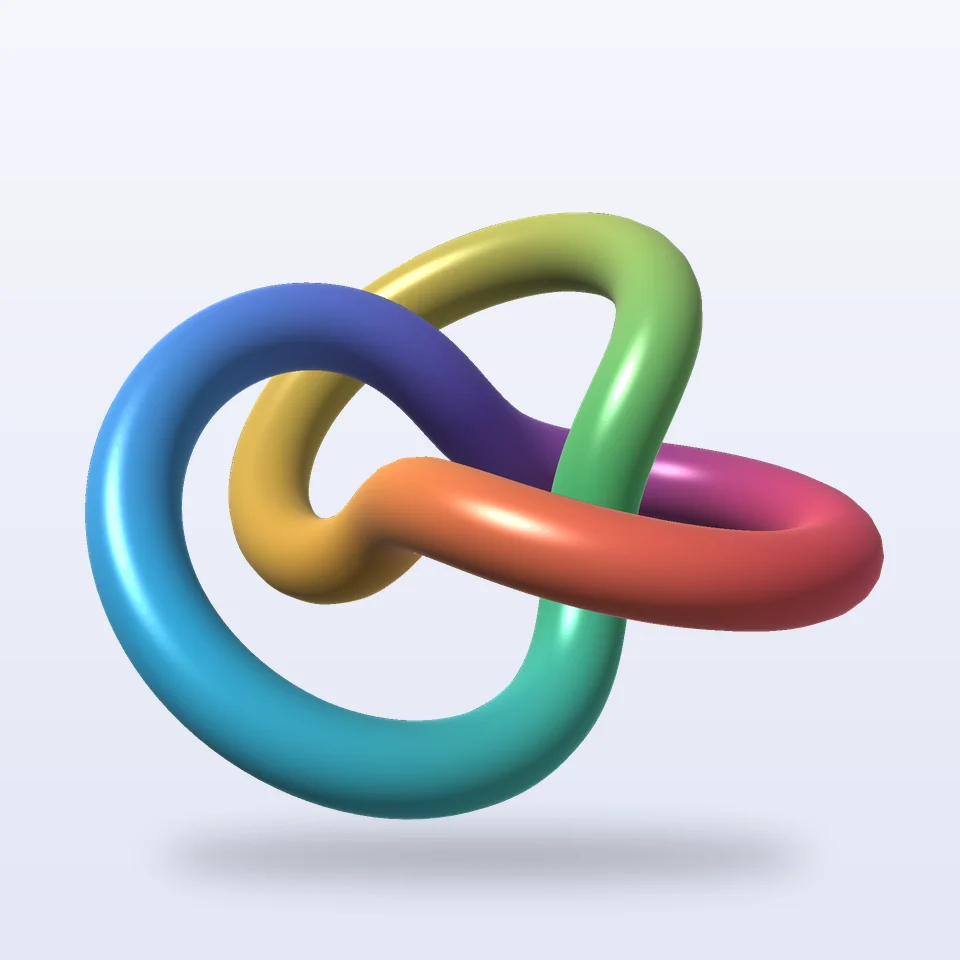
Torus knots explained
What a (p, q) torus knot is, why T(2, 3) is the trefoil, when a torus knot becomes a link, how its crossing number and unknotting number are found, and where torus knots appear in physics and chemistry.
Möbius strip and Klein bottle
Turn one-sided surfaces in 3D: the Möbius strip with any number of half twists, the Klein bottle and Boy's surface. Colour the two sides and watch them meet, send a walker once round to come back on the other face, and read the sides, edges and Euler characteristic.
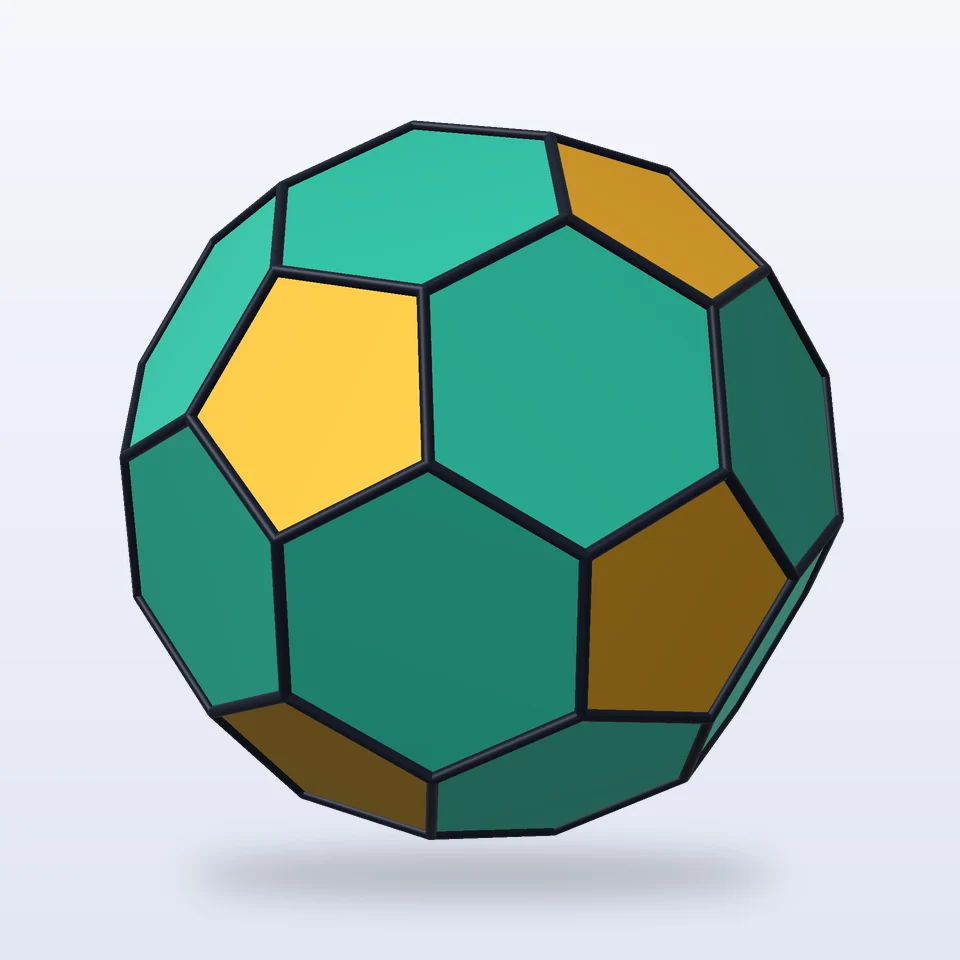
Platonic and Archimedean solids
Turn all five Platonic solids and the thirteen Archimedean solids in 3D, from the tetrahedron to the truncated icosahedron soccer ball. Show their duals, colour the faces by kind, and read the faces, edges, vertices, Euler's formula and dihedral angles.
Rubik's Cube Solver
Free online Rubik's cube solver: colour the stickers of your own cube or scramble one, and get a solution of about 20 moves from Kociemba's two-phase algorithm. Play it move by move on a 3D cube, with the moves in standard notation.
Fourier Epicycles
Draw any shape and watch rotating circles trace it: Fourier epicycles online. Pick a heart, star or butterfly, type a word, choose how many circles turn and save a PNG or SVG.
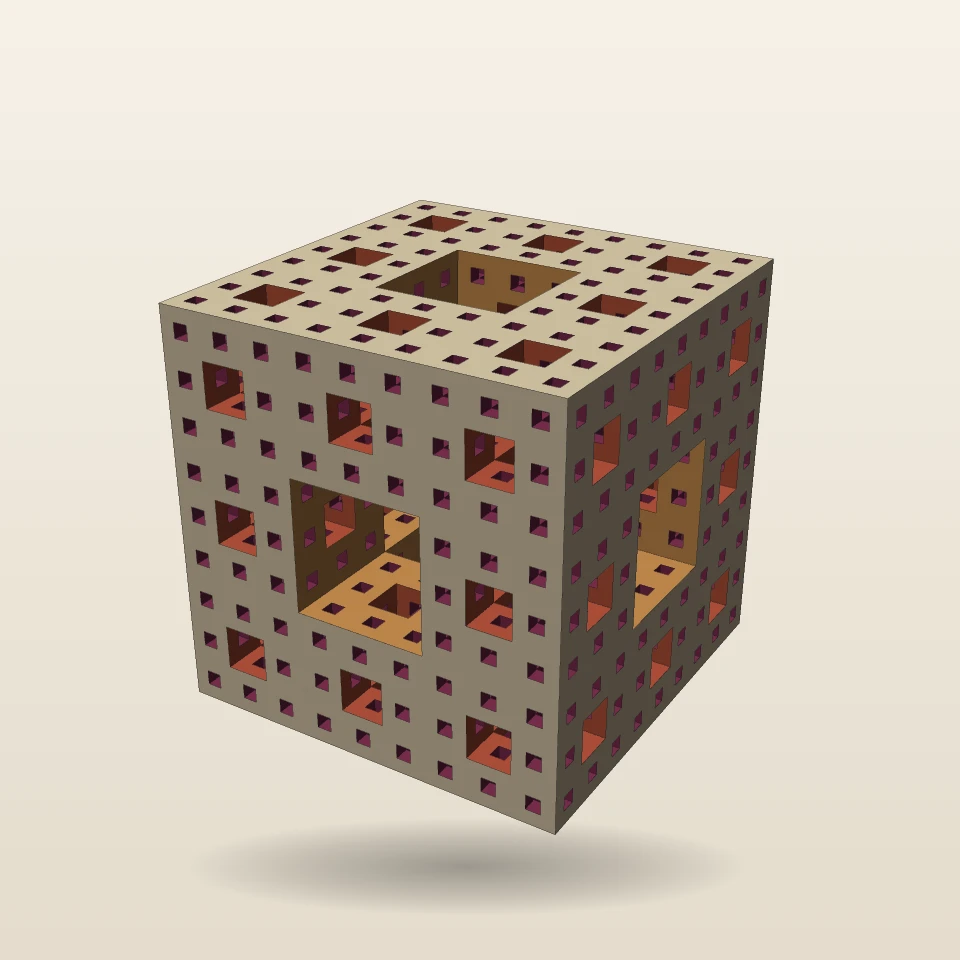
Menger sponge in 3D
Drill the Menger sponge level by level and turn it in 3D. Compare the Jerusalem cube, the Sierpiński tetrahedron, the Mosely snowflake and Cantor dust, slice through them, and watch the volume vanish while the surface grows.
Ready to try it?
Open PictorX in your browser — no install, no credit card required to start.
Go to Editor