
Platonic and Archimedean solids explained
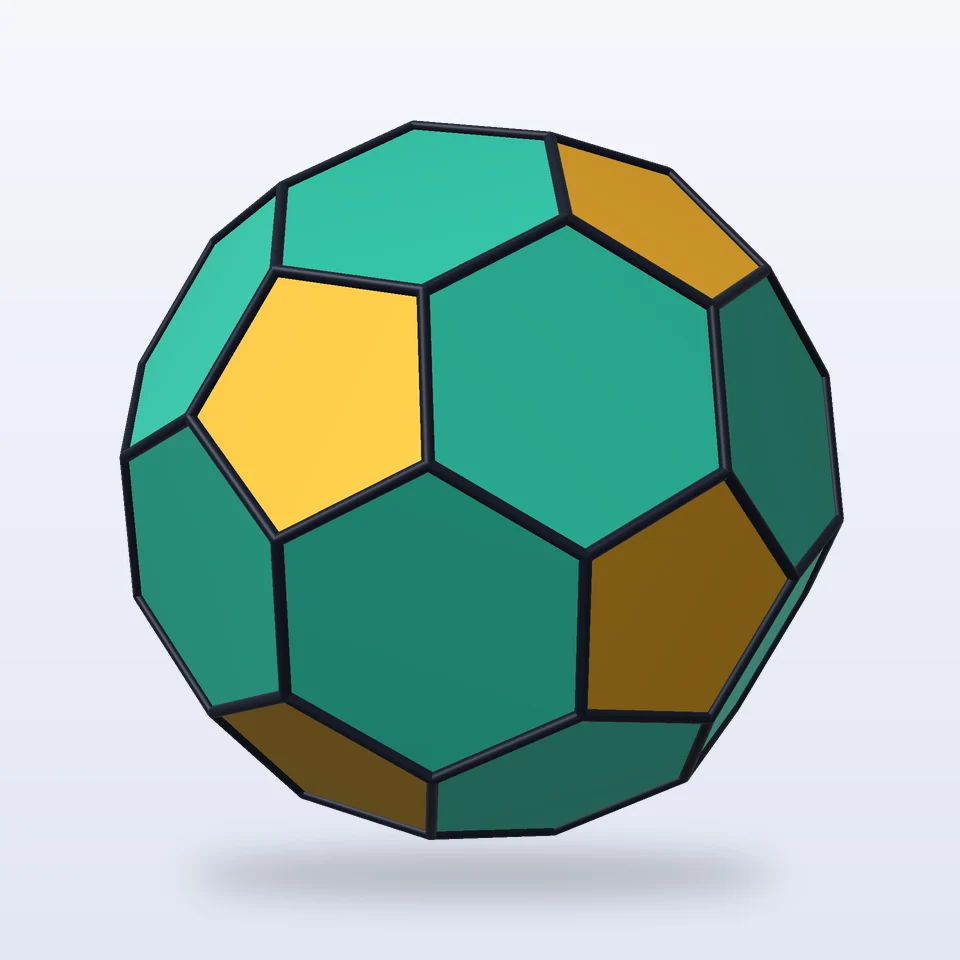
The Platonic solids are the most symmetric shapes that can be built from flat faces, and the Archimedean solids their nearest relatives. They have fascinated people for at least two and a half thousand years, from carved stone balls in neolithic Scotland to Plato, Kepler's model of the solar system, the soccer ball and the shells of viruses.
Regular faces, alike corners
A polyhedron is regular when all its faces are the same regular polygon and the same number of faces meet at every corner. In two dimensions there are infinitely many regular polygons, but in three there are only five regular convex polyhedra. Their Schläfli symbols say it briefly: {3,3} for the tetrahedron, three triangles at each corner; {4,3} for the cube; {3,4} for the octahedron; {5,3} for the dodecahedron and {3,5} for the icosahedron.
Euclid's proof
Around a corner the faces' angles must add up to less than a full turn, or the corner flattens out. With equilateral triangles of 60° there can be three, four or five; with squares of 90°, three; with regular pentagons of 108°, three; hexagons of 120° fit only flat. Five possibilities, and each gives exactly one solid. Euclid closed his Elements with this proof and the construction of all five, about 300 BC.
Plato, Kepler and the elements
In his dialogue Timaeus, Plato made the tetrahedron the atom of fire, the octahedron of air, the icosahedron of water and the cube of earth, and said the dodecahedron was used for the arrangement of the whole heaven. Two thousand years later Johannes Kepler nested the five solids between the spheres of the six known planets in his Mysterium Cosmographicum of 1596. The model was wrong, but the search for it led him to his laws of planetary motion.
Archimedes' thirteen
Allow regular faces of more than one kind, keep every corner alike, and exclude the endless prisms and antiprisms: exactly thirteen convex solids remain. Pappus reports that Archimedes described them; Kepler rediscovered and named them. Seven come from truncating, cutting the corners off a Platonic solid; the cuboctahedron and the icosidodecahedron sit halfway between a solid and its dual; the rhombi- solids push the faces apart; and the two snub solids twist them, which makes them chiral.
Duals and Catalan solids
Exchange the roles of faces and corners and you get the dual: a corner for every face and a face for every corner, with edges crossing at right angles. Cube and octahedron, dodecahedron and icosahedron are dual pairs; the tetrahedron is self-dual. The duals of the Archimedean solids, described by Eugène Catalan in 1865, have identical faces that are not regular, such as the rhombi of the rhombic dodecahedron, the shape of garnet crystals and of a honeycomb cell's end.
Euler's formula
Count the vertices V, edges E and faces F of any convex polyhedron and V − E + F = 2. Euler found it in 1750; it holds because the surface is a sphere, and it changes for surfaces with holes: on a torus the count gives 0. Combined with the rule about angles at a corner, Euler's formula gives a second proof that there are only five regular solids, and it shows that a solid made of pentagons and hexagons with three at each corner always has exactly twelve pentagons, as every soccer ball and fullerene molecule does.
Where the shapes appear
Many viruses build their shells as icosahedra, from identical protein pieces. Methane is a carbon atom at the centre of a tetrahedron of hydrogens; salt and pyrite crystals grow as cubes and octahedra. The C60 buckyball is a truncated icosahedron of carbon atoms, and dice for role-playing games come as all five Platonic solids. Architects and designers use the geodesic subdivisions of the icosahedron for domes, and the soccer ball made the truncated icosahedron the most familiar polyhedron in the world.
Explore it
Open the Platonic solids, start with the cube and show it with its dual to see the octahedron inside, then step through all eighteen with Next solid. Colour by kind of face to see how the Archimedean solids mix their polygons, compare the vertex configurations in the tiles, and check Euler's formula on each. The pencil opens the picture in the photo editor with each kind of face on a layer of its own.
Frequently asked questions
Why are they called Platonic?
Because Plato described them in his dialogue Timaeus, around 360 BC, as the building blocks of the four elements and of the heavens. They were known before him, possibly to the Pythagoreans, and Theaetetus is credited with the first proof that there are only five.
Are there more solids with regular faces?
Yes, if the corners do not all have to be alike. Besides the 5 Platonic and 13 Archimedean solids and the infinite prisms and antiprisms, there are exactly 92 Johnson solids, such as the square pyramid, listed by Norman Johnson in 1966 and proved complete by Victor Zalgaller in 1969.
What does truncated mean?
Cut off at the corners. Truncating a solid replaces every corner by a small face and turns every face into one with twice as many sides: the cube's corners become triangles and its squares become octagons, giving the truncated cube. Cut deeper and you reach the cuboctahedron, halfway to the octahedron.
Which solids are chiral?
Only the snub cube and the snub dodecahedron among these eighteen: each exists in a left- and a right-handed version that are mirror images and cannot be turned into each other. The app draws one of the two.
What symmetry do they have?
The tetrahedron has tetrahedral symmetry (Td), the cube and octahedron octahedral symmetry (Oh), the dodecahedron and icosahedron icosahedral symmetry (Ih). The Archimedean solids share these groups; the snub solids keep only the rotations (O and I). The tile under the angles shows the group.
Related tools
Platonic and Archimedean solids
Turn all five Platonic solids and the thirteen Archimedean solids in 3D, from the tetrahedron to the truncated icosahedron soccer ball. Show their duals, colour the faces by kind, and read the faces, edges, vertices, Euler's formula and dihedral angles.
Torus knot
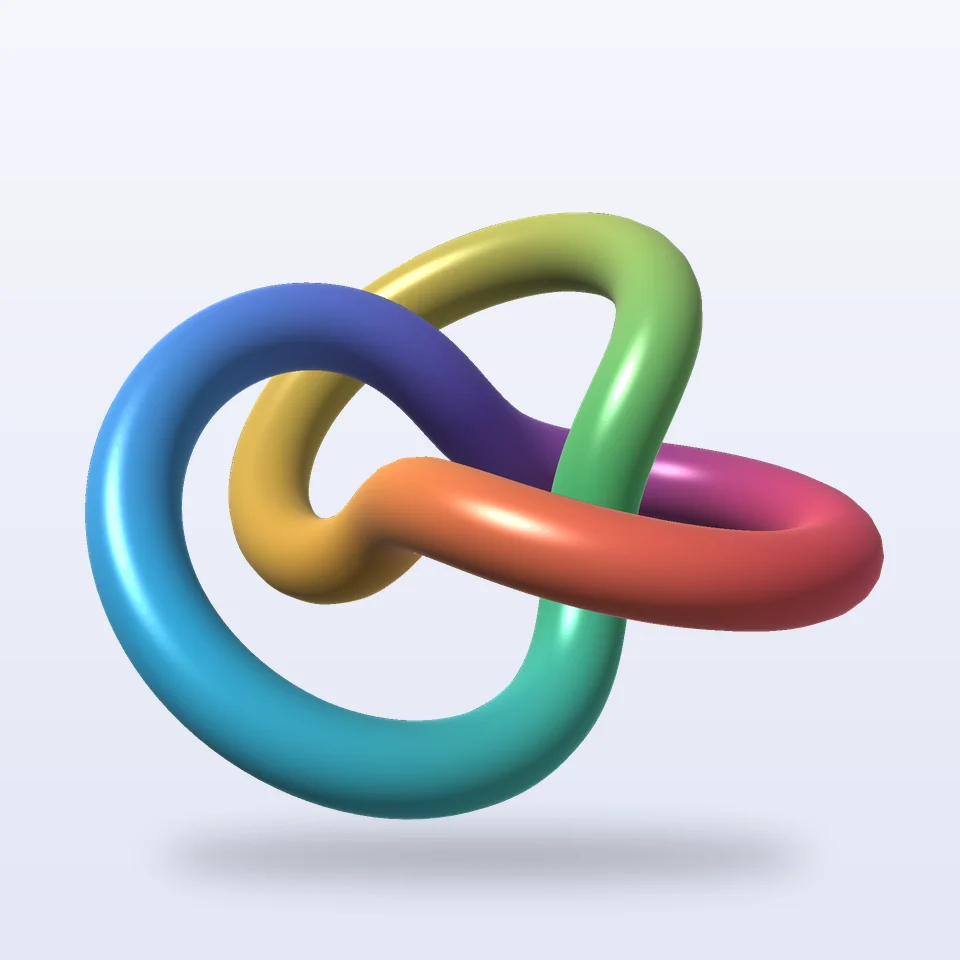
Turn any (p, q) torus knot in 3D: the trefoil, the cinquefoil, the Hopf link and Solomon's link. Trace how the knot winds around the torus, colour it in flowing gradients or stripes, and read its crossing, unknotting and linking numbers.
Rubik's Cube Solver
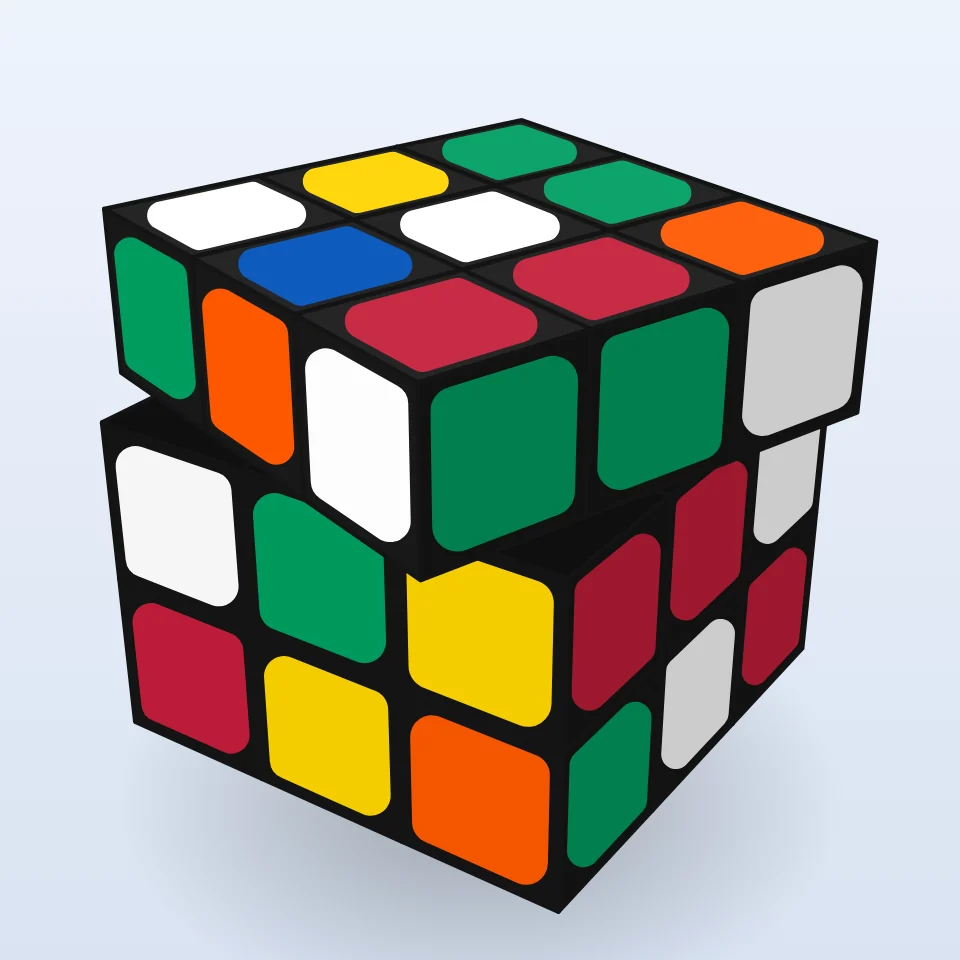
Free online Rubik's cube solver: colour the stickers of your own cube or scramble one, and get a solution of about 20 moves from Kociemba's two-phase algorithm. Play it move by move on a 3D cube, with the moves in standard notation.
Menger sponge in 3D
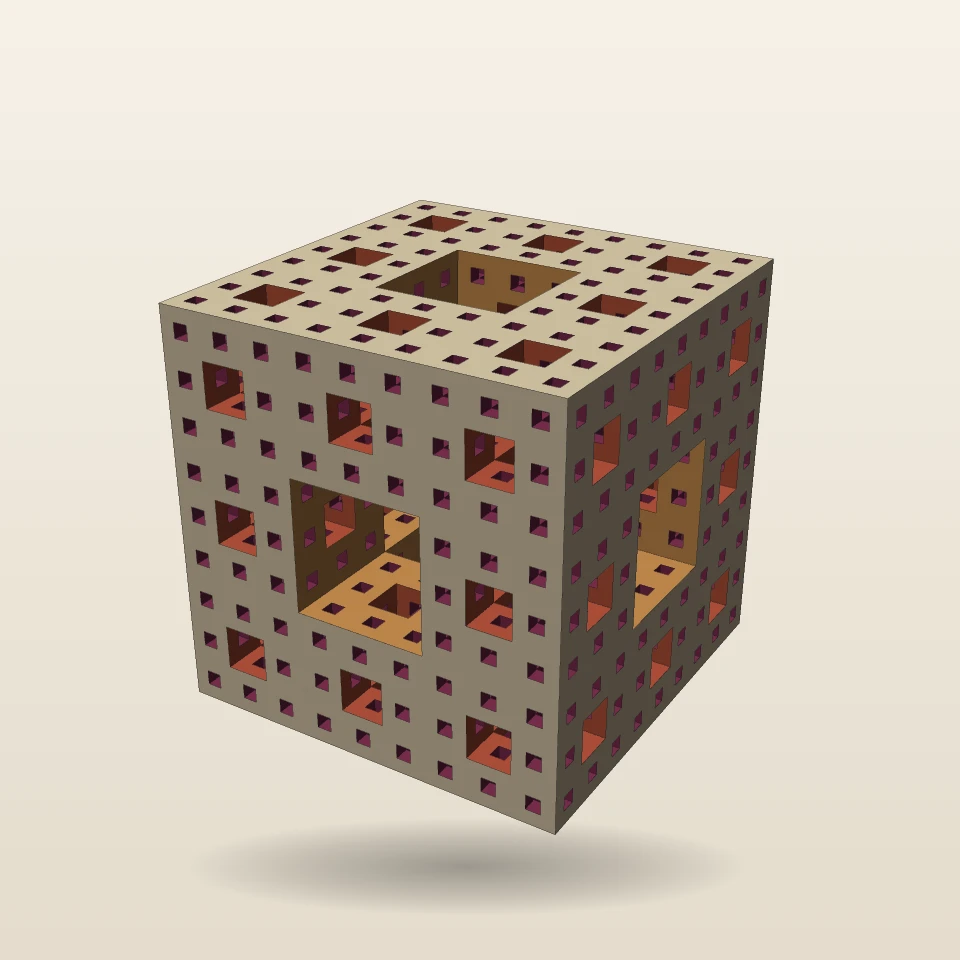
Drill the Menger sponge level by level and turn it in 3D. Compare the Jerusalem cube, the Sierpiński tetrahedron, the Mosely snowflake and Cantor dust, slice through them, and watch the volume vanish while the surface grows.
Tessellation maker
Cover the plane with regular and Archimedean tessellations. Tune scale, colours, and warp square edges Escher-style — then save a PNG.
Ready to try it?
Open PictorX in your browser — no install, no credit card required to start.
Open the Platonic solids