
This equation combines independent reactions, so it balances in more than one way. The one with the smallest coefficients is shown.
| Element | Oxidation number | Change |
|---|
| Substance | Coefficient | Molar mass (g/mol) | You have (g) | Reacts / forms | Moles | Left over |
|---|
Chemical equation balancer
Type a reaction and get the smallest whole-number coefficients at once. Every element is counted on both sides, atom by atom, so you can see that nothing is lost; switch to As typed to find what was wrong with your own attempt. The app names the type of reaction, shows which elements are oxidised and reduced, and, with the mass or moles of what you have, finds the limiting reactant, the theoretical yield and what is left over. Type a reaction with an arrow between the reactants and the products, such as C3H8 + O2 -> CO2 + H2O, or pick an example. The smallest whole-number coefficients appear at once, with the atoms of every element counted on both sides. As typed shows your own coefficients, with the elements that do not match in red. Enter the mass or moles of one or more reactants to find the limiting reactant, what reacts and forms, and what is left over.
How it works
- Type a reaction with an arrow between the reactants and the products, such as Al + Fe2O3 -> Al2O3 + Fe, or pick one of the examples.
- Read the balanced equation and check the atoms of every element on both sides; As typed shows your own coefficients and the elements that do not match.
- Enter the mass or moles of the reactants you have to see the limiting reactant, what reacts and forms, and what is left over. Copy the result or save it as an image, PDF or JSON.
How an equation is balanced
Atoms are not made or destroyed in a reaction, so every element needs the same number of atoms on both sides. Give each substance an unknown coefficient and that rule becomes one equation per element: for C3H8 + O2 → CO2 + H2O, carbon gives 3a = c, hydrogen 8a = 2d and oxygen 2b = 2c + d. The app solves these exactly with fractions and scales the answer to the smallest whole numbers: 1, 5, 3 and 4. With ions, the total charge is one more equation.
From coefficients to grams
The coefficients count particles, so they are mole ratios: one mole of propane takes five moles of oxygen. Multiply by the molar masses to get grams. The reactant that runs out first, relative to its coefficient, is the limiting reactant: it sets how much product forms, and the others are left over. With 10 g of propane and 40 g of oxygen, propane runs out first, about 29.9 g of carbon dioxide forms, and about 3.7 g of oxygen remains.
Frequently asked questions
How do I type charges, hydrates and states?
Write a charge after a caret or in braces, such as Fe^3+, MnO4^- or SO4{2-}; Fe3+ and NH4+ also work, and SO42- is read as sulfate. Type an electron as e-. Join a hydrate with a dot or an asterisk: CuSO4·5H2O or CuSO4*5H2O. States such as (s), (l), (g) and (aq) may follow a formula and are kept in the result. Any arrow works: ->, =, → or ⇌.
Why does it say the equation cannot be balanced?
Usually a formula is wrong, or a product is missing. If an element appears on one side only, no coefficients can fix it, and the message names it. Remember that symbols start with a capital letter: Co is cobalt, while CO is carbon monoxide. If the equation only balances with a substance on the other side of the arrow, or without it, the app says so too.
What does As typed show?
Your own coefficients, as you typed them in front of the formulas (1 where there is none), with the atoms of each element counted on both sides. Elements whose counts do not match are shown in red, so you can check a balancing you did by hand and see exactly where it goes wrong.
How are the oxidation numbers worked out?
With the usual textbook rules: free elements are 0, fluorine is −1, the alkali metals +1 and the alkaline earth metals +2, hydrogen +1 (−1 in metal hydrides), oxygen −2 unless the rest of the formula decides otherwise, as in peroxides, and the last element follows from the total charge. Common ions such as sulfate and nitrate are recognised. Where atoms of one element differ, the number is an average, such as +8/3 for iron in Fe3O4.
Is anything sent to a server?
No. The balancing, the oxidation numbers and the amounts are all worked out in your browser, and your last equation and amounts are kept in this browser's local storage.
Related tools
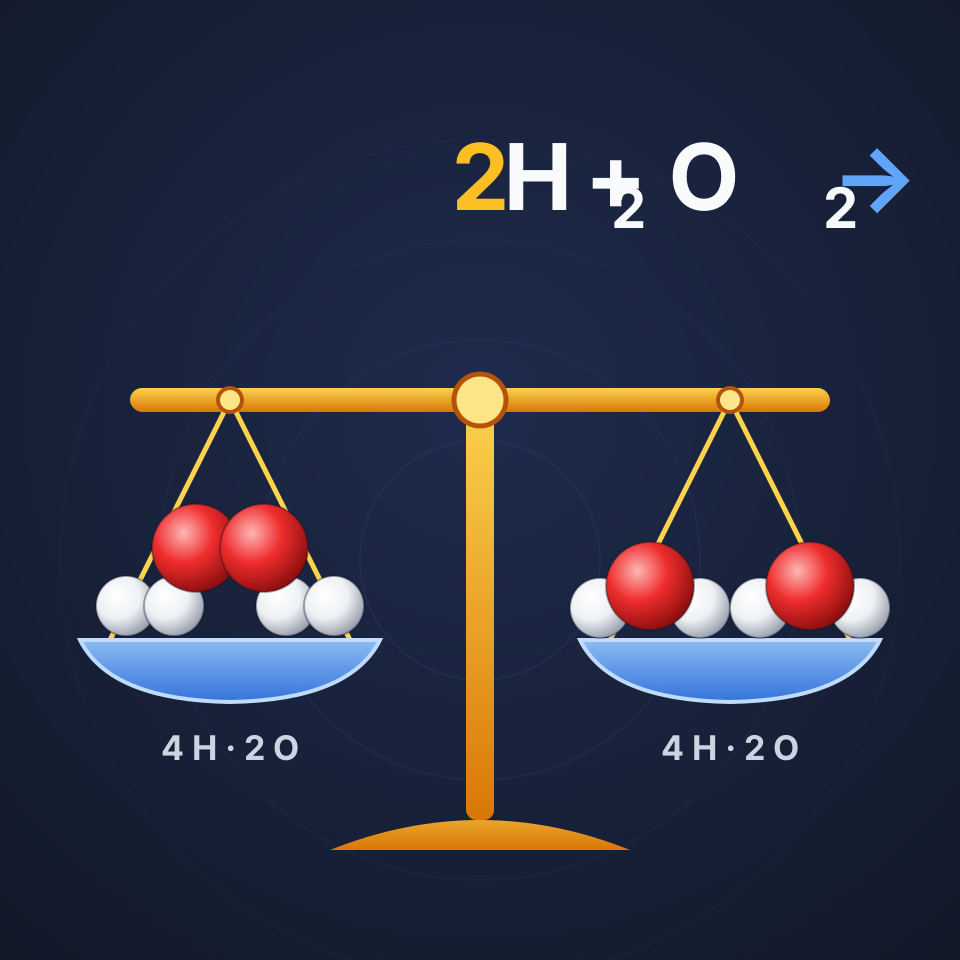
How to balance chemical equations
How to balance chemical equations step by step: conservation of atoms, the inspection and algebraic methods, ionic and redox equations with oxidation numbers, and how coefficients lead to moles, grams and the limiting reactant.
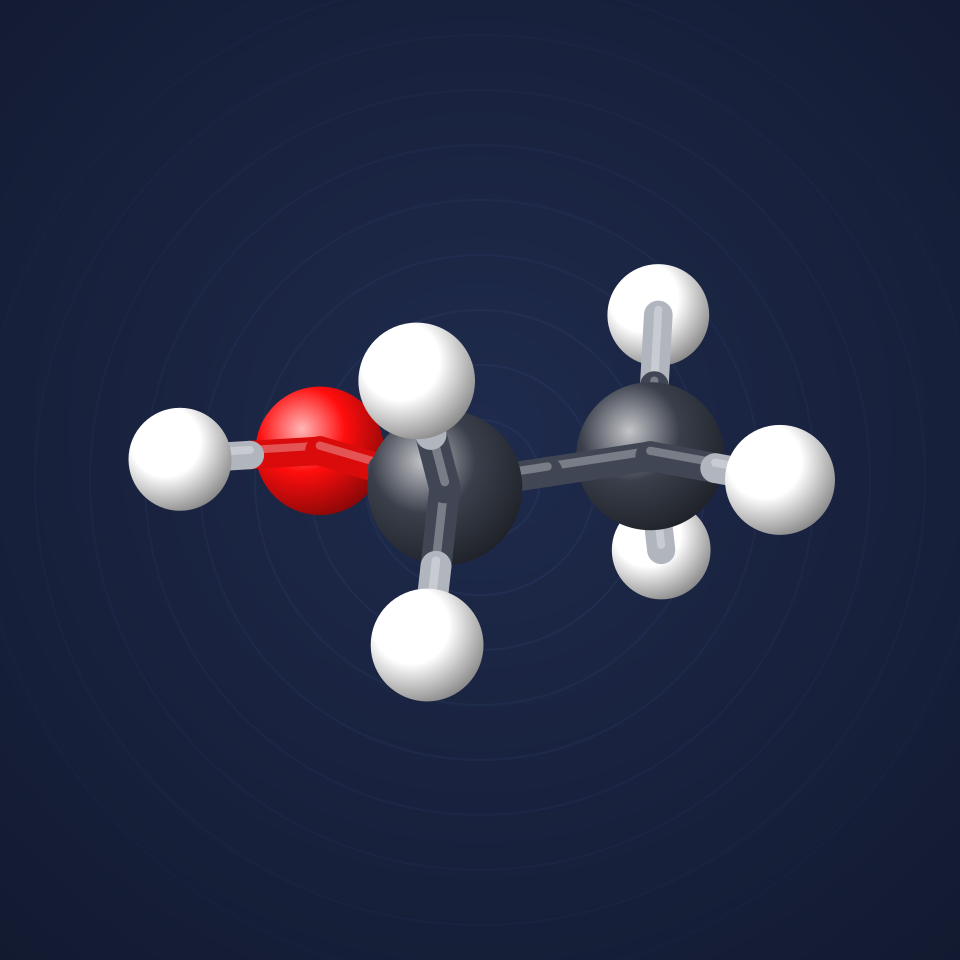
Molecule builder
A free online molecule builder: join atoms with single, double and triple bonds, get the formula and molar mass, see the molecule's real shape in 3D, and solve chemistry challenges.
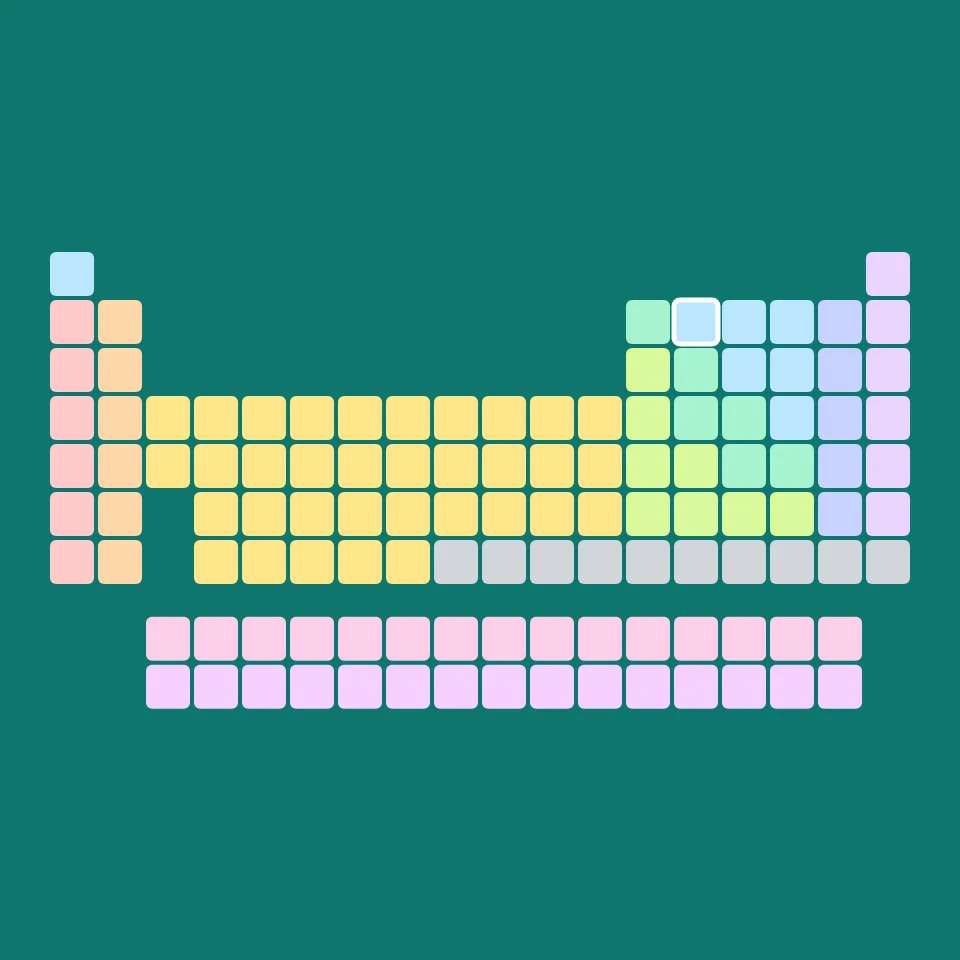
Interactive periodic table
An interactive periodic table of all 118 elements: color it by category, block, state or electronegativity, and click an element for its atomic weight, electron configuration and shells.
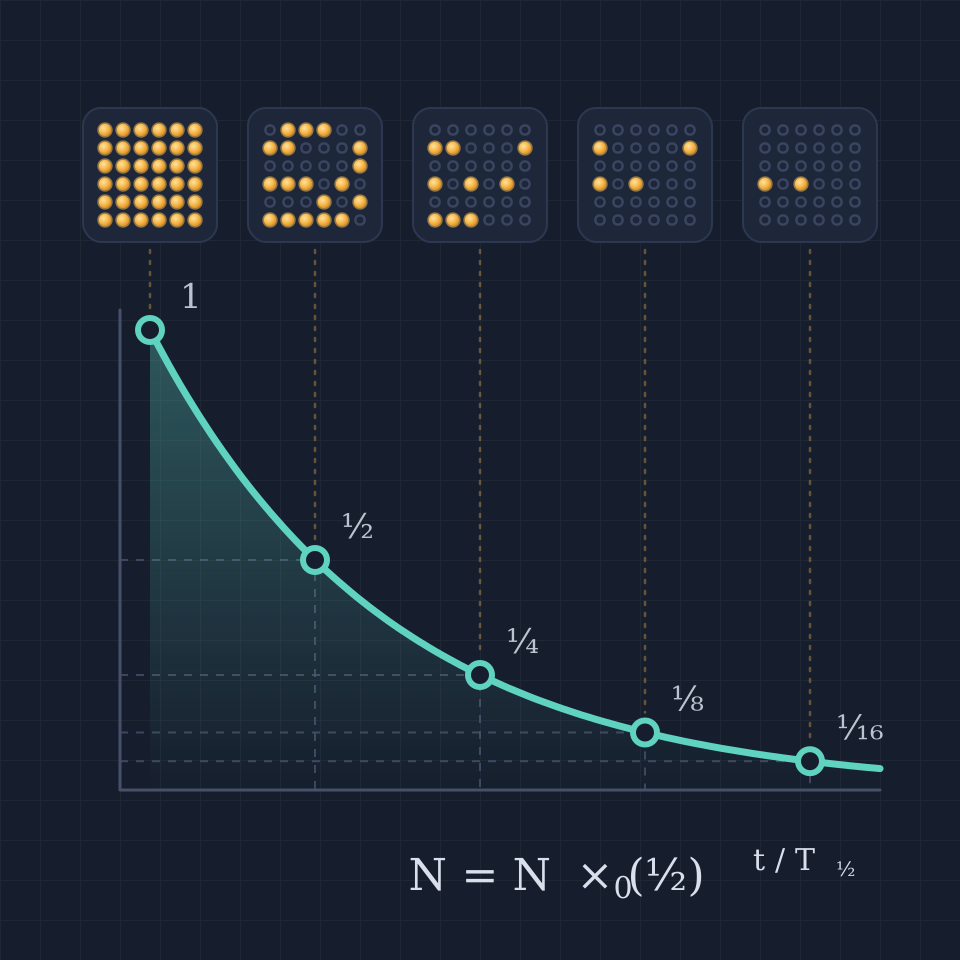
Half-life calculator
A free half-life calculator: work out the amount left, the initial amount, the elapsed time or the half-life of radioactive decay, with isotope presets, a decay curve and the calculation written out.
Matrix calculator
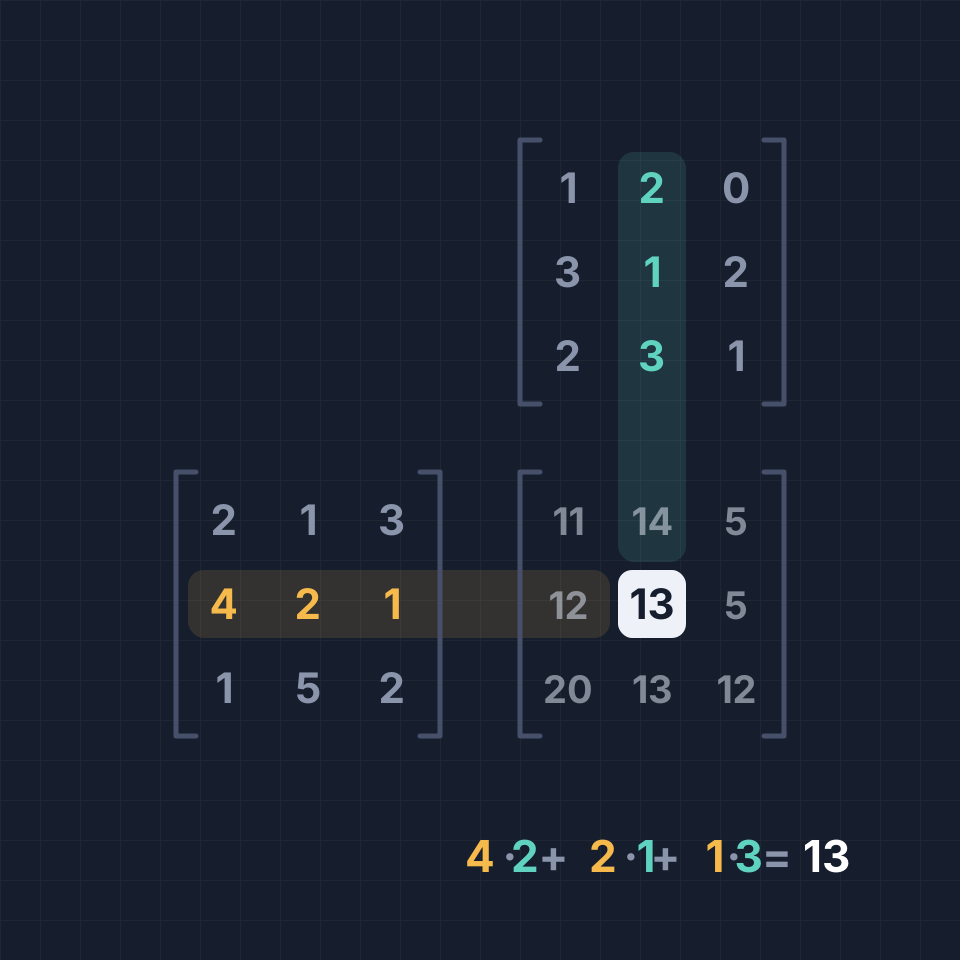
A free online matrix calculator: add, subtract, multiply, transpose and invert matrices up to 6x6, with determinant, rank, powers and exact fractions.
Ready to try it?
Open PictorX in your browser — no install, no credit card required to start.
Go to Editor