
- Amount left
- Each half-life
- Your calculation
| Half-lives | Time | Amount left | Remaining |
|---|
Half-life calculator
Work out exponential decay from any three of the four values: the initial amount, the amount left, the elapsed time and the half-life. Pick an isotope such as carbon-14 or iodine-131 to fill in its half-life, then read the result, the percentage left, the decay constant and the mean lifetime, with the decay curve and a table for every half-life. Choose what to work out and enter the other three values, or pick an isotope to fill in its half-life. The results, the decay curve and the table update as you type, and your last input is kept in this browser.
How it works
- Choose what to work out: the remaining amount, the initial amount, the elapsed time or the half-life.
- Enter the other three values, or pick an isotope to fill in its half-life, and choose the time unit.
- Read the result, the percentage left and the decay constant, follow the decay curve and copy the calculation or the table.
The half-life formula
After every half-life, half of what was there is left. After a time t, the amount left is N = N₀ × (1/2)^(t / T½), where N₀ is the initial amount and T½ the half-life. 100 g of carbon-14, with a half-life of 5,730 years, leaves 100 × 0.5^(10,000 / 5,730) = 29.83 g after 10,000 years. Turned around, the elapsed time is t = T½ × log₂(N₀ / N) and the half-life is T½ = t / log₂(N₀ / N).
Decay constant and mean lifetime
The decay constant λ = ln 2 / T½ is the share of the atoms that decays per unit of time: for carbon-14 about 0.000121 per year. The mean lifetime τ = T½ / ln 2, about 1.44 half-lives, is how long an atom lasts on average: 8,267 years for carbon-14. With λ the formula also reads N = N₀ × e^(−λt).
Frequently asked questions
Does it work for things other than radioactive isotopes?
Yes. Anything that halves at a steady rate follows the same formula, such as the charge of a capacitor discharging through a resistor or, roughly, the level of many medicines in the blood. Choose Custom, enter the half-life, and use any unit for the amounts.
Which units can I use?
Any unit for the amounts (grams, milligrams, becquerels, counts or percent), as long as both amounts use the same one, because only their ratio matters. The elapsed time and the half-life share one time unit, from seconds to years; when you change it, both are converted. A year here is 365.25 days.
How accurate are the isotope half-lives?
They are rounded, commonly cited values, such as 8.02 days for iodine-131 and 4.468 billion years for uranium-238. For carbon-14 the calculator uses 5,730 years, the value most textbooks give; the latest measurement is 5,700 ± 30 years. For precise work, choose Custom and enter the value from a current nuclear data table.
Related tools
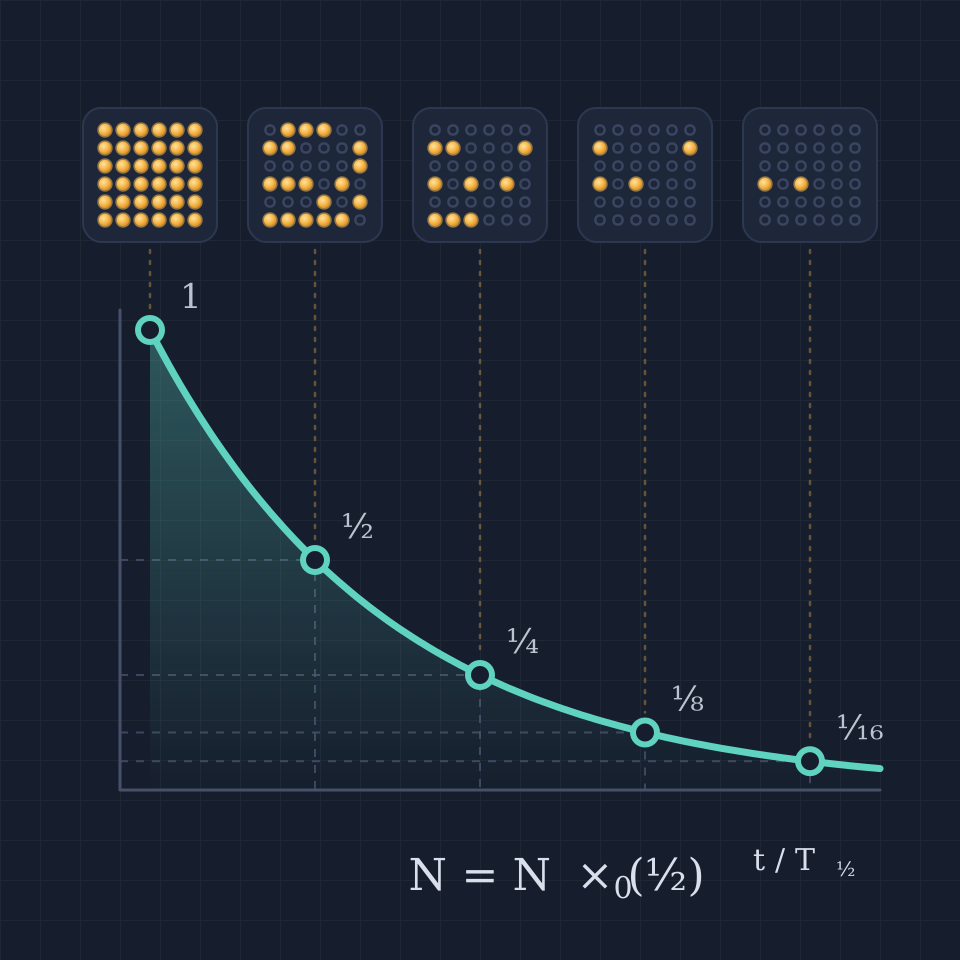
How half-life works
What is a half-life? Why radioactive decay halves, the formulas, decay constant, activity and mean lifetime, carbon-14 dating and half-lives of common isotopes.
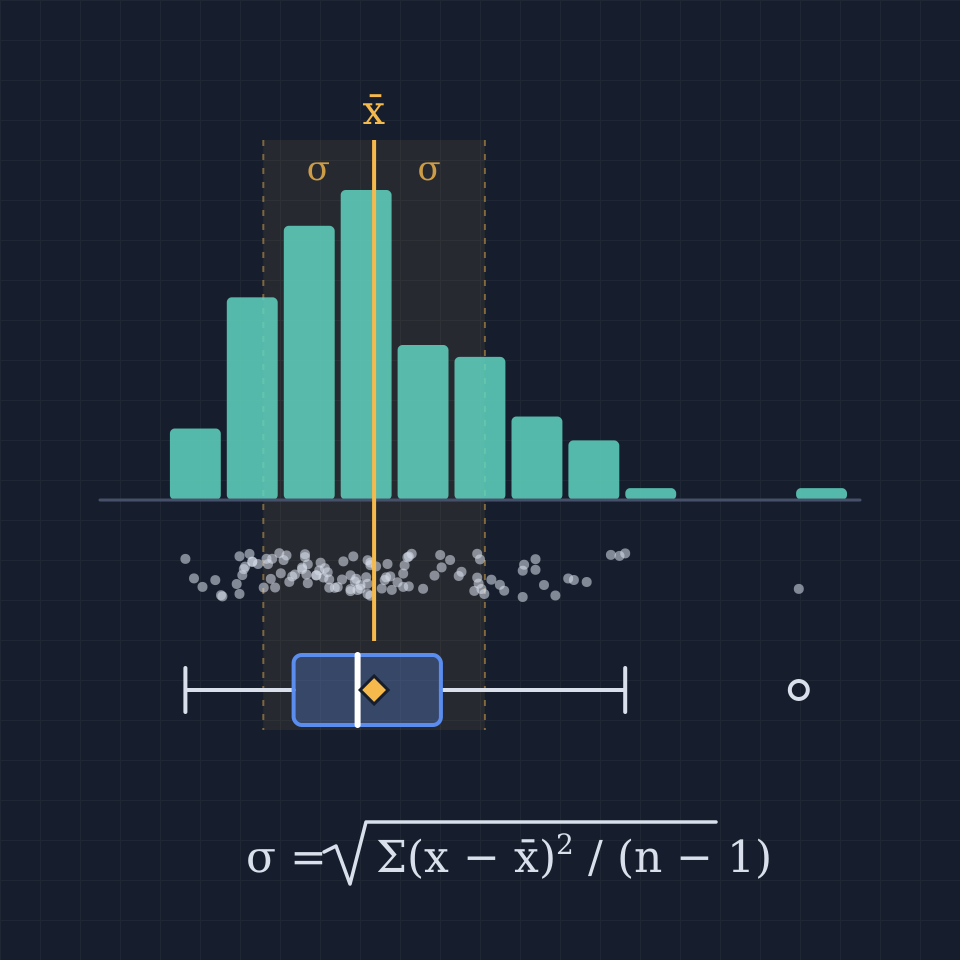
Statistics calculator
A free online statistics calculator: paste numbers and get the mean, median, mode, variance, standard deviation, quartiles and a histogram instantly.
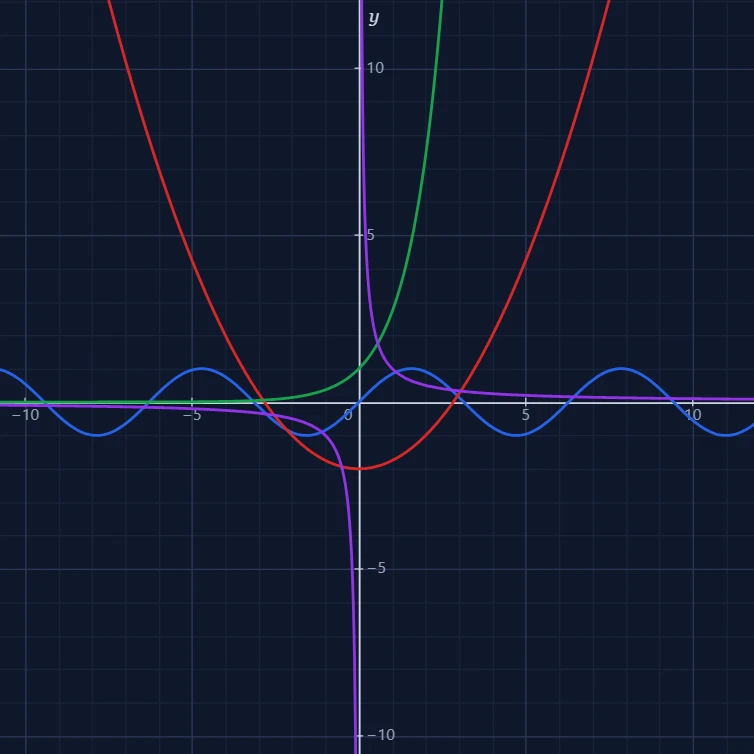
Function plotter
A free online function plotter: draw x², sin x, ln x, 1/x and your own formulas on an interactive grid. Pan, zoom, trace x and y, and save the graph as a PNG.
Unit converter
A free online unit converter for length, weight, temperature, speed, area, volume, time, pressure, energy and computer data - bytes to gigabytes and GB to GiB.
Ready to try it?
Open PictorX in your browser — no install, no credit card required to start.
Go to Editor