
How to balance chemical equations
A chemical equation is a recipe written in formulas, and a balanced one is an honest recipe: every atom that goes in comes out again. Balancing is the first step in almost every calculation in chemistry, from how much fuel an engine burns to how much medicine a reaction yields. Here is why it works, how to do it by hand, and what the coefficients tell you.
Why equations must balance
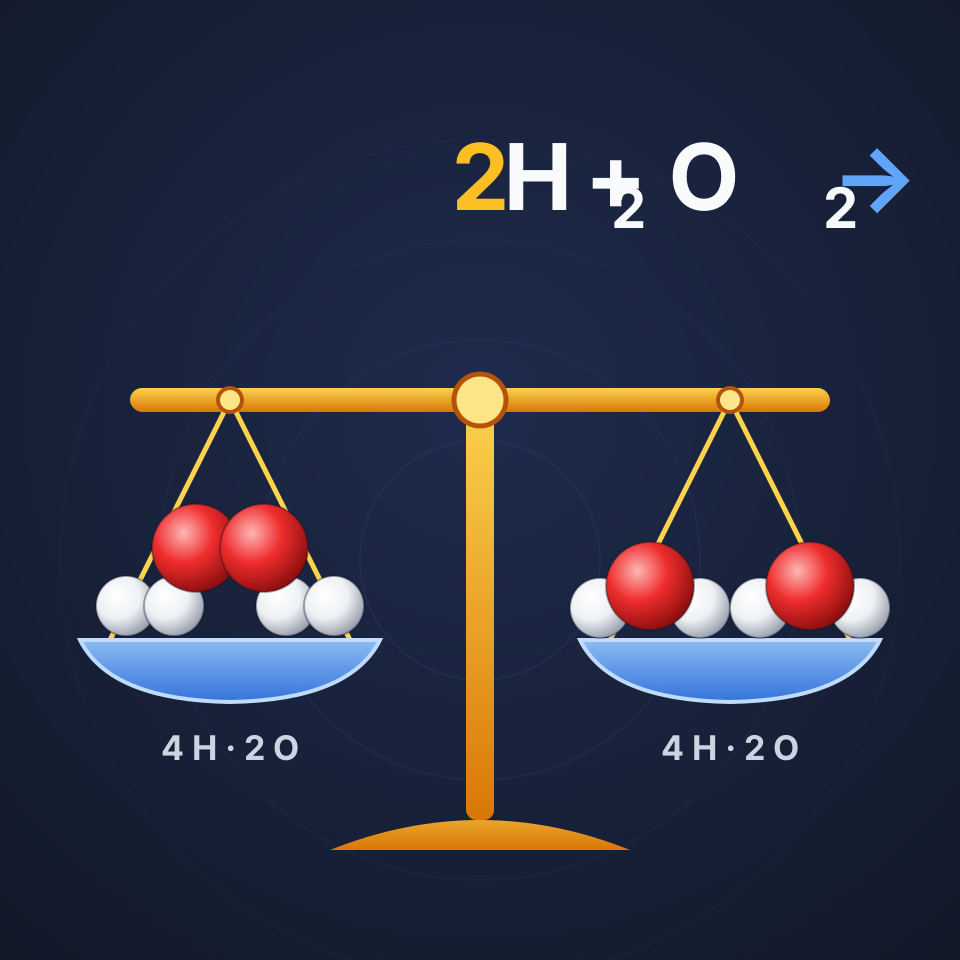
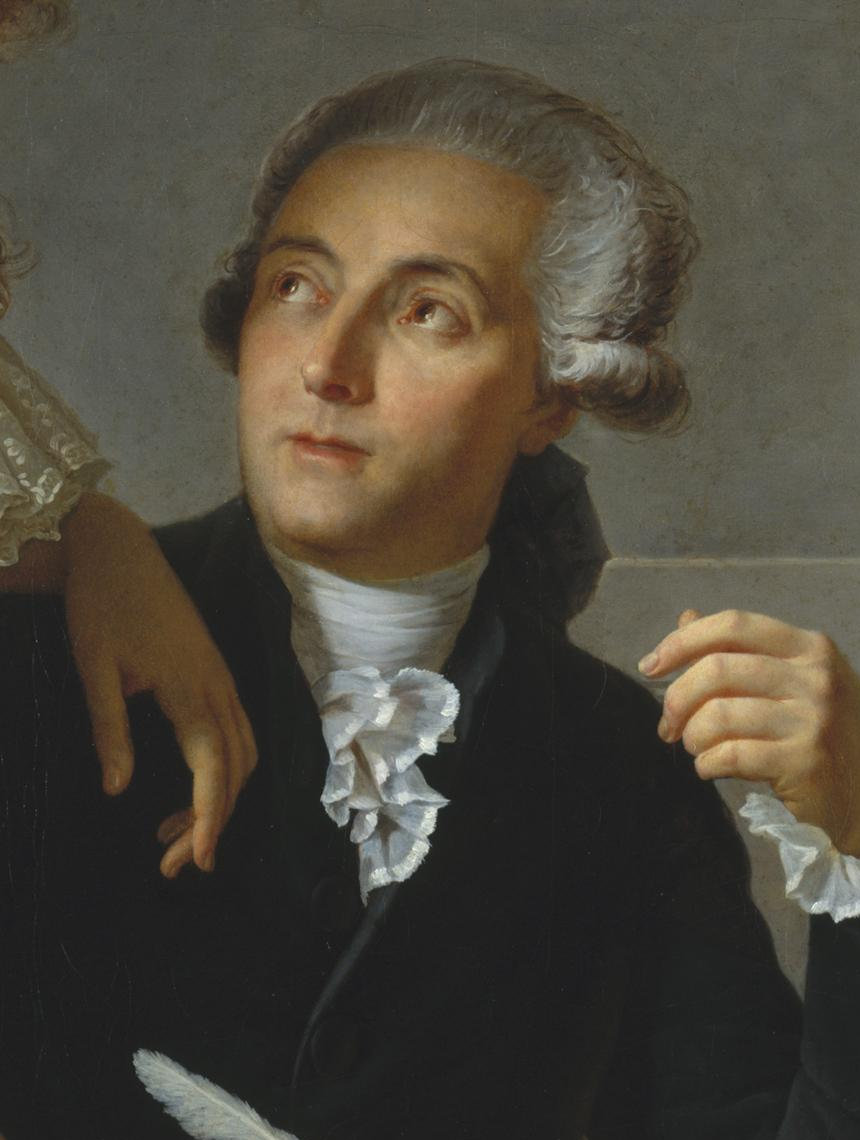
In a chemical reaction, atoms swap partners but are never created or destroyed. Antoine Lavoisier showed this in the 1770s by weighing reactions in sealed vessels: the mass before and after was the same. So the equation for a reaction must have the same number of atoms of every element on each side, and, for ions, the same total charge. The numbers in front of the formulas, the coefficients, make this true. The small numbers inside a formula, the subscripts, may never change, because they define the substance: H2O is water, H2O2 is hydrogen peroxide.
Balancing by inspection
For most equations a few rules of thumb are enough. Start with the element that appears in the fewest formulas, leave hydrogen and oxygen for last, and treat a polyatomic ion that stays intact, such as sulfate, as one unit. For propane, C3H8 + O2 → CO2 + H2O: three carbons give 3 CO2, eight hydrogens give 4 H2O, and that makes 6 + 4 = 10 oxygen atoms on the right, so 5 O2. Fractions are allowed along the way, as long as you multiply them out at the end: octane needs 25/2 O2, so the equation is doubled to 2 C8H18 + 25 O2 → 16 CO2 + 18 H2O.
The algebraic method
Any equation can be balanced without guessing. Give each substance an unknown coefficient, a, b, c and so on, and write one equation per element saying that its atoms are equal on both sides. For Fe + O2 → Fe2O3 that is a = 2c for iron and 2b = 3c for oxygen. Set one unknown to 1, solve, and scale to whole numbers: c = 2 gives a = 4 and b = 3, so 4 Fe + 3 O2 → 2 Fe2O3. In linear algebra terms, the coefficients form the null space of the matrix of atom counts. This is how the balancer works, with exact fractions, so even a reaction with ten substances and coefficients in the hundreds comes out exactly.
Ions, half-reactions and redox
In an ionic equation, the charges must balance as well as the atoms. In a redox reaction, electrons move from one substance to another: the one that loses electrons is oxidised and its oxidation number rises, the one that gains them is reduced and its number falls. When permanganate oxidises iron(II) in acid, MnO4- + 5 Fe2+ + 8 H+ → Mn2+ + 5 Fe3+ + 4 H2O, manganese goes from +7 to +2 and takes five electrons, one from each of five iron ions, which go from +2 to +3. By hand, such equations are often balanced as two half-reactions, one for each change, which are scaled so that the electrons cancel. Solving for the atoms and the charge together gives the same answer.
From the equation to the amounts
Coefficients count particles, so they are also mole ratios. In 2 H2 + O2 → 2 H2O, two moles of hydrogen react with one mole of oxygen to give two moles of water. To work in grams, divide each mass by the molar mass, the sum of the atomic weights in the formula, compare, and multiply back. The reactant that runs out first, relative to its coefficient, is the limiting reactant. It decides the theoretical yield, the most product the reaction can give; the other reactants are in excess and partly left over. Real reactions give less, and the actual yield divided by the theoretical yield is the percentage yield.
Types of reactions
Many reactions fall into a few families. In a combustion, a fuel burns in oxygen, and a hydrocarbon gives carbon dioxide and water. In a synthesis, substances combine into one; in a decomposition, one substance breaks apart. In a single replacement, an element takes the place of another in a compound, as aluminium takes iron's place in the thermite reaction; in a double replacement, two compounds swap partners, often forming a precipitate. In an acid–base reaction, an acid and a base neutralise each other, usually giving a salt and water. Combustions, single replacements and many syntheses and decompositions are also redox reactions.
Frequently asked questions
Can I change the subscripts to balance an equation?
No. The subscripts are part of the formula and say which substance it is; changing H2O into H2O2 turns water into hydrogen peroxide. Only the coefficients in front of the formulas may change.
Does a balanced equation mean the reaction really happens?
No. Balancing only makes the bookkeeping of atoms right. Whether a reaction happens, how fast and how far, depends on energy, conditions and kinetics. Copper and hydrochloric acid give a perfectly balanced equation, Cu + 2 HCl → CuCl2 + H2, but copper does not dissolve in hydrochloric acid.
Why do some equations balance in more than one way?
When an equation mixes two independent reactions, any combination of them balances. H2 + O2 → H2O + H2O2 can make more water or more peroxide in any proportion. Chemically, such an equation should be split into its separate reactions; the balancer reports it and shows the combination with the smallest coefficients.
Related tools
Chemical equation balancer
Balance any chemical equation instantly and exactly, ions, hydrates and redox reactions included. Count the atoms on both sides, see the oxidation numbers that change, and work out molar masses, the limiting reactant and the yield.
Molecule builder
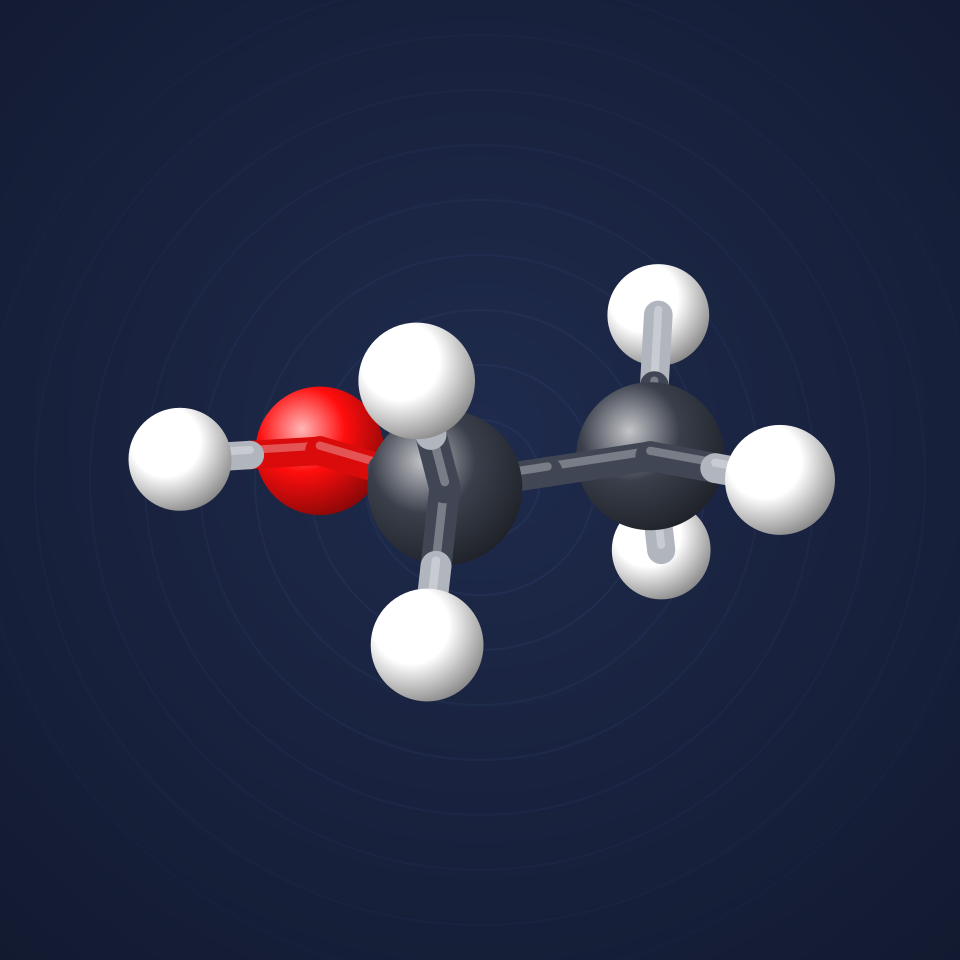
A free online molecule builder: join atoms with single, double and triple bonds, get the formula and molar mass, see the molecule's real shape in 3D, and solve chemistry challenges.
Interactive periodic table
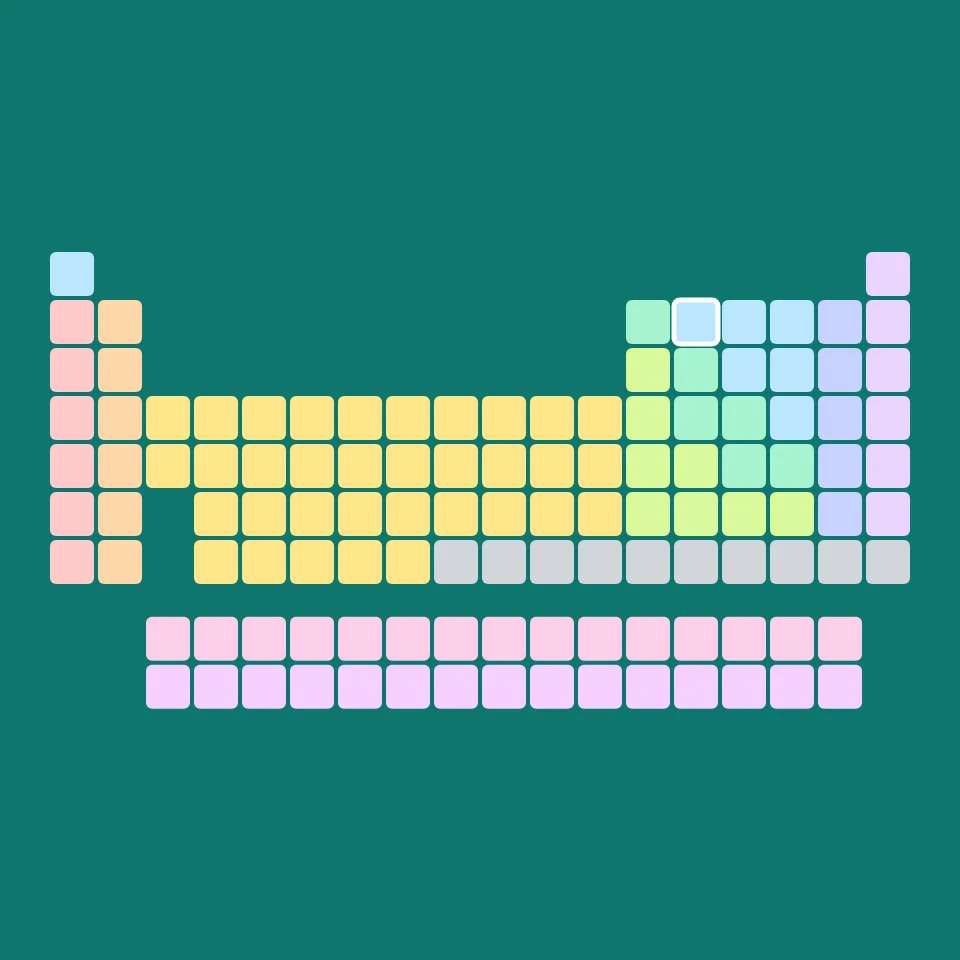
An interactive periodic table of all 118 elements: color it by category, block, state or electronegativity, and click an element for its atomic weight, electron configuration and shells.
Matrix calculator
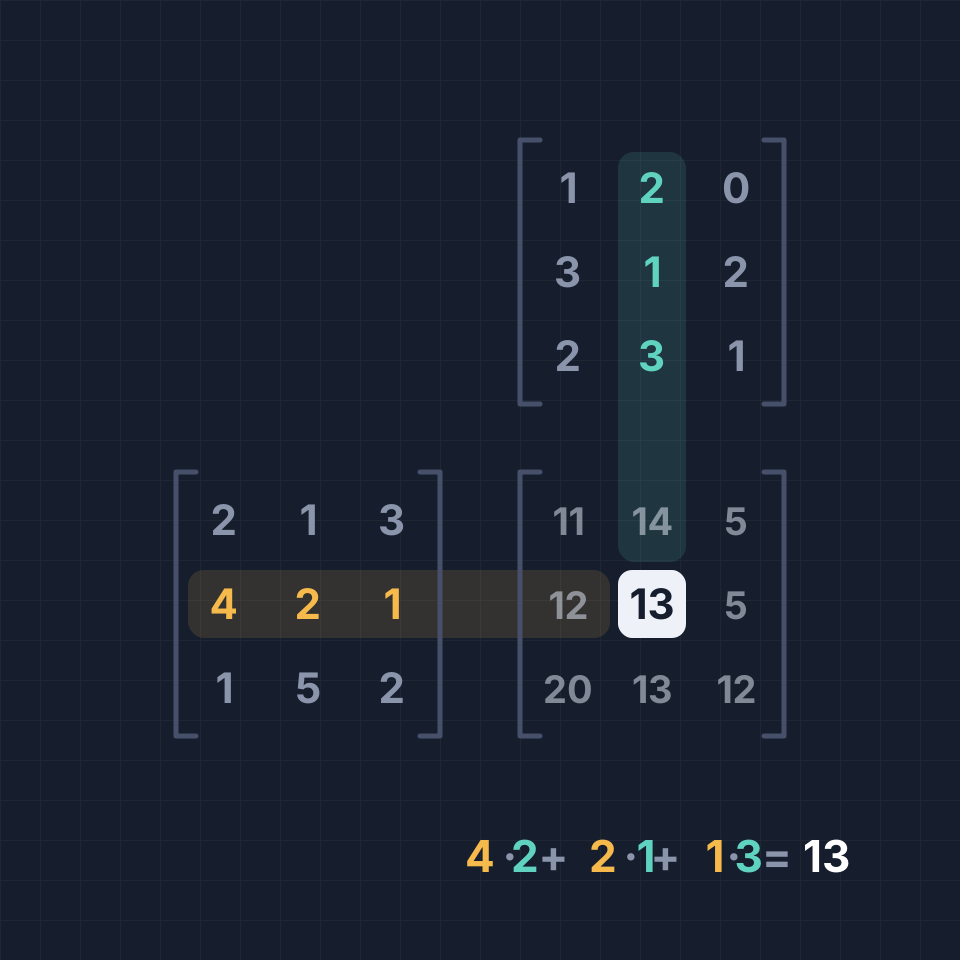
A free online matrix calculator: add, subtract, multiply, transpose and invert matrices up to 6x6, with determinant, rank, powers and exact fractions.
Ready to try it?
Open PictorX in your browser — no install, no credit card required to start.
Open the chemical equation balancer