
Binary Puzzle
The binary puzzle is a grid you fill with 0s and 1s, also known as Takuzu or Binairo. Three rules decide everything: never three equal digits side by side, as many 0s as 1s in every row and column, and no two rows or columns the same. Every puzzle here is made in your browser with exactly one solution, and the hint tells you which rule to use next. Fill the grid with 0s and 1s. No more than two equal digits may stand next to each other in a row or a column, every row and every column has as many 0s as 1s, and no two rows and no two columns are the same. Click a cell for a 0, again for a 1 and once more to clear it; a right click goes the other way. Digits that break a rule turn red.
How it works
- Choose a board size and a difficulty, or keep the 8 x 8 Medium puzzle that is ready.
- Click a cell for a 0, again for a 1 and a third time to clear it; a right click goes the other way. With the keyboard, type 0 or 1.
- Fill every cell without breaking a rule. Digits that break one turn red; Hint marks the next cell you can work out and says why, and Solve fills in the rest.
The three rules
No more than two equal digits may stand next to each other, across or down. Every row and every column holds as many 0s as 1s, so a row of 8 has four of each. And no two rows are the same, nor are any two columns. That is all, and it is enough for one solution.
The first tricks
Two equal digits side by side must be fenced in by the other digit on both ends: 0 0 becomes 1 0 0 1. Two equal digits with one cell between them need the other digit in the gap: 1 _ 1 becomes 1 0 1. And once a row has all its 0s, the rest of it is 1s. Easy puzzles can be solved with these alone.
Thinking in whole lines
On Medium and Hard you look at a row or column as a whole: of all the ways left to finish it without breaking a rule, some cells hold the same digit in every one of them, and those cells are certain. Hard puzzles also lean on the third rule, when one way to finish a line would make it a copy of another.
Frequently asked questions
Does every puzzle have exactly one solution?
Yes. Each puzzle is made from a finished grid by taking digits away, and a digit is only removed when the puzzle can still be solved, by the level's reasoning on Easy and Medium and by a full check for one solution on Hard.
What does Hint tell me?
Hint marks a cell you can work out from the digits on the board and says which rule gives it: a pair, a gap, a full count, the whole line or two lines that would be the same. If one of your digits is wrong, Hint points that out first.
Why are some digits red?
A red ring means three equal digits in a row. A softer red means a row or column has too many of one digit, or is the same as another finished row or column. The marks follow the rules only, so they never give away the solution.
Is the binary puzzle the same as Takuzu and Binairo?
Yes. Takuzu, Binairo, Binero and binary puzzle are names for the same game, published under different names in different countries. Some versions use colours or X and O instead of 0 and 1; the rules are the same.
Can I play with the keyboard?
Yes. The arrow keys move between cells, 0 and 1 fill the chosen cell, Backspace or Delete clears it, and Space or Enter cycles through 0, 1 and empty. Ctrl+Z undoes a change.
Binary Puzzle: how do I record a video?
Press the red Record button in the playback bar: it films what the stage shows. Press it again to stop, and the video is saved to your device. Recording is free; you only need to sign in. Without a subscription the video carries a small PictorX logo in a corner. The button beside Record opens the video options: the shape (as shown, square, story 9:16 or wide 16:9), the length (until you stop, or 5, 10, 15 or 30 seconds for social media) and the file: MP4, WebM or an animated GIF. You can add one of three music tracks: calm, bright or beat.
Related tools
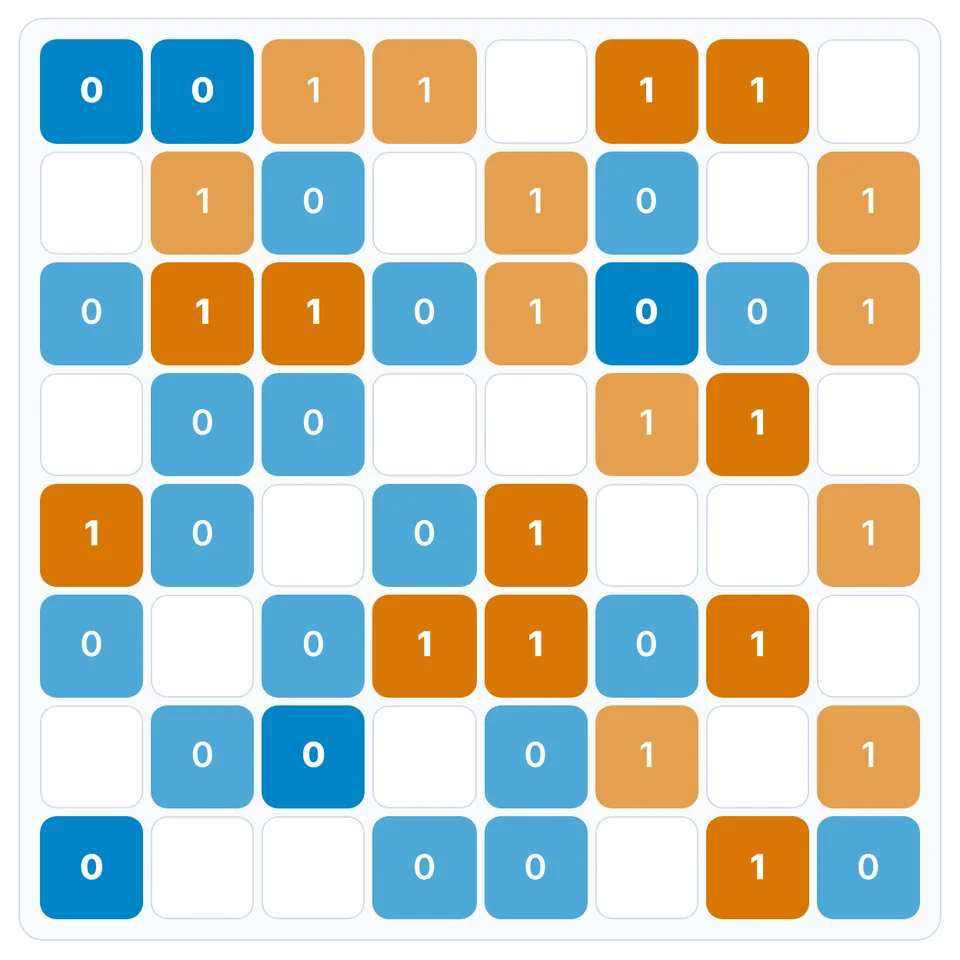
How the binary puzzle works
How the binary puzzle works: the three rules of Takuzu and Binairo, the techniques that solve it, how many rows are possible, and how puzzles with one solution are made.
Sudoku
Play Sudoku free in your browser. Fresh puzzles with exactly one solution, four levels from Easy to Expert, pencil notes, hints, mistake highlighting and undo.
Nonograms
Solve free nonograms in your browser. Every puzzle is generated, has one logical solution and reveals a pixel picture. Choose sizes from 5x5 to 20x20 and mark empty cells with crosses.
Bridges
Play Bridges, the island puzzle also called Hashi, free in your browser. Join numbered islands with bridges on boards from 7 x 7 to 15 x 15, easy to hard, with hints, the solution and your best times.
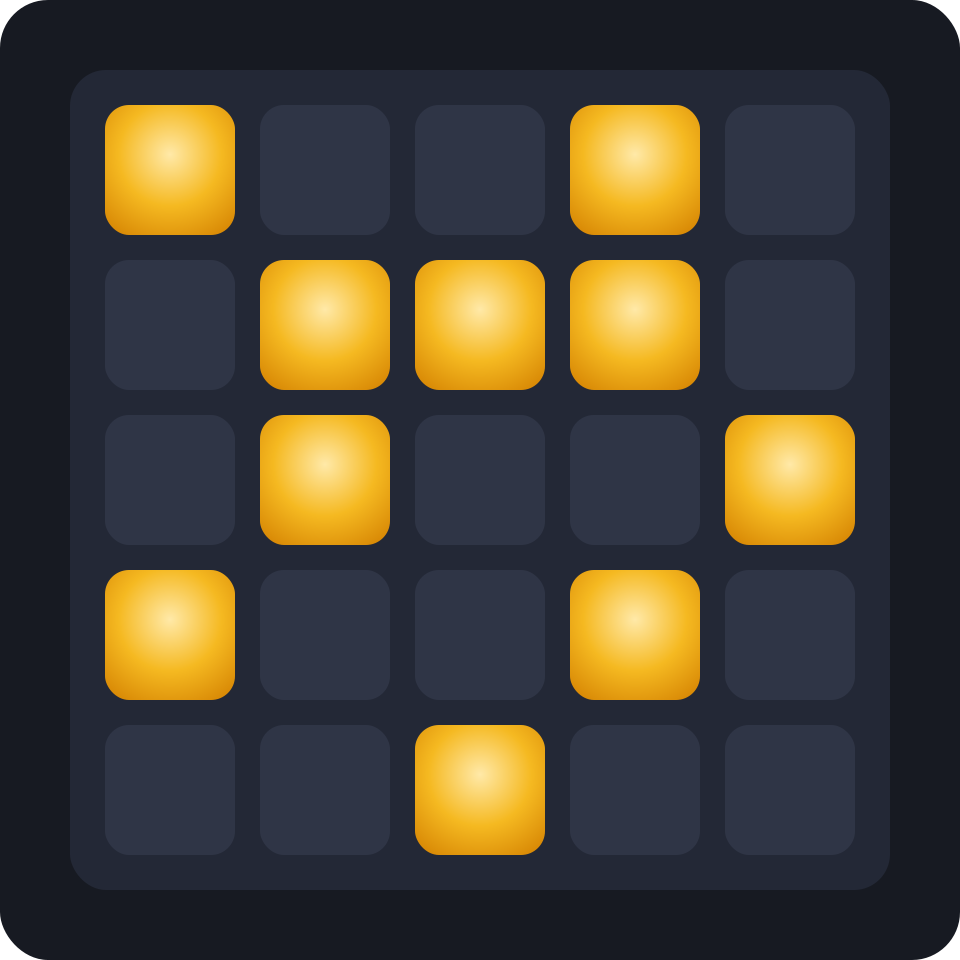
Lights Out
Play Lights Out, the classic lamp puzzle: press a lamp to toggle it and its neighbours until every lamp is off. Boards from 3×3 to 6×6, always solvable, with hints, a solver and best scores.
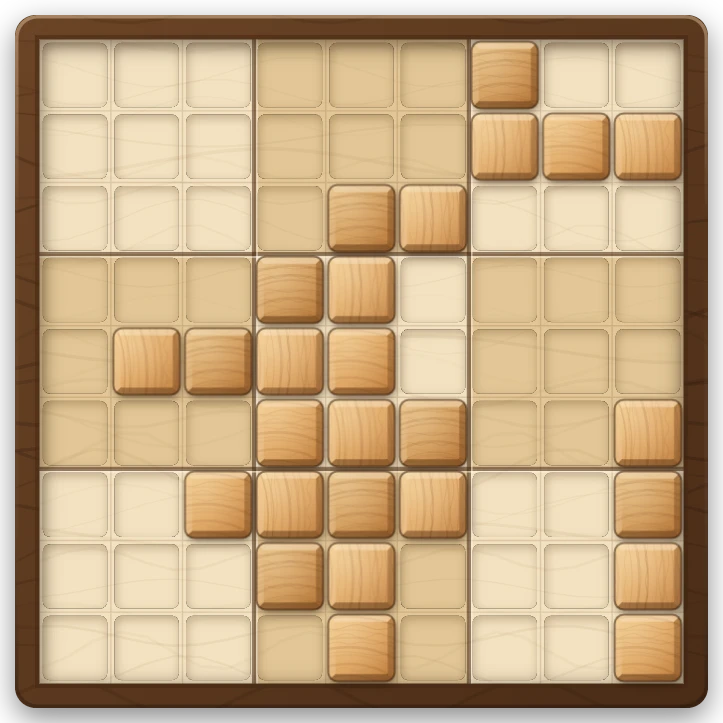
Wood Block Sudoku Puzzle
Play Wood Block Sudoku free in your browser. Drag wooden pieces onto a 9x9 board and clear rows, columns and 3x3 boxes. Combos, streaks, a holder slot and no time limit.
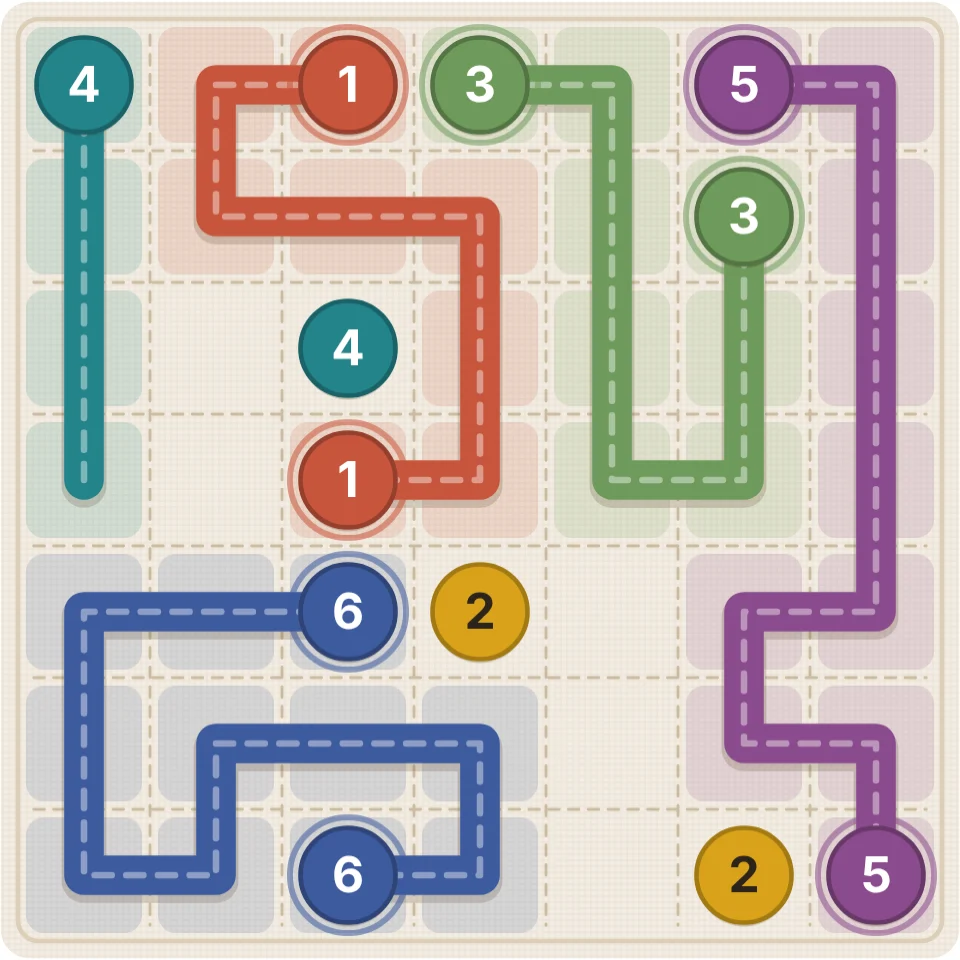
Thread Link
Play Thread Link, a free numberlink puzzle: draw a thread between each pair of matching numbers, without crossings, until every square is used. Seven board sizes, endless numbered puzzles, hints and undo.
Ready to try it?
Open PictorX in your browser — no install, no credit card required to start.
Go to Editor